


Tools that Advance ALPA's Pilot-Partisan Agenda
Editor’s note: In celebration of ALPA’s 95th anniversary this year, this nine-part Air Line Pilot series revisits some of the union’s “wins”—successful campaigns, projects, and products that make public air transportation safer and more secure and that improve the working lives of the union’s members.
ALPA Wins, Part 6: The Key to Successful Advocacy
Airline pilots work in one of the most federally regulated professions in both the United States and Canada. From Capitol Hill in Washington, D.C., to Parliament Hill in Ottawa, Ontario, policy makers routinely enact legislation that directly affects—either positively or negatively—the careers of ALPA members.
Recognizing the great impact that lawmakers yield over both the airline piloting profession and the industry, Association leaders have long understood the importance of having an in-house entity to monitor federal activities and act on behalf of ALPA’s best interests.
Section 125, Part 1.Q of the union’s Administrative Manual states, “Being aware of the continued and growing threat, the Board of Directors [ALPA’s highest governing body] recognizes the Government Affairs Department to be among the most important, if not the most important, department at the ALPA Home Office, and endorses continued strong support for, if not an enhancement of, the Government Affairs Department and the vital work in this area.”
“There’s an old saying in Washington that if you aren’t at the table, you’re on the menu,” says Capt. Jason Ambrosi, ALPA’s president, confirming the importance of representing the airline piloting profession in the policy-making arena. “By committing to being at the table anytime the safety or rights of pilots come up, ALPA is continuing a long and proud tradition that’s helped make aviation the safest form of transportation in the world.”
Government Affairs staff professionals work alongside active pilot volunteers to engage elected officials through Calls to Action, District and Constituency advocate programs, and coordinated lobbying days. Together, they promote the Association’s pilot-partisan agenda, defend the national importance of the U.S. and Canadian airline industries, and work to uphold the highest safety and security standards.
From the Beginning
Those who’ve read Flying the Line, the history of the Air Line Pilots Association, know that ALPA’s initial lobbyist was its first president—Capt. David Behncke. As the book’s author, George Hopkins, observes, “Behncke spent much of his life trying to educate pilots. The airline business was highly political, unable to survive in those days without direct government subsidy, and Behncke knew all about the role clout played.”
While his lobbying efforts were ongoing throughout his tenure as president, Behncke’s first major campaign came in 1934, when he successfully persuaded the National Labor Board to address pilot fatigue and limit flight deck crewmembers to 85 hours a month. Working directly with U.S. President Franklin Roosevelt and his allies, he also secured a federally guaranteed minimum wage for pilots as part of the Air Mail Act of 1935.
In these efforts, ALPA’s first president took a bipartisan stance, backing politicians who supported domestic labor, U.S.-based airlines, and the airline piloting profession, setting the tone for what would become the Association’s party-neutral, pilot-partisan agenda.
Thanks to Behnke’s leadership and as a result of the Association’s consistent activism, several successful programs have evolved to enable ALPA to navigate and wage effective advocacy campaigns in government.
Approaching the Summit
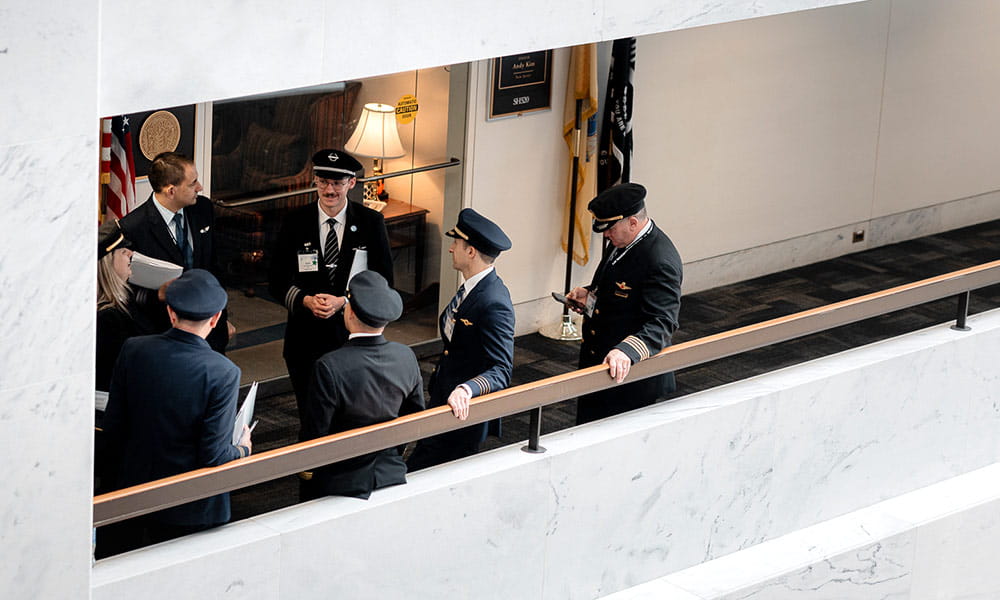
In Flying the Line, Capt. James Roe (TWA, Decd.) talks about what it was like lobbying for ALPA in the early days. He notes how one pilot couldn’t cover Congress, “so 10 or 15 of us would map out the group of people we wanted to see, and we would just go in. We got to know a lot of politicians, and some of them became our good friends. We always wore our uniforms; Behnke asked us to.”
While pilots continue to meet with their members of Congress face to face, the Association now coordinates large-scale lobbying campaigns—the Legislative Summit in the United States and Parliament Hill Day in Canada. The goal of these annual events is to sway support and influence policy outcome.
ALPA’s first Legislative Summit took place in the spring of 2012, when pilot representatives converged on Capitol Hill to lobby in support of the Federal Flight Deck Officer (FFDO) program. This initiative authorizes qualified and deputized flightcrew members to carry firearms while on duty and defend the flight deck against criminal threats such as air piracy.
At the time, the FFDO program was in danger of having its budget cut in half as part of the FY2013 Executive Branch budget proposal.
Capt. Brendan Cantwell (Delta), then an Air Wisconsin pilot who participated in the day’s scheduled meetings, notes, “Whenever I talk to members of Congress, I really appreciate the fact that they’re always engaged. The majority of them have questions, and they take interest.”
ALPA’s inaugural Parliament Hill Day took place late in the summer of 2023. Pilots representing nearly every Canadian ALPA pilot group participated, highlighting issues such as pilot supply and training, the implementation of flight- and duty-time regulations, northern and remote operations, and ongoing collective bargaining issues and priorities.
These organized lobbying campaigns have made a tangible difference in the support the Association has garnered from members of Congress and Parliament, particularly those on aviation-related committees. During the most recent Legislative Summit, ALPA pilots urged their members of Congress to back legislation that mandates Automatic Dependent Surveillance-Broadcast (ADS-B) In technology that’s integrated into the airline flight deck. ADS-B In could have provided the pilots of PSA Flight 5342 with additional situational awareness and time to visually acquire the aircraft and avoid the collision on January 29, 2025, with an Army Black Hawk helicopter, saving 67 lives.
Advocating at Home
In addition to Capitol Hill office visits, ALPA’s District Advocate program enables pilots to promote the Association’s legislative goals in home offices of their congressional representatives. As district advocates, pilots schedule and conduct local meetings with their elected officials. These face-to-face encounters help build strong relationships and demonstrate how proposed legislation can impact pilots who are also constituents.
District advocates attend town hall meetings and get to know district office staff, positioning themselves to provide valuable insights and expertise on aviation-related matters. Over time, they become trusted resources for federal representatives seeking education or advice on aviation issues.
ALPA’s online advocacy training program is available via ALPA Academy , the Association’s learning management system. The program offers several courses curated by the Government Affairs Department, available to both U.S. and Canadian members, that explain the value of government affairs advocacy and how to build relationships with lawmakers
Back the PAC
While not unique to ALPA, the union’s political action committee (PAC) has been gathering momentum since its creation in 1975, thanks to the support from the union’s Board of Directors. Last year, approximately 17,180 members contributed to ALPA-PAC, which raised $3.2 million.
ALPA-PAC is the most bipartisan labor PAC in the country, supporting politicians who champion pilots’ interests regardless of political affiliation. It also reaches beyond incumbents, supporting new candidates willing to promote the Association’s pilot-partisan agenda.
ALPA-PAC is 100% funded by voluntary contributions from Association members living in the United States. All donations are used to educate decision-makers in Washington, D.C., and build pilot-partisan majorities in the House of Representatives and Senate. This important tool is a key way to educate policy makers about the issues that matter most to airline pilots.
The PAC is governed by a nine-member Steering Committee. Appointment to this presidential committee is determined per Section 100 of ALPA’s Administration Manual. The Association’s Executive Committee must approve the appointments.
During the last decade, ALPA-PAC has more than doubled in total donors and total receipts—increasing ALPA’s political clout on Capitol Hill. But with only approximately 17,000 of the more than 60,000 eligible U.S. members currently contributing, there’s significant room to grow the PAC’s power.
A Vital Resource
At this year’s Legislative Summit, Ambrosi told the many participants, “Our union was founded on the fundamental truth that pilots are the most effective advocates for aviation safety. We train hard for thousands of hours, we approach every action with diligence and professionalism, and as a result, we have a safety record that does laps around every other form of transportation.”
Thanks to the staff experts in ALPA’s Government Affairs Department, the Association is communicating this message to lawmakers to help promote pilots as a vital resource when evaluating and advancing aviation legislation.

Featured Articles


