


Harnessing the Power of the Home Front
District Advocates Are the Backbone of ALPA’s Legislative Success
In Washington, D.C., legislative battles are often won or lost long before a vote is ever called on the House of Representatives or Senate floor. While ALPA’s Government Affairs team plays a crucial role in navigating the complex corridors of the Capitol, the true driving force behind the union’s political influence lies far from the Beltway. It resides in local communities, on neighborhood streets, and in regional offices of elected officials. That’s why the bedrock of the Association’s legislative success is its network of district advocates (DAs).
As the critical August congressional recess approaches, the importance of this network can’t be overstated. This month-long period represents a significant opportunity for ALPA members to advance the union’s legislative priorities. For current advocates, it’s by securing vital in-district meetings. For those who’ve yet to step up, it’s an invitation to join the ranks of the Association’ frontline advocates. Recruiting new voices into this program is a vital necessity for enhancing the piloting profession, aviation safety and security, and collective bargaining.
The Strategic Importance of the Grassroots Front Line
Elected officials respond to many inputs, but nothing carries quite the same weight as a constituent who can vote them into—or out of—office. A professional lobbyist in Washington may be viewed as merely a representative of an interest group. A line pilot living in an elected official’s district, however, represents a community member, a taxpayer, a potential voter, and a constituent eyewitness to the airline industry’s daily realities.
DAs bridge the gap between abstract policy language and the real-world operational environment. When ALPA advocates speak with their members of Congress or their staff, they aren’t just reading from a briefing paper. They’re speaking with the unique expertise of a professional who commands an aircraft, understands the nuances of airspace management, and experiences firsthand how federal regulations impact safety, security, and labor standards.
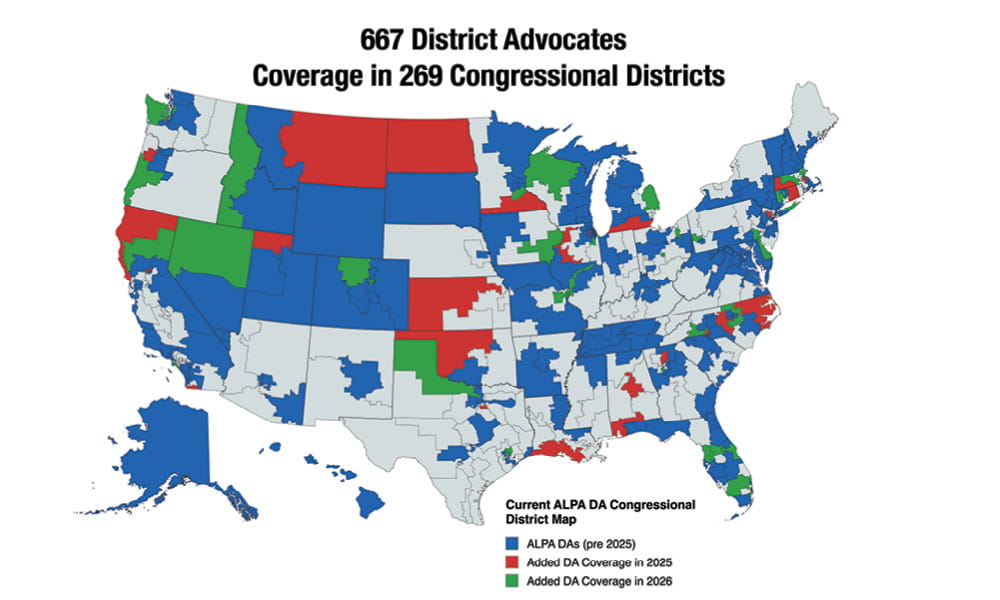
This localized approach is especially critical given the geographic diversity within the Association. Because ALPA members have such varied professional experiences and live and work in nearly every congressional district in the nation, ALPA’s potential reach is unmatched. When a unified front of pilots engages locally, Congress listens.
The August Recess: Capitalizing on the Ultimate Home-Court Advantage
Every year, August marks a dramatic shift in the rhythm of American politics. Congress adjourns, and lawmakers leave Washington to return to their home states and districts. This August congressional recess is a strategically vital timeframe on the advocacy calendar.
During the recess, senators and representatives look to reconnect with the people they represent. Their Washington schedules are notoriously frantic, often carved up into tight 10-minute increments interrupted by votes and committee hearings. In contrast, meetings held in local district offices tend to be more relaxed, substantive, and impactful. Lawmakers and their local staff have time to engage in deeper conversations, ask questions, and truly absorb the issues.
For current DAs, the August recess is the opportune time to secure an in-district meeting with members of Congress and their office staffers.
Three Key Objectives for August Meetings
The relationships built or strengthened during this month pay massive dividends later in the year when critical bills move to a vote or are reintroduced during the next legislative session. If a member of Congress already knows you, respects your expertise, and understands how an issue impacts their home district, they’re far more likely to pick up the phone and consult ALPA before casting their vote.
1. Establish Personal Connections
Put a local face to ALPA’s priorities. It’s okay if the congressional member isn’t available. Cultivating a strong relationship with the district director and local staffers can be just as valuable as meeting the member face-to-face, as these staff members act as the primary gatekeepers and advisors to the lawmaker.
2. Provide Concrete Local Context
Explain how strong national aviation safety standards impact constituents living right in their backyard.
3. Deliver the Unvarnished Truth on Safety
Use your operational expertise to educate lawmakers on critical technology gaps, such as why ADS-B In is so vital to safety, and reiterate the importance of addressing air traffic control modernization needs.
Turning Policy into Law: Current Legislative Objectives
The true power of a DA is realized when abstract policy objectives are transformed into actionable legislative support. The Association is currently engaged in a critical policy fight in which local, pilot-led advocacy is a crucial factor in moving the needle.
The Airspace Location and Enhanced Risk Transparency (ALERT) Act has passed in the House, and the Rotorcraft Operations Transparency and Oversight Reform (ROTOR) Act has passed in the Senate. While there are a multitude of different stakeholders lobbying on these bills, ALPA advocates offer a vital reality check.
In-district meetings provide the perfect forum to explain that while the House ALERT Act contains certain incremental improvements, it represents a partial solution. Crucially, it fails to address what ALPA and the NTSB view as the absolute core of midair collision prevention: a comprehensive mandate for integrated Automatic Dependent Surveillance-Broadcast (ADS-B) In technology on commercial airliners.
The union’s DAs can look a member of Congress in the eye and explain the operational reality: while ADS-B Out simply broadcasts an airplane’s position, ADS-B In allows pilots greater situational awareness to see nearby traffic directly on their flight deck display, providing critical lifesaving information. Explaining that the Senate’s ROTOR Act contains these stronger provisions helps decision-makers understand exactly what language needs to be included in a final legislative compromise.
The Urgent Call for Reinforcements: Recruiting the Next Generation of Advocates
An effective grassroots network requires continuous growth and renewal. As new legislative challenges emerge, ALPA must aggressively recruit new DAs. The union can’t rely solely on a handful of dedicated veterans to carry the water for the entire organization. A robust defense of the profession requires a deep, active, and constantly growing bench.
Many pilots hesitate to volunteer for legislative advocacy because they believe they lack political expertise or don’t consider themselves “politicians.” ALPA doesn’t need polished political operatives; it needs authentic airline pilots to serve as a voice for the profession.
When new advocates join the program, they’re backed by the full weight of ALPA Government Affairs. They are provided with comprehensive briefing materials, clear talking points, and ongoing support. An advocate’s job isn’t to draft legislation or to explain complex terminology; it’s to tell a firsthand account and explain in basic terms how policy decisions affect the flight deck and why those decisions matter to pilots and the flying public.
Recruiting new advocates is essential to expanding the union’s geographical footprint. If ALPA has blocks of districts without active local connections, the Association has its flank exposed to antilabor forces and special interests looking to degrade safety and security standards. As the old D.C. saying goes, “If you don’t have a seat at the table, you’re likely on the menu.” The relationships that DAs build help ensure ALPA is at the table when aviation-related decisions are made and the union’s collective voice is heard.
Protect the Profession on the Home Front
The strength of the Association is rooted in the solidarity and engagement of its members who fly the airplanes, protect the passengers and cargo, and safeguard the future of the industry.
To ALPA’s current DAs: Your union is counting on you this August. Seize the recess. Reach out to your local congressional offices immediately to schedule meetings, prepare your notes, and show up ready to represent the finest traditions of aviation professionalism.
To those who’ve watched from the sidelines: There has never been a more critical time to get involved. The decisions being made in Washington today will dictate the safety and security regulations, labor protections, and operational frameworks of tomorrow. Don’t leave your career and your profession in the hands of others.
Whether you need to sign up, step forward, or take action, do it today to make sure that when Congress returns to Washington this fall, the voice of America’s pilots is echoing clearly in their ears and resonates through the halls of the Capitol.
Become a District Advocate
We’ll provide training to teach you how to schedule and lead in-district advocacy visits with your member of Congress.

Featured Articles


