


Protecting Aviation Safety Beyond the Flight Deck
Pilot Advocacy on Capitol Hill
The world’s safest aviation system is built through countless decisions, some made on the flight deck, others in control towers, regulatory agencies, and in the halls of Congress. While airline pilots protect the traveling public every time they fly, they also help shape the policies that strengthen aviation safety for the future.
This year’s Legislative Summit came at a pivotal moment for the industry. In the wake of recent accidents and growing scrutiny of the national airspace system, U.S. ALPA pilots from across the country traveled to Washington, D.C., to ensure that lawmakers heard directly from those with firsthand operational experience. Their message: strengthening aviation safety requires continued investment in air traffic modernization, a robust and well-staffed air traffic control system, and proven technologies that enhance situational awareness. That’s why ALPA’s top legislative priorities included mandating the implementation of Automatic Dependent Surveillance-Broadcast In to help reduce the risk of future midair collisions.
Legislative advocacy is just one more way that ALPA pilots fulfill their commitment to protecting the traveling public. By building relationships with lawmakers and helping to shape the policies that govern aviation, they ensure that the voices of frontline aviation professionals remain central to the decisions that define the future of flight and safeguard the airline piloting profession for the next generation.
ALPA Pilots Deliver Clear Message to Capitol Hill Policy Makers
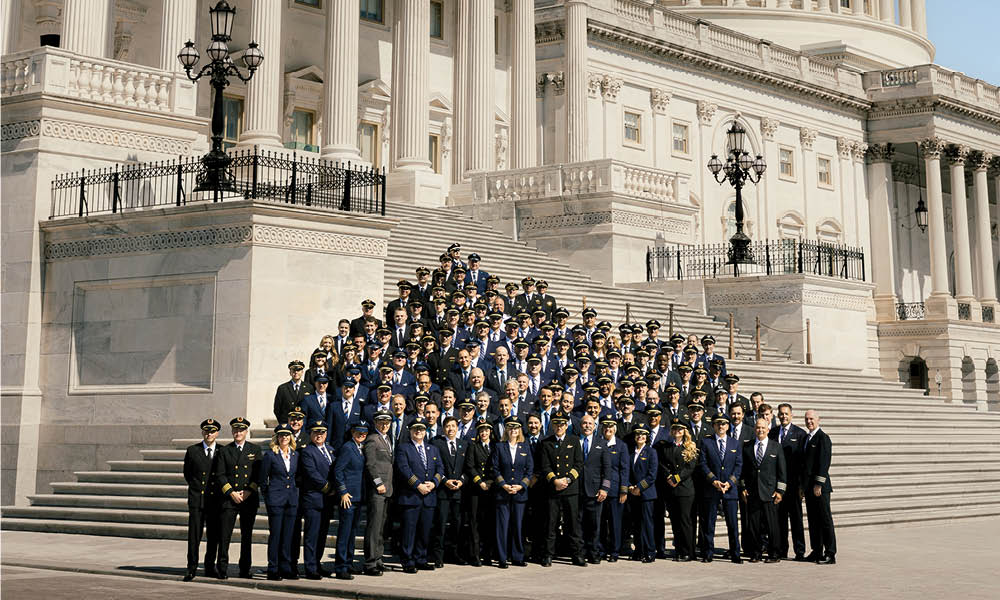
More than 165 pilot volunteers gathered in Washington, D.C., the week of June 1 to take part in ALPA’s 13th Legislative Summit, a one-of-a-kind opportunity to promote the Association’s pilot-partisan agenda face-to-face with elected officials on Capitol Hill.
This year’s participants engaged in more than 200 meetings to ask their members of Congress to support legislation that would mandate the installation of integrated ADS-B In technology in all airline aircraft. This equipment would provide pilots with the greatest degree of situational awareness available, increase alerting time, and help avoid disasters like the collision of an Army Black Hawk helicopter with PSA Flight 5342 on January 29, 2025, in Washington, D.C.
Advocating for Safety
ALPA pilots were divided into groups, based on the states where they live. This year’s Georgia contingent consisted of Delta pilots F/O Alex Capogna, F/O Elliot Couch, F/O Charles Enderlin, Capt. Sam Mason, and F/O Bryan Patchen, ALPA’s newly appointed Aviation Security Group chair.
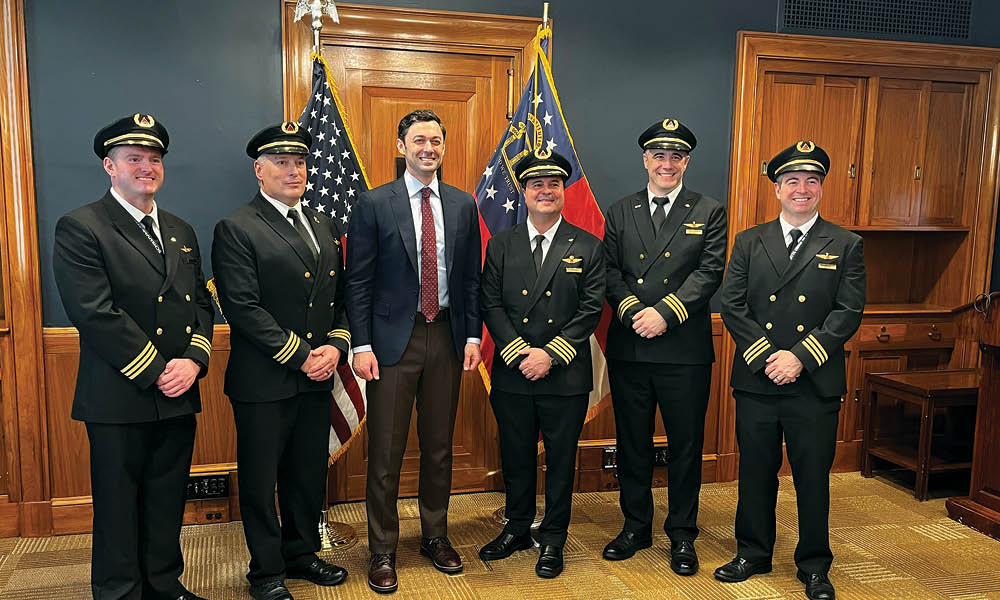
Throughout the day, the pilots talked to Georgia Senate and House of Representatives members as well as congressional staff about legislation to address the NTSB’s findings from the PSA accident and the best course of action to achieve the safest outcome moving forward.
During one meeting, Enderlin explained the difference in the Senate’s Rotorcraft Operations Transparency and Oversight Reform (ROTOR) Act and the House’s Airspace Location and Enhanced Risk Transparency (ALERT) Act. He urged Rep. Brian Jack (R-GA) to support the inclusion of Section 4 of the Senate legislation in an updated House bill, which outlines the requirement for ADS-B In technology. Jack previously supported the ROTOR Act when it was considered in the House in February.
Sitting in Jack’s Longworth office, Capogna compared a simulated view of what the PSA crew was able to see using the current TCAS technology with what they could have seen using ADS-B In. Both views were presented from the perspective of 59 seconds prior to the collision.
“That’s a massive amount of time when you’re flying a jet,” remarked Couch, noting that with the proper equipment, the pilots would have had ample opportunity to react to the helicopter’s presence.
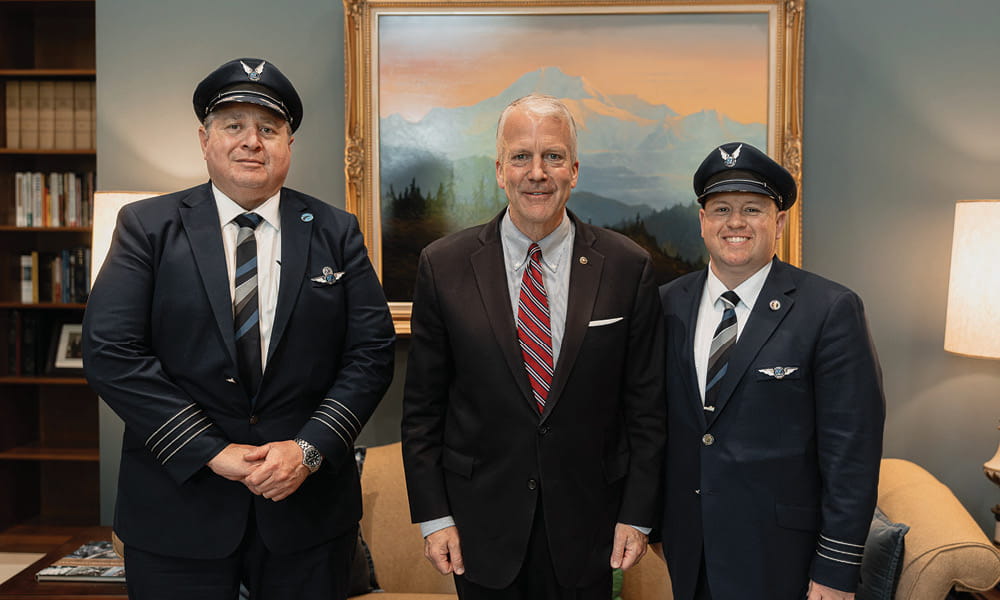
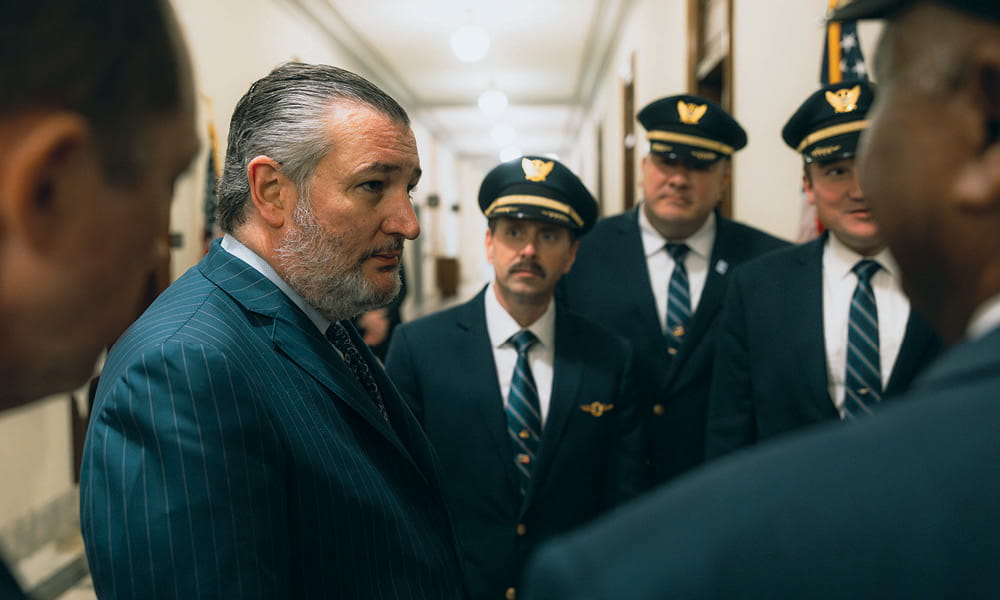
In an earlier meeting with Tyler Hofmann-Reardon, the legislative assistant for Sen. Raphael Warnock (D-GA), Mason, who flies the Airbus A330, noted that his aircraft type already has ADS-B In installed. Referencing times when the technology may be turned off, he asserted, “It feels like I’m flying naked without it.”
In a later meeting in the Rayburn Building with George Copelan, legislative assistant for Rep. Barry Loudermilk (R-GA), Patchen remarked that on the night of the accident, the military helicopter’s ADS-B In was turned off. A former U.S. Air Force B-52 pilot, Patchen emphasized that there was no reason for a military crew to have this feature disabled, unless they were flying a sensitive, critical mission.
The Georgia ALPA pilots also participated in a “Welcome to Washington” event in which they talked extensively with Sen. Jon Ossoff (D-GA) and met with the staff of Rep. Nikema Williams (D-GA) and Rep. Andrew Clyde (R-GA).
Pilots representing other states shared similar thoughts with their public officials. To amplify the message of these meetings, ALPA’s summit communications strategy included sponsorship of Politico’s Weekly Transportation, which is widely read by elected officials and transportation stakeholders across the aviation industry, to ensure that the important safety reasons for installing ADS-B In reached the inboxes of these key decision-makers.
Practice Makes Perfect
During the two days prior to the Hill visits, the pilot volunteers met in a nearby hotel to learn more about effective lobbying, hear informative presentations, and practice their skills before the congressional visits. This portion of the summit was moderated by Capt. Jim Hinz (Alaska), vice chair of his pilot group’s Government Affairs Committee.
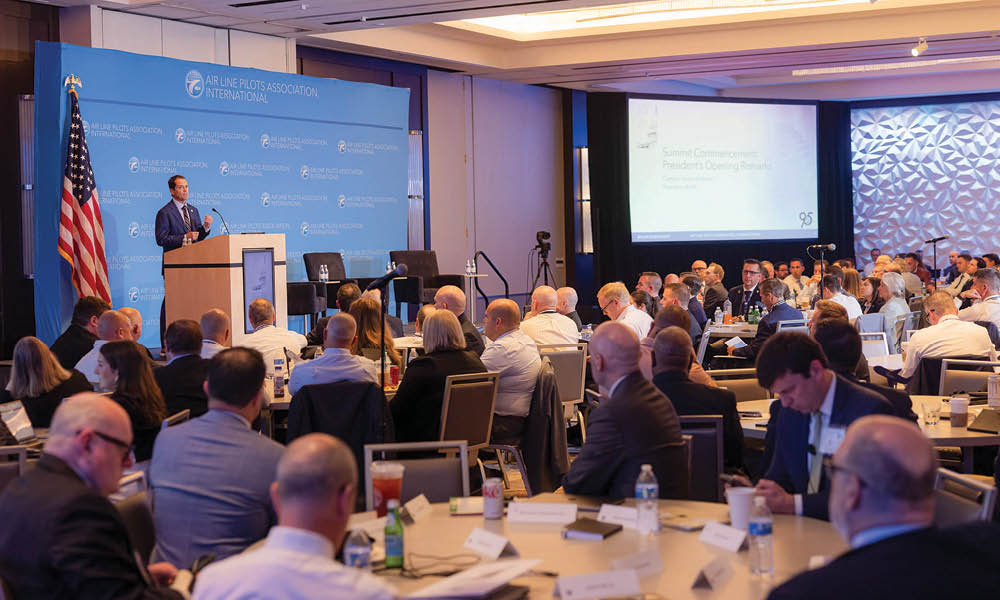
On that Monday morning, Capt. Jason Ambrosi, ALPA’s president, welcomed summit attendees. “Over ALPA’s 95 years, it’s been pilots like you who step up and advocate for the pilot-partisan agenda that makes aviation the safest form of transportation,” he said, noting, “Our union was founded on the fundamental truth that pilots are the most effective advocates for aviation safety. That shared cause brings us together this week.”
Capt. Wendy Morse, the Association’s first vice president and national safety coordinator, spoke to the group the following day. “As airline pilots, you bring something uniquely valuable to Capitol Hill. That’s your firsthand operational experience and practical knowledge on aviation issues that can only be developed by being out there every day flying the line,” she commented.
Among the many presentations, Tim and Sheri Lilley, the parents of PSA Flight 5342 honorary Capt. Sam Lilley, addressed summit attendees. “We have an opportunity to make changes from the lessons learned,” said Tim, who together with Sheri and the other families of the victims are lobbying for stronger safety measures and stressing that this accident could have easily been avoided.
In coordination with the summit, ALPA hosted a press conference alongside the Lilleys, who shared their personal impact of the PSA tragedy directly with participating reporters. Ambrosi spoke with television news stations across the country, including those in key congressional districts where members are currently working to finalize the legislation, putting the pilot perspective front and center for millions of viewers to see.
Congressional Pilot Partisans
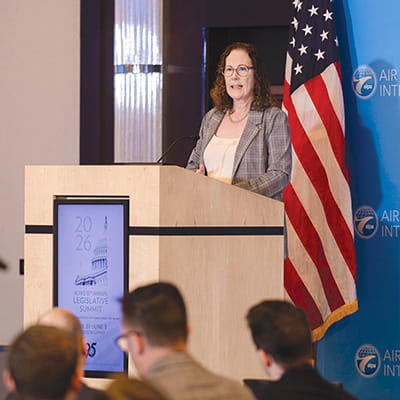
“I trust my life and my family’s life to our pilots and our airlines,” Sen. Ruben Gallego (D-AZ) told the pilot volunteers.
Dovetailing with Gallego’s remarks, Rep. Val Hoyle (D-OR), a member of the House Transportation and Infrastructure Committee, noted that when addressing aviation safety matters, “As airline pilots, you have a special kind of credibility.”
“We have a responsibility to do all we can to prevent tragedies,” said Rep. Rob Bresnahan (R-PA), adding, “The worst thing we can do is nothing.” Bresnahan is a member of both the Transportation and Infrastructure Committee and the Aviation Safety Caucus.
These remarks were part of three keynote addresses presented during the summit.
In addition, Elizabeth Baker, director of the Association’s Government Affairs Department, Government Affairs staff, and pilot subject-matter experts moderated and participated in various other panel discussions, issue briefings, and breakout sessions, highlighting topics ranging from ALPA’s state labor advocacy efforts to effective communications techniques.
At Issue
The PSA Flight 5342 accident exposed a significant safety gap. The lack of integrated ADS-B In with appropriate alerting on the PSA aircraft forced the pilots to rely on TCAS collision avoidance technology, which offers limited alerting time and insufficient audible information about the location and altitude of nearby aircraft and is suppressed during the descent into airport environments.
Both the House and Senate passed bipartisan legislation (the ALERT and ROTOR Acts, respectively) in response to the accident. The two chambers are now working to reconcile the two bills and as noted, Section 4 of the Senate ROTOR Act requires integrated ADS-B In situational technology for pilots—which ALPA adamantly supports.
Honoring ALPA Champions
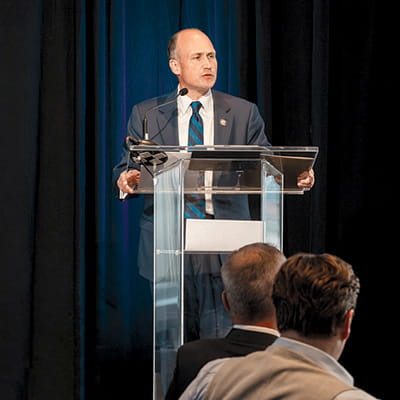
During this year’s ALPA Advocacy Awards dinner, the 2026 ALPA Pilot Partisan of the Year Award was presented to Rep. Nick Langworthy (R-NY), who was recognized for his work championing ADS-B In requirements, leading to two letters supporting Rotorcraft Operations Transparency and Oversight Reform Act provisions. He also created and leads the Aviation Safety Caucus and has supported the Association’s pilot-partisan agenda since coming to Congress.
Also during the awards dinner, the Association recognized 2026 pilot A-Team members who raised money for ALPA-PAC, served as district advocates and met with their members of Congress in their home districts, and amplified the Association’s priorities using social media. Honorees included
- Capt. Jason Ambrosi (Delta)
- F/O Dave Anfora (United)
- F/O John Boccieri (United)
- Capt. Ryan Breznau (Delta)
- Capt. Brendan Cartwell (Delta)
- Capt. Gareth Carter (Delta)
- Capt. Alex Cole (United)
- Capt. Gary Connell (United)
- Capt. Reed Donoghue (Delta)
- Capt. Zachary Hill (Endeavor)
- Capt. James Hinz (Alaska)
- Capt. Chris Hughes (Delta)
- Capt. Chris Jones (United)
- F/O Aaron Kennington (FedEx Express)
- Capt. Kevin Kilpatrick (Delta)
- Capt. Mark Manausa (Frontier)
- Capt Doug Mattson (United)
- Capt. Wendy Morse (United, Ret.)
- F/O Kaori Paris (United)
- Capt. Eric Rodriguez (JetBlue)
- F/O Andy Rowe (FedEx Express)
- Capt. Bernie Ruddy (United)
- F/O M.C. Russell (United)
- Capt. Bill Secord (FedEx Express)
- F/O Kyle Stuhlweissenburg (JetBlue)
- F/O Greg Sumner (United)
- Capt. Robert Ventura (United)
- F/O Zachary Wilkie (United)
- Capt. John Wood (Delta)
- F/O Logan Woods (Delta)
ALPA Pilot-Partisan Advocates
Interested in lobbying as an ALPA pilot-partisan advocate? ALPA Academy offers programs to help you better understand what it means to volunteer as a district or constituency advocate to educate lawmakers in the United States or Canada about issues that impact pilots most.
ALPA Members Take to Capitol Hill
On June 3, more than 165 ALPA pilots attending the 13th Legislative Summit engaged in more than 200 meetings to urge their members of Congress to back legislation mandating the installation of integrated ADS-B In technology in airliners.




Featured Articles


