


ALPA Works to Secure Lifesaving ADS-B Legislation
For a decade and half, the U.S. aviation system has experienced a record level of safety. Much of the industry’s safety success has stemmed from legislative and regulatory changes borne from the tragedy of the Colgan Air Flight 3407 crash. Unfortunately, despite the high safety bar set by improved pilot qualifications, training, and fatigue mitigations, the industry suffered a major setback on January 29, 2025, with the midair collision of PSA Flight 5342 and an Army Black Hawk helicopter near Washington National Airport. To add to this tragedy, the accident could have been prevented.
ADS-B, a Military Loophole, a Preventable Tragedy
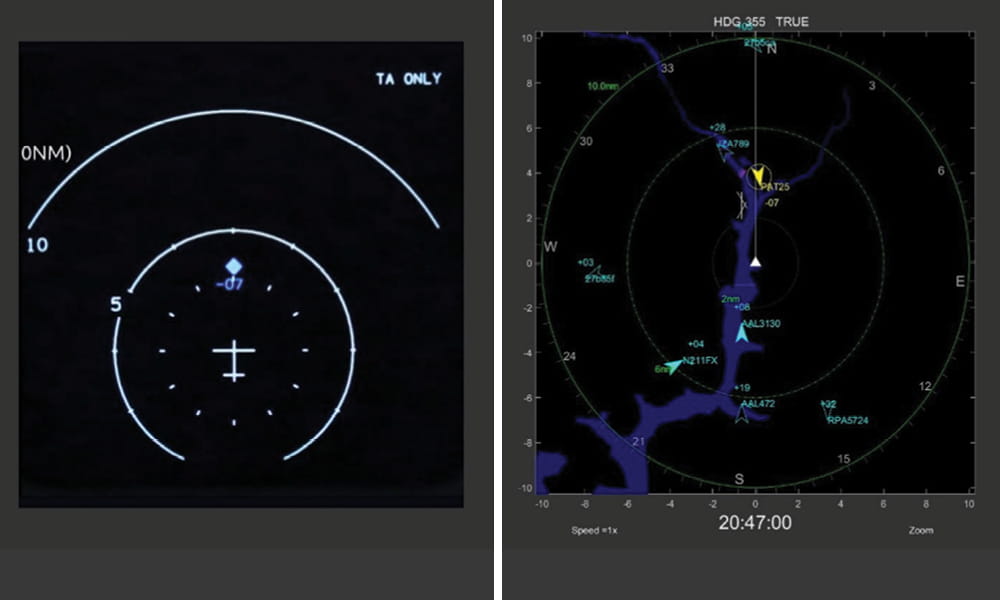
The National Transportation Safety Board (NTSB) investigation into the crash identified as a contributing factor limitations in the traffic awareness and collision alerting systems (TCAS) on both aircraft that precluded effective alerting of the impending collision to the flight crews. The collision exposed a specific safety gap: the lack of a mandated integrated Automatic Dependent Surveillance-Broadcast (ADS-B) In compels pilots to rely on near-imminent collision-avoidance technologies, like TCAS, that offer limited alerting time and insufficient call-out information and are inhibited in the airport environment. Collision-avoidance technologies like TCAS provide protection through two layers: a resolution advisory that tells a pilot to climb, descend, or take action and a traffic advisory that provides a preliminary aural warning—approximately 19 seconds prior to the collision of PSA Flight 5342 and the Army helicopter—of nearby traffic. These two layers of protection are insufficient, particularly in a low-altitude, congested, and high-workload environment like the approach to Washington National Airport Runway 33.
An ensuing congressional investigation revealed that the military regularly operates with ADS-B Out transmissions in the off position in highly congested, mixed-traffic airspace, including near Washington, D.C. While the NTSB investigation revealed that the Black Hawk’s transponder ADS-B squitter was off, preventing it from broadcasting ADS-B Out, there was a systemic failure to broadcast ADS-B Out by the Armed Forces during routine operations.
In 2010, the FAA issued a final rule for ADS-B Out, requiring all aircraft to operate in “transmit mode” at all times. However, in 2019 before the rule went into effect, an exemption was made for “sensitive operations conducted by federal, state, and local government entities in matters of national defense, homeland security, intelligence, and law enforcement.” That exemption was to not routinely be used. However, in a 2023 letter to D.C. Delegate Eleanor Holmes Norton, the Department of Defense stated that in the national capital region—which includes the D.C. area and the U.S. Army Aviation Brigade at Fort Belvoir and Marine Squadron One—100 percent of missions should be executed with ADS-B Out off.
In addition, during a Senate Commerce Committee hearing held after the crash, a U.S. Army representative refused to provide a memo and information related to what standards are applied for ADS-B Out use. Simply put, after the collision, there was deep confusion about what standards, if any, existed and a refusal by the Army to provide information or change standards related to transmissions.
Senate’s ROTOR Act Aims to Close Safety Gaps
While the NTSB’s final report on the midair collision was being prepared, the Senate Commerce Committee, led by Chair Ted Cruz (R-TX) and Sen. Maria Cantwell (D-WA), worked with ALPA to close the safety gaps exposed by relying on TCAS and the inadequacies of military ADS-B Out standards. The ensuing legislation, the Rotorcraft Operations Transparency and Oversight Reform (ROTOR) Act, fixed these deficiencies through its integrated ADS-B In mandate, which would significantly increase the length of alerting time for pilots in both the air and surface environments; provide directional traffic symbols on a display; and generate aural alerts indicating the clock position, relative altitude, range, and vertical tendency of nearby traffic.
These standards and the ROTOR Act’s implementation timeline would ensure that airline pilots have optimal situational awareness and the ability to more quickly identify a potential intruder aircraft and take evasive action. These standards would likely have saved 67 lives last January, and ALPA stands firm that any final aviation safety legislation must incorporate these lifesaving provisions.
The ROTOR Act would also require military aircraft to be equipped with safety-enhancing ADS-B In. However, the legislation preserves national-security interests through ongoing ADS-B exemptions for fighters, bombers, and other special-mission aircraft. Yet, the legislation does provide statutory requirements for ADS-B Out transmission requirements nationwide that would vastly improve aviation safety by ensuring civilian aircraft and military aircraft can see and be seen by one another.
The Senate unanimously passed the ROTOR Act on December 17, 2025, with a strong ALPA endorsement. After passage, Cruz was able to secure a commitment from House Speaker Mike Johnson (R-LA) for a ROTOR vote on the House floor. It’s rare for a Senate bill to be put directly on the House floor under an expedited process. The House considered the bill under “suspension of the rules,” which requires more than two-thirds of members to vote for a bill’s passage. The House committees of jurisdiction—the Transportation and Infrastructure and the Armed Service Committees—opposed the bill on the House floor. After ALPA lobbying during a highly condensed time period of two days, the ROTOR Act came within a single vote (264–133) of meeting the requirement for passage. A snowstorm in the Northeast stranded many would-be pro-ROTOR congressional members from being able to vote.
House’s ALERT Act Is Not Enough
Following the close ROTOR vote, the House Transportation and Infrastructure Committee and the House Armed Services Committee produced their own bill, the Airspace Location and Enhanced Risk Transparency (ALERT) Act. The ALERT Act focuses on using ACAS-Xa, a TCAS successor, for collision avoidance rather than ADS-B In. ACAS-Xa is a promising technology, but, unlike ADS-B In, it’s currently inhibited at low altitudes in the airport environment, does not require directional traffic symbols and the same advanced audio alerts as ADS-B In, and provides less alerting time compared to ADS-B In. Fixing these standards and completing the rulemaking process, avionics certification, production, and installation of this new technology is highly unlikely to occur by the 2031 deadline, and the ALERT Act allows the FAA to extend the rulemaking portion of the process until 2035. ACAS-Xa represents an improvement over TCAS and provides another layer of safety, but it doesn’t include the enhancements that leverage ADS-B In capabilities, which are specifically designed to improve pilots’ broader situational awareness.
During the Transportation and Infrastructure Committee’s markup, Reps. Val Hoyle (D-OR) and Rob Bresnahan (R-PA) led a bipartisan amendment to insert the ROTOR Act’s ADS-B In mandate. Unfortunately, the amendment was withdrawn based on the likelihood of losing a vote in the committee, and the ALERT Act passed out of the committee on March 26. Just prior to the House floor vote, the Armed Services Committee added a section dealing with military aircraft, which was framed around a memorandum of agreement that provides the Armed Forces with too much discretion, including the sole authority of whether and how to equip aircraft with ADS-B In. Furthermore, the ALERT Act relies on discretionary agency authority related to how helicopters broadcast their position with ADS-B Out and simply establishes “procedures” for ADS-B Out that are subject to the U.S. military’s discretion.
Final Bill Must Include Integrated ADS-B In and Regulations for Military Aircraft
Given the NTSB’s identification of a failure of traffic awareness and collision alerting systems for military aircraft and the military’s policies of keeping ADS-B Out off, the ROTOR Act provides the appropriate balance between safety and security for the nation’s civilian and military operations.
ALPA and the victims’ families of PSA Flight 5342 didn’t support the House bill, which passed on April 14. Both the Senate and House are working to resolve the bills’ substantial differences, with ALPA’s guidance, for a final piece of legislation. Through “conferencing,” ALPA is hopeful that a final bill will require aircraft to be equip with integrated ADS-B In and regulate military aircraft that operate in mixed traffic, high-density airspace.
Lives Are at Stake: Demand an ADS-B In Mandate for Commercial Aircraft
The ALERT Act is not enough! Demand that Congress adopt the stronger safety mandates of the ROTOR Act into the final law.
Featured Articles


