


ADS-B In, Surface Safety, and ATC Modernization Highlight ALPA Safety Forum Discussions
ALPA’s 70th Air Safety Forum
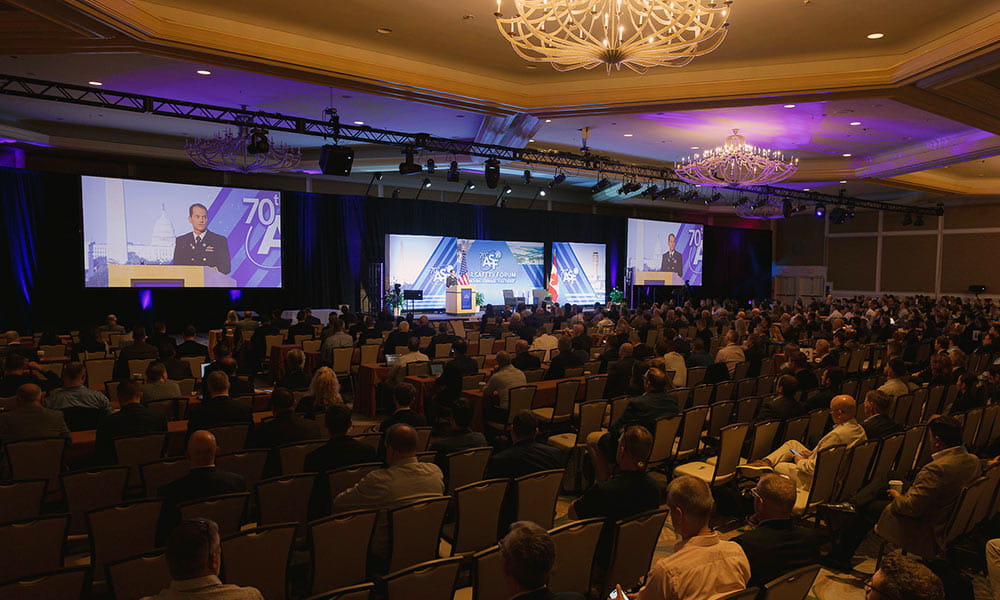
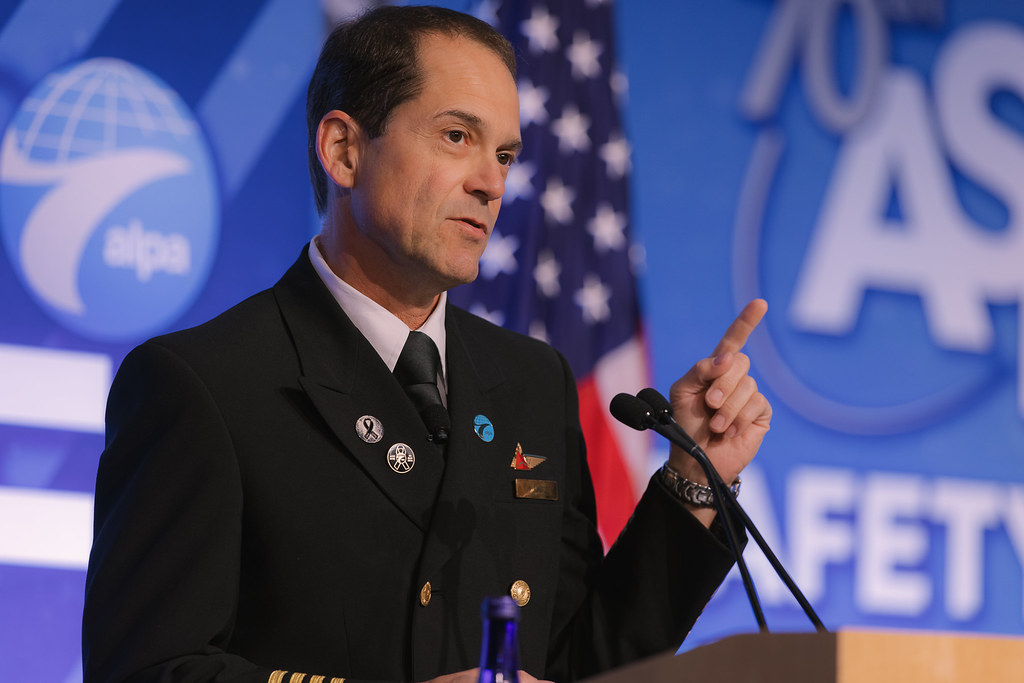
Experts from around the globe gathered in Washington, D.C., this week for ALPA’s 70th Air Safety Forum (ASF). With the theme “Moving Forward Together,” this annual event offers unmatched collaborative and networking opportunities to discuss critical topics facing not just the airline piloting profession but the entire industry.
This year’s discussions centered on a theme ALPA leaders described as both a tribute and a mandate, honoring the lessons of past accidents while pressing urgently for the technology needed to prevent the next one.
ALPA used the forum to renew its call on a crucial safety fix available to Congress right now: a requirement for integrated ADS-B In technology, with audio and visual alerting, in every flightdeck. To further elevate the urgency of the ADS-B In mandate, on Tuesday ALPA joined the National Transportation Safety Board (NTSB) and the families of PSA Airlines Flight 5342 for a press conference dedicated to the technology and the lives it stands to protect.
In addition to a full day open to the public on Tuesday, the four-day forum included two and a half days of private meetings of various councils, committees, and groups within the ALPA Air Safety Organization’s (ASO) four pillars of safety, security, pilot assistance, and jumpseat. Joined by industry and government experts, ASO volunteers gathered to share current priorities, review past accomplishments, and lay the groundwork for future success.
Keeping ‘Our Shared Commitment to Safety’
In opening Tuesday’s public sessions, ALPA president Capt. Jason Ambrosi reminded attendees: “Our shared commitment to safety is the backbone of this event. As we celebrate our safety achievements, the work we do, and the gains we make, we do so in part to honor the lives of our colleagues lost in aviation accidents. That is the very reason this union exists. From our beginnings 95 years ago, this union was formed because of the lives lost in aviation.”
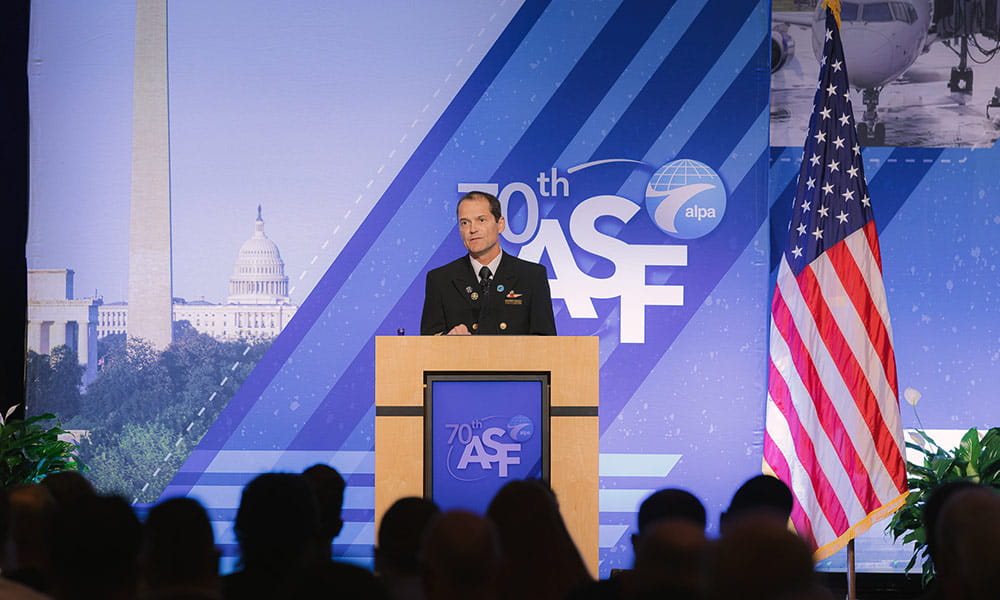
Ambrosi referenced recent tragedies, including Jazz Aviation Flight 8646, PSA Flight 5342, 21 Air Flight 7598, and UPS Flight 2976, noting that “every tragedy is a reminder that we can and must improve aviation safety.” He elaborated on the NTSB’s recommendations following the PSA Flight 5342 investigation, specifically the need for integrated ADS-B In on the flight deck. ALPA continues to lobby Congress to ensure that this requirement is included in the final safety legislation.
“Without a concentrated effort,” Ambrosi stated, “an NTSB report could become just another government report in a filing cabinet, but because safety advocates continue the drumbeat, we turn recommendations into requirements.”
ALPA’s president highlighted the Association’s recent advocacy efforts, celebrating the successes while identifying that work still remains. He marked ALPA’s hard work in combatting the threat of reduced-crew operation but cautioned that we must remain vigilant. He praised the requirement for secondary barriers on all newly manufactured passenger aircraft—a decades-long ALPA priority—while reminding that aircraft already in service must be retrofitted. He also highlighted ALPA’s fight against special interests who sought to reduce the critical safety gains that came out of Colgan Air Flight 3407 in recent Federal Aviation Administration (FAA) reauthorizations.
“The core strength of a union is that we create a powerful voice,” Ambrosi declared. “We dedicate that voice to supporting our members and advocating for safety.”
NTSB Chair Expresses Concerns About Overlooked Recommendations
A highlight of this year’s public day, Ambrosi sat down with NTSB Chairwoman Jennifer Homendy for a fireside chat to discuss the Board’s recent activities and priorities.
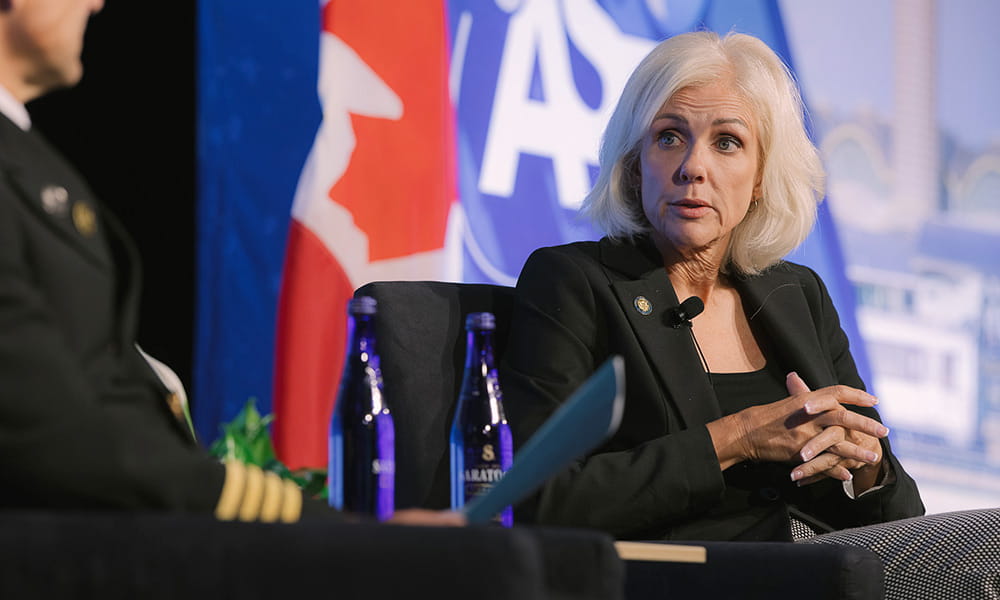
Homendy talked about the NTSB’s restrictive policies regarding the use of artificial intelligence and the tendency for the news and social media to speculate on the cause of accidents before the Board can complete an investigation. “It drives me crazy. They have a job to do, and they want whatever soundbite they can get,” she said.
When asked about the single greatest threat to aviation safety, Homendy remarked, “We at the NTSB have provided a roadmap of how to improve safety.” She continued, “Right now, we have 235 open safety recommendations to the FAA. Forty percent of those are open/unacceptable.” She noted that an important recommendation addressing the February 2009 Colgan Air Flight 3407 accident in Buffalo, New York, remains outstanding.
The NTSB chair also commented on the need for the FAA to act on many of the recommendations associated with the PSA Flight 5342 accident at Washington National Airport on January 29, 2025. Following the fireside chat, Ambrosi, Homendy, and families of crash victims held a Capitol Hill press conference demanding immediate legislative action following the NTSB’s announcement, labeling the FAA’s responses to 11 of the 33 urgent safety recommendations as completely unacceptable. Both ALPA and NTSB continue to press for the installation of integrated ADS-B In equipment with traffic displays for all aircraft operating in high-volume airspace.
Later in the day, Homendy returned to the Air Safety Forum to act as the public day’s closing keynote speaker with a stirring and urgent call to all participants to advance safety.
Boeing’s Chief Aerospace Safety Officer Focuses on Safety and Trust
“We all share something special together when it comes to flight,” proclaimed Don Ruhmann, Boeing’s chief aerospace safety officer in his keynote remarks at the ASF. “It’s more than transportation—it’s trust.” That trust, he said, takes time and work to build.
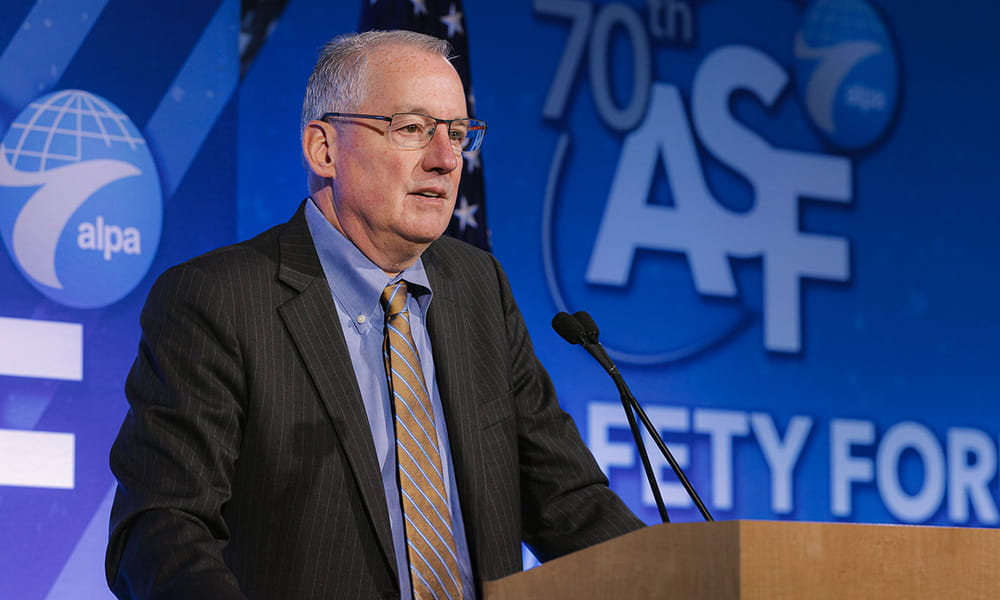
Ruhman remarked that at Boeing “safety is personal to all of us” and shared details on three areas where Boeing puts in the work to increase safety and build trust: human factors, safety resilience, and data collection and sharing.
Ruhmann also bolstered two ALPA priorities, stating that:
- Boeing’s current design policy is centered on two pilots, and the company is not currently designing for fully automated flight. Instead, he said, Boeing looks for ways to inject automation where it helps pilots with safety.
- Boeing has long supported employee mental health and well-being, and the company supports the Mental Health in Aviation Act. “Mental health is just as important as physical health,” he said.
Amplifying the theme of this week’s event—Moving Forward Together—Ruhmann emphasized the importance of collaboration in service of safety. Human factors design—which he termed “designing for the way people actually work”—relies on the pilot perspective. Continuing to collect, share, and analyze data across all roles and disciplines will help discover not only “what failed?” but also what happened to make an event successful.
“Safety work is team work,” he said, “and it takes all of us to get it done.”
FAA’s ‘Amazing Progress’ to Improve Surface Safety
Matthew McCann, program manager of the FAA’s Surface Team, joined for a five-minute “taxi talk” where he outlined what he termed the “amazing progress” the FAA has made and continues to make to modernize surface safety through surveillance and collision prevention technology. The Surface Team aims to “enhance situational awareness for both the air traffic controller up in the tower along with the pilot,” McCann remarked.
Up until recently, only 44 airports in the United States had surface surveillance technology for air traffic controllers. McCann said, “Just two years ago, people sitting in their living room had more technology” to be able to see surface traffic. By the end of 2027, however, every airport staffed with FAA controllers will have the surface awareness initiative.
McCann highlighted a number of additional FAA efforts to increase surface safety, including updating surface surveillance equipment and radar at airports with outdated technology, increasing and updating runway status lights, and adding vehicle transponders where possible.
“We are dedicated to rolling out technology and moving forward,” he said.
Flightpath to a Modern ATC System
During a panel discussion, aviation experts outlined efforts to replace aging air traffic control infrastructure while emphasizing that new technology must improve safety without overwhelming pilots and controllers.
Moderated by Capt. Craig Boxrucker (Alaska Airlines), chair of ALPA’s Air Traffic Services (ATS) Group, “Flightpath to a Modern ATC System” examined upgrades to communications, surface surveillance, radar coverage, and air traffic-flow management throughout the national airspace system.
Paul Fontaine, executive director of the Transformative Technology Organization in the FAA’s Office of Airspace Modernization, said the agency is using an initial $12.5 billion investment to replace critical infrastructure. Work to reduce the system’s dependence on aging copper-based equipment is approximately 65 percent complete. The FAA has also installed approximately 200 communications switches and 400 compatible radios, while contracts have been awarded for 612 radar systems.
Cyriel Kronenburg, vice president of Airports and Air Traffic Management at uAvionix, described how smaller, rapidly deployable receivers are extending surface surveillance to airports that previously lacked the capability. Michael Garcia, chief innovation scientist at Aireon, discussed how space-based ADS-B provides real-time aircraft surveillance over oceans and remote regions, reducing coverage gaps and supporting more efficient separation and routing.
From the flight deck, Capt. Sy Pinkert (United Airlines), ATS Group vice chair, said that improved trajectory information can give air traffic controllers more time to resolve conflicts, potentially resulting in more preferred routes and altitudes and less radar vectoring. Pinkert also stressed the importance of keeping pilots at the center of technological development.
Panelists agreed that modernization efforts must combine new technology with collaboration among government, industry, controllers, and pilots to build a safer, more resilient ATC system.
ALPA’s Role in the PSA Flight 5342 Accident Investigation
The final panel of the public forum, “Honoring Legacy with Action,” brought together participants from the NTSB’s investigation of PSA Flight 5342 to discuss in general terms how this and similar investigations aim to learn from tragedy to advance safety.
Moderated by F/O Mike Wickboldt (United Airlines), chair of ALPA’s Accident Investigation Board, the panel discussed the NTSB’s investigation process, its recommendations, and ALPA’s role.
According to Chris Heck, manager of Engineering & Investigations in ALPA’s Engineering and Air Safety Department, when invited to participate in an investigation, ALPA’s role is to provide technical expertise to the NTSB. “It’s the line pilot expertise. When we show up, we help the NTSB develop a full actual record,” he said.
Brice Banning, an accident investigator with the NTSB who was the investigator-in-charge in the Flight 5342 investigation, explained how the organization uses its findings to make recommendations, with 52 recommendations—including two urgent ones—coming out of this investigation. He added that the NTSB has no enforcement ability, so recommendations are how they can encourage changes in the system.
Capt. Mike Palazzolo (PSA Airlines), the pilot group’s chief accident investigator, came away impressed with the thoroughness of the investigation. “The level of detail and attention to detail is incredible,” he said. He also praised one of the NTSB’s urgent recommendations regarding the airspace around DCA as restoring a “level of trust in a fractured system at the time” when implemented.
Heck explained how ALPA participates throughout an investigation, reviewing field notes and factual reports and also providing a party submission when ALPA’s experts develop safety recommendations they want included. ALPA will often speak with NTSB members as well to help provide them with a greater understanding of the pilots’ perspective.
Once the report and recommendations are released, both ALPA and the NTSB turn to advocacy. For Flight 5342, that means the 50 remaining recommendations.
“We are actively advocating for the implementation of all 50 of the recommendations,” promised Banning. “The NTSB is a small agency, but we have a big voice. We’re going to use that voice” to advocate alongside ALPA for the recommendations.
ALPA continues to advocate strongly as well, including efforts to ensure the inclusion of integrated ADS-B In technology in the final bill that comes out of Congress.
Palazzolo completed his accident investigation training with ALPA the year before the tragedy occurred and never imagined anything like what he participated in—but he’s extremely proud of the role he played and ALPA’s support of accident investigations overall.
“They’ve got our backs,” he told the pilots in attendance. “That’s the best way to describe how proud I am to be part of the ALPA team.”
And the Awards Go to…
As has become tradition, the ASF public day concluded with the annual evening awards banquet highlighting the outstanding accomplishments of ALPA pilots. The union celebrated pilots who demonstrated exceptional teamwork on the flight deck, along with dedicated pilot volunteers who helped make the airline piloting profession safer and more secure.
Photo Gallery
Featured Articles


