

ALPA Presses for ADS-B In Mandate
Technology Could Have Prevented Recent Fatal Collisions
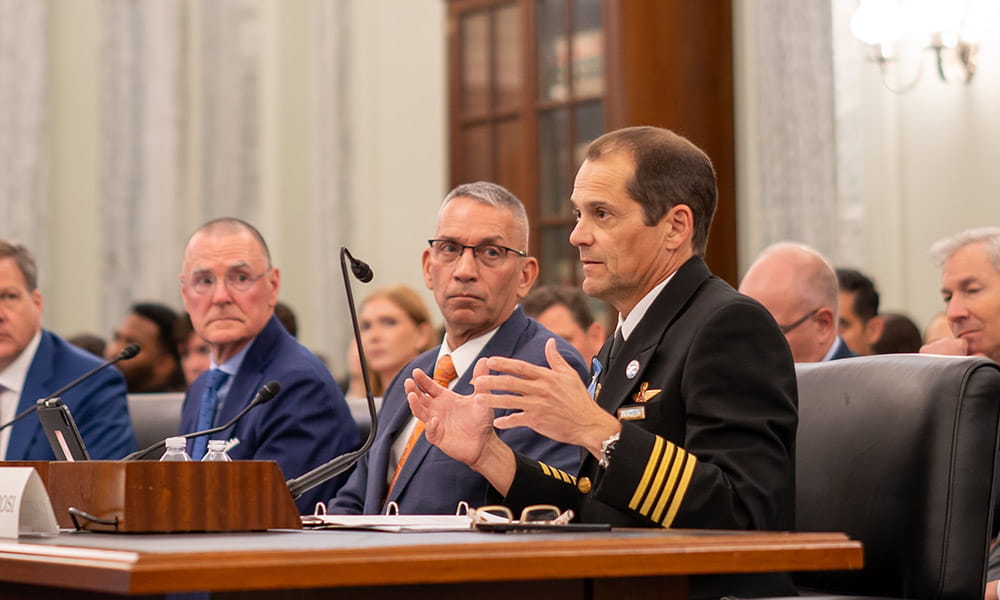
Capt. Jason Ambrosi, ALPA’s president, testified on June 23, 2026, before the Senate Aviation Subcommittee at a hearing titled “Close Calls: Improving Safety Across the National Airspace System.” The hearing focused on technologies that could be implemented to reduce the risk of runway incursions and midair collisions in the wake of two fatal collisions in as many years and a spate of close calls.
Ambrosi dedicated his testimony to the four ALPA members who lost their lives in these accidents: Capt. Jonathan Campos (PSA), honorary Capt. Samuel Lilley (PSA), Capt. Antoine Forest (Jazz Aviation), and F/O MacKenzie Gunther (Jazz Aviation). He noted that technology to avoid these tragedies exists today but isn’t required on airliners.
“It’s technology that’s readily available. The NTSB [National Transportation Safety Board] has been saying we should have had it since 2008. Why don’t we have it?” asked Ambrosi.
The ROTOR Act, the ALERT Act, and ADS-B In
A focal point of the hearing as the ongoing effort to require a full suite of collision-avoidance capabilities that include the addition of Automatic Dependent Surveillance-Broadcast (ADS-B) In integrated into airline flight deck displays, which is a key component of the U.S. Senate-passed Rotorcraft Operations Transparency and Oversight Reform (ROTOR) Act. The bill would enact some of the NTSB’s safety recommendations from its investigation into the midair collision between PSA Flight 5342 and a U.S. Army Black Hawk helicopter on January 29, 2025.
ADS-B In, with the performance standards included in the ROTOR Act, would provide pilots with icons on flight deck displays indicating nearby traffic both in the air and on the airport surface with direction, speed, and climb or descent indications. The technology would provide visual and audible alerts to pilots if that traffic poses a risk of collision. If implemented, it would improve pilot situational awareness.
In April, the U.S. House of Representatives passed the Airspace Location and Enhanced Risk Transparency (ALERT) Act, similar legislation that doesn’t include the same requirements for ADS-B In integration, and both chambers are currently meeting to reconcile the differences between the two bills.
“I commend the quick work of this committee and leaders in the Senate who drafted and passed the ROTOR Act, which seeks to close the gaps in the aviation safety net that allowed the Potomac midair collision and similar accidents to happen,” Ambrosi remarked. “The midair collision exposed a specific safety gap: the lack of an integrated ADS-B In mandate. Pilots are safest when we’re aware of and can avoid threats.”
Ambrosi emphasized that ADS-B In must be integrated into flight deck displays and noted that there is a decrease in the safety benefit if ADS-B In technology is rolled out in electronic flight bags.
“Let’s think about the situation, the tragic situation over the Potomac,” said Ambrosi.” If [ADS-B In] was on integrated displays, it would have given a warning, given more time, and it would have been in the pilots’ field of vision while conducting that maneuver near the ground. If it’s on an iPad, pilots have to look to the side and not focus on what’s going on in front of them. We have a lot of other apps and things that we need to have on that iPad.”
More from the Hearing
The hearing was called by Senate Aviation Subcommittee Chair Sen. Jerry Moran (R-KS) and also included testimony from Chris Sununu, president and CEO of Airlines for America; Todd Hauptli, president and CEO of the American Association of Airport Executives; and James Viola, president and CEO of the General Aviation Manufacturers Association.
In addition to the benefits of ADS-B In, the hearing touched on other technologies and solutions to address the risks of close calls in the air and on the ground, such as modernizing air traffic control systems, expanding nonpunitive safety reporting systems to include airport workers, and enhancing runway status alerting systems.
Congress has provided an initial $12.5 billion down payment toward air traffic control upgrades, but hearing witnesses stressed that a second, larger round of funding is essential for modernization efforts. They also encouraged Congress to continue funding surface safety initiatives like runway status lights, airport surface detection equipment, Model X (ASDE-X), and airport surface surveillance capability with ADS-B.
Lives Are at Stake: Demand an ADS-B In Mandate for Commercial Aircraft
The ALERT Act is not enough! Demand that Congress adopt the stronger safety mandates of the ROTOR Act into the final law.
Featured Articles


