

Combination for Success: Safety, Security, Pilot Assistance, and Jumpseat
Town Hall Highlights ‘The Work You Do’
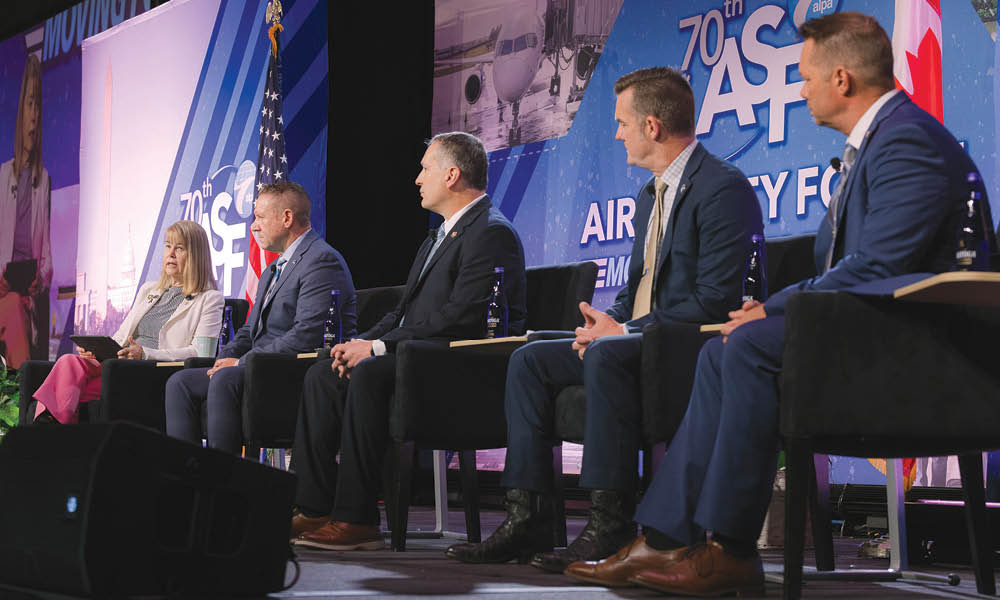
During the Association’s recent Air Safety Forum, the chairs of the four pillars of the Air Safety Organization—Aviation Safety, Aviation Security, Pilot Assistance, and Aviation Jumpseat—joined Capt. Wendy Morse, ALPA’s first vice president and national safety coordinator, to open a town hall meeting that highlighted the important work the groups are undertaking.
“Thank you for the exceptional work you do every year,” Morse said in opening the meeting. “The work you do truly helps make our skies safe.”
The chairs emphasized many of their priorities and underscored the collaboration among all four groups, noting that issues often fall across multiple arenas. “No issue is solely a security issue,” explained F/O Bryan Patchen (Delta), the Association’s Aviation Security Group chair.
Participants discussed air traffic control modernization, unmanned aircraft systems, secondary barriers, primary barriers for cargo, the Federal Flight Deck Officer program, ALPA’s Pilot Assistance Group and its important role in responding to accidents and serious incidents, and Aviation Jumpseat’s work protecting pilot-in-command authority.
Fireside Chat with the Federal Air Surgeon
F/O Richard Mahoney (Delta), the union’s Aeromedical Committee chair, sat down with Federal Air Surgeon Dr. Susan Northrup during “The Doctor Will See You Now,” a fireside chat to discuss the numerous policy changes announced by the medical certification branch of the FAA since Northrup took office in January 2021.
She spoke about her staff revisiting the medical certification process from beginning to end in preparation for the FAA Reauthorization Act of 2024. Northrup noted how certification processing times have improved and her office’s broadening of mental-health and antidepressant policies to eliminate barriers to treatment. The FAA’s current approach highlights education, early intervention, and more reasonable standards to ensure pilots can seek care without losing their careers.
Behind the Scenes of ALPA’s Response to PSA 5342
During a panel discussion titled “Beyond the Black Box,” Capt. Jeff Mee (United), the Association’s Accident Analysis & Prevention Group chair and a member of the union’s Accident Investigation Board, offered a behind-the-scenes look at the ALPA’s response to the January 2025 midair collision involving PSA Airlines Flight 5342 and an Army Black Hawk helicopter near Washington National Airport.
The Association’s pilots bring an indispensable operational perspective to an investigation, panelists explained. Their work can include conducting interviews, documenting evidence, reviewing technical reports, and editing hundreds of pages of investigative material.
“The one thing that many NTSB investigators don’t have is the experience of being a line pilot,” said Mee. “That adds a lot of value to the investigation.” At the time of the panel discussion, ALPA was participating in 27 active investigations.
Who’s Got Your Six?
To close out the town hall, Capt. Steve Jangelis, the union’s Aviation Safety Group chair, moderated a panel titled “Who’s Got Your Six?” that examined why pilots need legal representation following serious incidents and accidents.
Panelists discussed how attorneys can often play important roles in the response teams initiated by calls to the ALPA Accident/Serious Incident Hotline. They noted that legal representation can be particularly crucial when events occur in foreign countries, stressing the importance of maintaining two separate tracks following these occurrences—protecting the pilots and maintaining the integrity of the investigation.
More from the Air Safety Forum
The annual Air Safety Forum allows ALPA, as the world’s largest nongovernmental aviation safety organization, to work across pilot groups and with industry and government partners in the fields of safety, security, jumpseat, and pilot assistance. Public sessions of the forum covered critical topics like simulators, Land and Hold Short Operations, new turbulence avoidance technology, ADS-B In, air traffic control modernization, runway safety, and much more. The event’s long list of expert speakers provided crucial opportunities for collaboration across the industry.
Featured Articles


