


After the Towers Fell
25 Years Later, ALPA’s Former President Recalls the Union’s 9/11 Response
By 2001, the airline industry had finally turned a corner. It had taken most of two decades—the wreckage of deregulation, the 1998 Northwest strike, and hard-fought contracts at United and Delta. That May, ALPA merged with the Independent Association of Continental Pilots, the union representing Continental and Continental Express pilots. We thought we’d finally beaten it—that after all those years, we were back, and we were going to come out swinging.
One hundred days later, 9/11 happened.
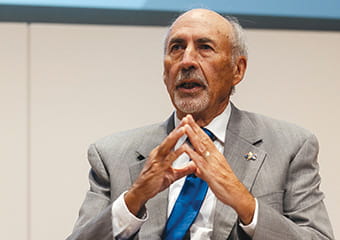
That night, Department of Transportation (DOT) Secretary Norman Mineta called. I’d known him a long time—his son flew for Delta, and his wife had been a United flight attendant. His first call was just to confirm I was in town. White House Chief of Staff Andy Card was putting a plan together, but he couldn’t say what yet. Later, after President George Bush’s national address, Mineta called back. Two Rapid Response Teams would be stood up, one for airports, one for airlines. Southwest Airlines CEO Herb Kelleher would run airports. I’d run airlines. I was told to be at a 4 a.m. meeting, before the morning television shows aired, because they’d be reporting that the White House had a plan in place.
The next morning, I parked at ALPA’s offices and walked six blocks to the White House on a completely empty street. When I got inside, Herb and I sat down at a table, and most of what was in front of us wasn’t new: hardened flight deck doors, secondary barriers, treating hijackings as terrorism instead of hostage negotiations. Our union had been pushing pieces of this since the 1970s.
By nine that morning, a national security team—the Secret Service, the military, and National Security Council staff—came in and told us that they were now in charge. In their view, this was a matter of national security, and the DOT’s Rapid Response Teams were unnecessary. Fortunately, President Bush didn’t agree.
The same group stated that jumpseating was no longer an option and that Washington National Airport was closing and would stay closed until further notice. It remained closed for 22 days and ran at a fraction of capacity for months after that.
The jumpseat fight was the worst of it. I finally told them that we weren’t coming back to the table—not just me, the but whole industry—until that changed. I had Card and Mineta in my corner, and it worked. But I was really concerned about the industry’s financial situation. I called our Government Affairs Department and asked staff to contact every union and every trade group to determine the amount of financial support the industry would need to keep operating. We landed on $20 billion. Congress passed legislation 10 days later, and President Bush signed it into law. What arrived was $5 billion in cash and $10 billion in loan guarantees, but it wasn’t enough. There was more disaster aid for a Midwest drought than for an industry that had just been used as a weapon.
Two weeks later, at our first ALPA Executive Council meeting since the terrorist attacks, I didn’t have to convince anyone that our industry was fighting to stay in business. They had already gotten there. That instinct carried us through the bankruptcies that followed—US Airways, United, Delta, Northwest—one after another for years.
What I’m proudest of isn’t anything I did that week. It’s what happened at the local level: master executive councils and local executive councils taking care of grounded crews and staying with the families of the four crews we lost. United’s Local Council in Denver, Colorado, has kept in touch with the families over the years, including the daughter of LeRoy Homer, United Flight 93’s first officer. She was three when her father died on 9/11. The Denver council also had a memorial built in honor of those lost that day.
Some of what we fought for became permanent fast: hardened flight deck doors and the Federal Flight Deck Officer program. Some took far longer than they should have. Secondary flight deck barriers, which finally were required to be installed on new passenger airliners earlier this year, still aren’t required on passenger airliners already in service. I don’t have a good explanation for that; I don’t think anyone does.
Twenty-five years on, this union has more members and stronger contracts and remains the conscience of the airline industry for safety and security. That fight never really ends, and I’m proud of what ALPA has become in carrying it forward.
Featured Articles


