


Born on 9/11
September 11, 2001, is one of those moments in history that you remember exactly where you were when you first heard about or saw footage of the horrific terrorist attacks. That’s especially true for those in the aviation industry, as they watched the very aircraft they devote their careers to be used as weapons of death and destruction. The impact of the attacks forever changed the industry.
“I was at the airport in the crew room, surrounded by other pilots,” remembers Capt. Jason Ambrosi, ALPA president. “There were more than 100 of us staring at the screen in disbelief as we watched it all unfold.”
As the years progress, and time and space fill the distance of 25 years gone by, more and more pilots are entering the profession who don’t recall where they were on that day. But for three ALPA members in particular, while they don’t have a memory of that tragic day, they know exactly where they were.
It’s the day they were born.
Happy Birthday
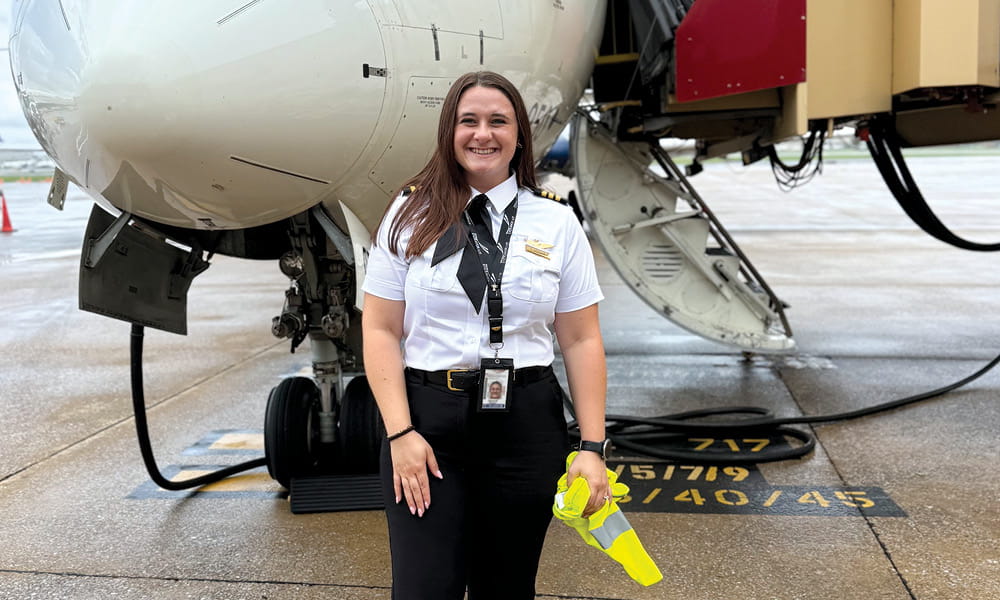
F/O Dianna Sprague (Endeavor Air) was born at 1:19 a.m. eastern time, a little more than seven hours before the attacks began. Her father, a former ALPA member, was supposed to fly into New York that day and stay in Manhattan but was able to get the day off to be at his daughter’s birth.
Her mom woke up from a nap and turned on the TV just in time to see the Twin Towers hit. Everyone in the hospital was in shock—as was the rest of the nation. But, as was seen throughout the country, people immediately started searching for hope.
“The nurses came into the room one by one,” she recalls her parents telling her. “Just to hang out.” The delivery doctors joined them. “With all the devastation,” Sprague says, “everyone wanted a little joy and happiness—so they all came to see the newborn baby. It’s neat to think that through all the darkness, I was a light for many people that day.”
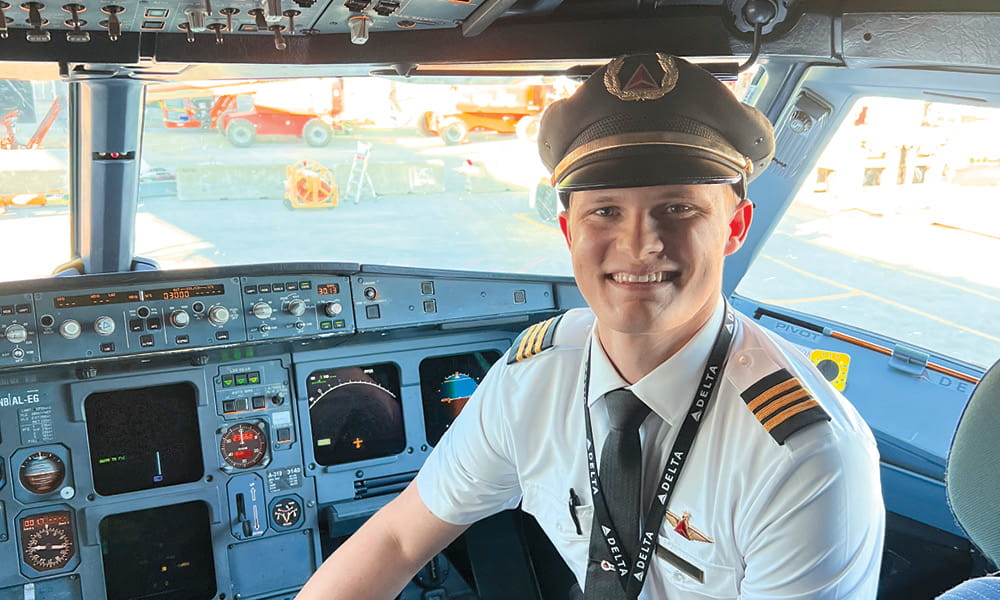
F/O Ben Priebe (Delta) arrived later in the day at 1:26 p.m. central time. “My mom and dad always told me I was a bright spot in their lives on a very dark day for Americans,” he remarks.
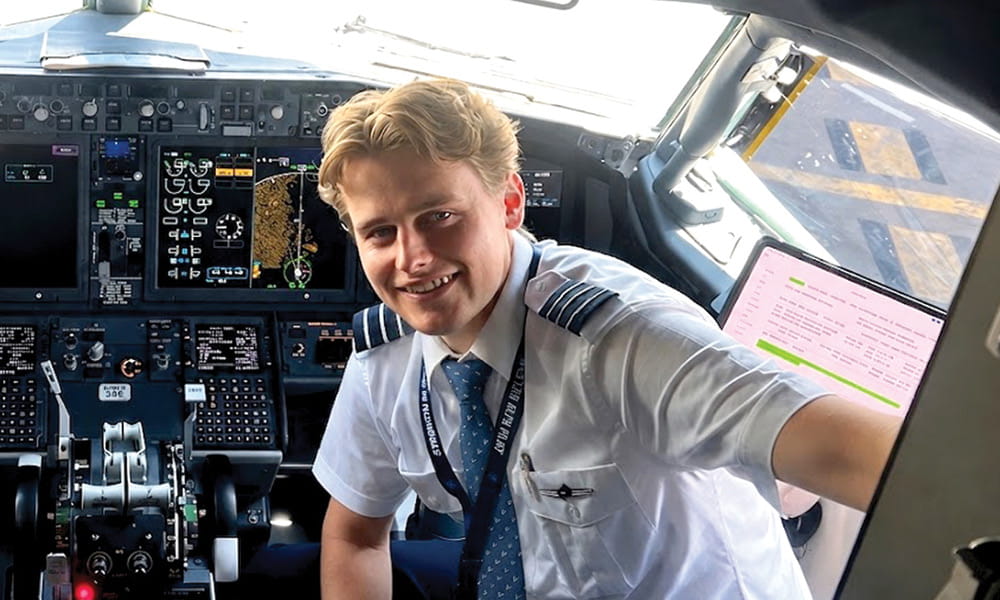
Then at 4:48 p.m. eastern time, F/O Harry Tibbetts (WestJet) joined the world. And while he was born in Guelph, Ontario, the attacks still hit close to home, as he’s part of a multigenerational aviation family that continues airline flying to this day.
Growing Up and the Path to the Flight Deck
Dianna Sprague Always Wanted to Be a Pilot
Sprague remembers first realizing the significance of her date of birth in first grade. In kindergarten, they announced her birthday and then the first part of the day was dedicated to remembering 9/11 and learning about the tragedy. “I don’t think the connection hit me until the same thing happened on my birthday the next year,” she recalls.
Still, “I think I always knew I wanted to be a pilot, especially growing up in an aviation household,” Sprague acknowledges. Around the age of five, her father brought her onto a B-727. “All I remember is that there were so many switches. I thought it was really neat that my office could be the sky,” she says.
After graduating high school, Sprague took lessons at a small Part 61 flight school—with her dad as her instructor. She earned the rest of her ratings while at Ohio University, then graduated and taught at the same Part 61 school to build the required flight hours. “I was lucky enough to get an interview with Endeavor Air, which is the airline I fly for today,” she notes.
Ben Priebe Caught the Flying Bug
Priebe’s parents typically would watch the morning news while getting him ready for school. “Every year on my birthday, I remember seeing images of the World Trade Center burning and how scary that was,” he recalls.
“I think even from a young age, I realized the significance of my birth date and what the day meant to Americans,” Priebe observes. “So many people talked about what they were doing that day, where they were in life, and how they felt about what happened. I was always lucky enough to celebrate my birthday with family and friends, but not without a great deal of respect for the many people who lost their lives on that day.”
Priebe got the flying “bug,” as he terms it, when he was invited to sit up front with the pilot on a flight out of Talkeetna, Alaska, for a glacial landing at the base of Mount Denali. “I was immediately hooked,” he remembers, and started flight training when he returned home to Minnesota.
Priebe did all his flight training at a Part 61 school, then instructed at a Part 141 school while getting his degree at Minnesota State University-Mankato. His commercial aviation career began with Sun Country, where he flew for just under four years before being hired by Delta earlier this year.
“I always thought it was amazing that two strangers could sit in an aircraft and work together so well with standard operating procedures and callouts,” Priebe shares. “From the very beginning of my aviation career, my dream was to be an airline pilot.”
Harry Tibbetts Was Born into It
“I was born into an aviation family and grew up around pilots,” Tibbetts says. Both his grandfathers and his father flew for Air Canada. His mother currently flies for the airline while his sister is a WestJet pilot. “So I was familiar with the industry and job as a whole.”
Tibbetts recalls that while growing up neither of his parents wanted to work on the anniversary of 9/11—“and not just because it was my birthday.” His mother still avoids working on that day. “I didn’t really understand the gravity of the day when I was young,” he notes, “but I remember people were sometimes sad.”
His familiarity with aviation helped him decide on a career path. “In high school, I was quite certain what I didn’t want to do—an office job working 9 to 5,” Tibbetts recalls. “I’d been accustomed to my parents’ schedules from an early age, and the days off and travel and constant variety and challenges of the job really appealed to me. But I was also aware of the sacrifices—one parent being home while the other one worked and not always having them both around for certain milestones. I knew all the ups and downs of the industry firsthand.”
Tibbetts obtained his private pilot license in 12th grade, attended an aviation college in Canada, and was hired by Sunwing as a cadet flying the B-737. His hire date was on his 22nd birthday, Sept. 11, 2023. Tibbetts then became a WestJet pilot when Sunwing and WestJet merged in 2025.
Today’s Generation
These three pilots—plus many of their contemporaries on the flight deck, and many more still to come—have lived their entire lives in a post-9/11 world while working alongside many who vividly remember the attacks.
“Being a third-generation airline pilot—on both my mother’s and father’s side—and both my birthday and date of hire being on September 11 is a pretty incredible story to most people and an unbelievable coincidence,” Tibbetts says.
“I think being born on September 11 is something that will always connect me to others in the aviation industry,” Priebe acknowledges. When other pilots learn of his birth date, they have a story to share. “It gives me so much perspective on the day hearing about it from others.
“During my certified flight instructor checkride,” Priebe remembers, “the examiner looked at the birth date on my medical certificate and immediately told me, ‘That day changed the course of my career.’ I’ve heard countless stories from other pilots about where they were that day, how it affected their career progression, and if they even had a job at all after 9/11.
“It’s important for all pilots to be cognizant of the 9/11 attacks,” Priebe remarks. “My hope is that professionals of my age continue to have respect for what our peers went through on 9/11 and the years that followed,” he states. “I truly hope that we never forget the hardships, sacrifices, and loss of life that resulted from those attacks.”
“My generation never experienced life before 9/11 and how the world changed afterward,” adds Sprague. “We’ve always had the Transportation Security Administration and security screenings. It’s important to keep in mind that they’re not there to be a hassle or to make travel stressful, but to prevent history from repeating.”
“I’m the only pilot among my close childhood friends, and I don’t think they understand the impact of that day. I probably don’t fully understand it either,” Tibbetts admits. “I’ve only known closed flight deck doors and the heightened security we all experience today. My brothers and sisters, who are older than me, all flew in the jumpseat at work with our parents—but everything changed after 9/11.”
“Never Forget”
According to ALPA data (as of August 1, 2026), 1,265 Association members were born on or after September 11, 2001. Keeping alive the memory of those who perished, how the attacks affected the airline industry, how the industry responded, and how it continues to pursue security measures remain top priorities for the union.
“‘Never Forget’ isn’t just a slogan or a platitude; it’s a directive ALPA takes seriously,” explains Capt. Wendy Morse, the Association’s first vice president and national safety coordinator. “And it’s becoming increasingly important as pilots join our ranks without any memory of the day—including those who’ve lived their entire lives in the post-9/11 world.”
Priebe concurs. “I think many people born after 9/11 forget the true impact that day had on our country,” he states. But hearing about it from colleagues reinforces the lessons learned. “I flew as a first officer with a captain at Sun Country who departed from John F. Kennedy International Airport on the morning of the attacks,” he recalls. “He couldn’t believe that he was flying with someone who was born on that day.”
Priebe says the captain told him the experience was, “as if it had happened yesterday, burned into his mind. It was something he truly could never forget.”
“When colleagues learn my birthdate, they all remember very clearly where they were on that day and where they got stranded or diverted to,” Tibbetts remarks. “Even 25 years later, almost every pilot and flight attendant can recount where they were at that exact moment in time.”
“I think ‘Never Forget’ will always be an important priority for ALPA and the industry,” Sprague acknowledges. “September 11 was a tragic day for every American—not just for those in the aviation industry. It’s important to always remember and honor those who lost their lives and to continue to protect against something like that ever happening again.”
“Every year that we talk about 9/11 and remember the events is a tribute to the lives that were lost and a reminder of their sacrifice,” Tibbetts states.
But that’s not all to remember, he says. “In Canada, we also recall the incredible kindness and generosity of the people of Gander who took in stranded passengers after the airspace was closed in the United States.” In addition to remembrance ceremonies and moments of silence, “we also try to reflect on the good side of humanity that was so evident in Gander.”
“There’s a wave of sadness every year that shouldn’t be overlooked,” Sprague notes, “but I think that 9/11 has become a day when our great nations stand together to remember our history and to be grateful that we continue to have our rights and freedoms. It’s become a day to remember the courageous heroes, many who lost their lives, responding to the attacks and protecting those they could.”
Memories Must Be Imparted
For pilots who remember September 11 firsthand, the memories remain vivid. For those who were born afterward, those memories must be imparted.
“It’s up to us all to make sure the stories of that day—and the weeks and months and years that followed—are shared and passed on,” Morse declares. “Especially as more of us who were flying that day retire, we need to not only pass it on but to make sure those we share it with know that they need to pass it on as well.”
That holds true whether you’re 25 and just starting out or approaching 65 and retirement. September 11 must always be the day we never forget.
25 Years Later, We Will Never Forget
The stories of ALPA pilots who lived through 9/11, those we lost, the days that followed, and our fight to secure the flight deck.

Featured Articles


