


Pilot Scheduling Reps Compare Pairing/Rotation Construction Approaches
Airline pilot scheduling is an involved, complex process that must adhere to carrier operational demands, federal regulations that address safety margins and pilot fatigue, and, for those fortunate enough to have it, labor contract language. While approaches vary greatly from airline to airline, the final product directly impacts operational safety and pilot quality of life.
To better understand how different airlines and pilot groups administer this detailed process, ALPA’s Economic &
Financial Analysis (E&FA) Department recently conducted a two-day Pairing/Rotation Construction Scheduling Workshop.
More than 45 scheduling volunteers from 16 U.S. and Canadian pilot groups and members of the Allied Pilots Association, the Southwest Airlines Pilots Association, and the Teamsters gathered on July 27–28 at ALPA’s McLean, Virginia, headquarters. Together, they evaluated and compared the creation of these essential building blocks of monthly pilot schedules.
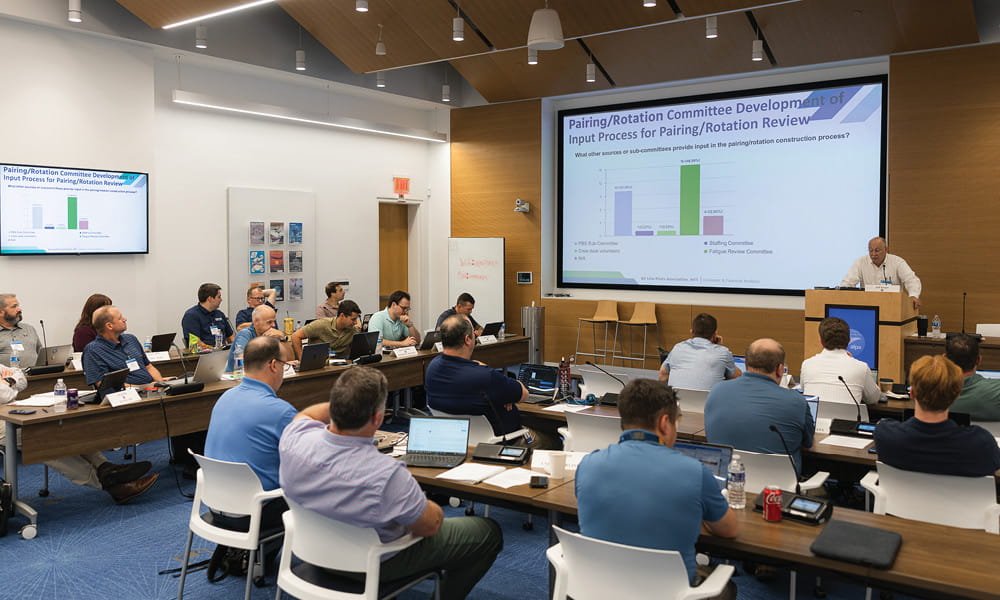
“This is your workshop. You steer the direction and topics to be discussed,” said Jeff Nooger, a former United pilot and current E&FA Department senior scheduling and work rule analyst, who facilitated the event. What followed was an organic, free-flowing conversation in which the pilots reviewed the various processes and vendors they use and the subsequent experiences they’ve encountered.
Workshop participants compared and contrasted their individual Scheduling Committee structures as well as their level of involvement in pairing construction and the working relationship they’ve developed with their management counterparts. They also talked about pairing optimizers—software used to assess demands, rules, and priorities and assemble monthly trips.
Several attendees explained their processes for gathering information on pairing improvements and provided demonstrations. In one presentation, Capt. Kyle Opp (United) and Capt. Michael Kulbacki (United) outlined features of their pilot group’s construction process. United uses local council Scheduling Committee input for this effort. As evidence of the size and scope of this task, Opp pointed out that last November, the airline had 56,612 flight segments (including deadheads) for its B-737 fleet alone—which equated to 12,496 pairing solutions.
Capt. J.J. Sweetser (Delta), F/O Justin Anderson (Delta), and Capt. Gabrielle Jordan (Delta) explained the surveying process their Scheduling Committee conducts to better understand the primary concerns and level of satisfaction within their pilot group. Among other tasks, survey participants are asked to prioritize and comment on rotation considerations such as trip commutability, the number of days assigned, layover length and location, the inclusion of overnight (or redeye) flights, and other variables. “Building trips that pilots like solves a lot of problems,” Sweetser noted.
Sweetser and Jordan also demonstrated the Boeing Alertness Model, the fatigue model integration feature that their pairing optimizer produces. Both United and Delta use the Jeppesen Crew Pairing solution.
In addition, pilots from the JetBlue and Alaska Scheduling Committees, which construct pairing sets themselves or in conjunction with crew resources, explained how their groups build pairing sets using Jeppesen software. One pilot from Republic and another from Sun Country reviewed their carriers’ use of the S3RUS optimization software for constructing pairing sets and demonstrated how their pairing optimizer works.
Later in the workshop, Capt. Doug Marchese (JetBlue), ALPA’s Flight Time/Duty Time Committee chair, spoke about the fatigue parameters to consider during the pairing construction period and the fatigue analytics that should be run after the pairings are built. His presentation led to an extended discussion among the attendees about problems encountered and general best practices. As part of the conversation, the pilots considered whether their fatigue programs fall under their Safety or Flight Operations departments and the resulting ramifications.
Participants reviewed the cost in pairings and run solutions, including cost drivers such as flight credits, assigned deadheads, layover hotels, temporary-duty assignments at other domiciles, and long-haul-duty issues. They also discussed the importance of regularly communicating the status of schedule building with pilots. In addition, attendees observed how collective bargaining can address aspects of the scheduling protocol that need to be resolved.
Scheduling Workshop Series
The Pairing/Rotation Construction Scheduling Workshop is the second of three scheduling workshops that ALPA’s E&FA Department is hosting this year. In May, the Association held a Preferential Bidding System Scheduling Workshop, and the third workshop, Day of Operations/Crew Desk, is planned for September 30–October 1.

Featured Articles


