


Pilot Negotiators Discuss Practices, Experiences at ALPA Roundtable
100+ Gather for Industry Bargaining Roundtable
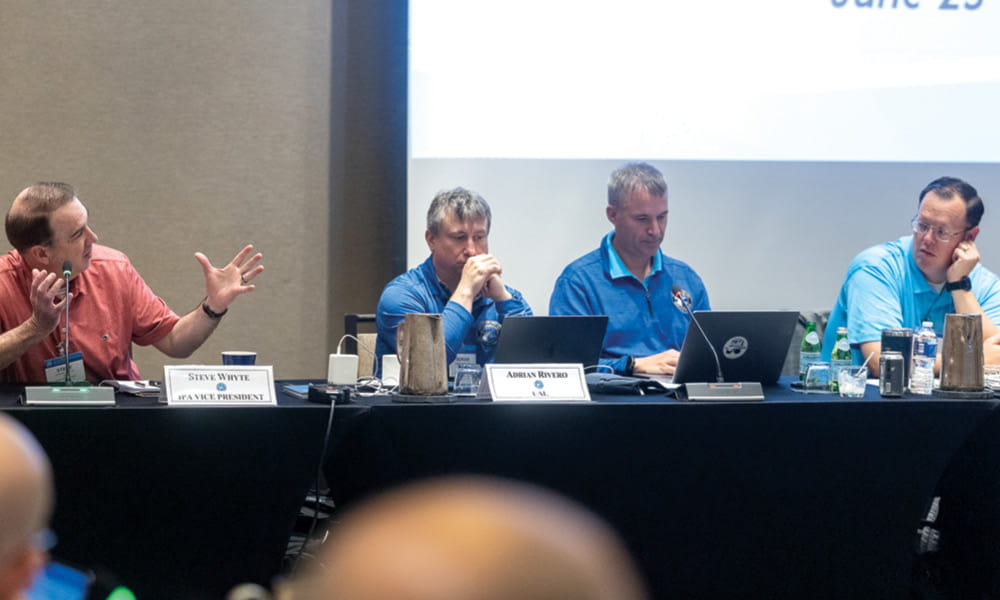
In the wake of recent pilot agreements ratified at Air Transport International, Canadian North, FedEx Express, and Kelowna Flightcraft, as well as contract gains at other ALPA pilot groups, the Association held its annual Industry Bargaining Roundtable. More than 100 pilot negotiators, Master Executive Council leaders, subject-matter experts, and ALPA staff members gathered on June 23–24 in McLean, Virginia, to discuss practices and trends.
In addition to Negotiating Committee members from ALPA’s U.S. and Canadian pilot groups, attendees representing the Allied Pilots Association, the Independent Pilots Association, and the Southwest Airline Pilots Association provided a comprehensive look at the North American airline pilot negotiating environment.
“Meetings like this matter,” said Andrew Shostack, director of ALPA’s Representation Department, who underscored the value of networking and sharing information across airlines. “It’s important that pilot negotiators talk to one another and coordinate through events such as this roundtable to ensure pattern bargaining targets are developed, understood, and achieved.”
Building on Shostack’s remarks, Capt. Phil Otis (United), the Association’s Collective Bargaining Committee chair, commented, “None of us can say we have a monopoly on the best bargaining strategy or the issues and methods that will most effectively unify a pilot group. However, combining these experiences and sharing this information with all ALPA pilot groups brings our collective bargaining capability to a higher level.” Otis also noted the benefit of having a diversity of perspectives when exploring strategies and considering alternative opportunities in a forum such as this.
Pilot Groups Share Current Scenarios, Strategies, and Challenges
Much of the roundtable agenda featured the Association’s pilot groups, in various stages of negotiations, engaging in an organic discussion about what they’re presently encountering. Participants outlined the value of using strategic plans and negotiating protocol agreements, routine polling and surveying to assess pilot priorities, and contract comparisons to better understand the current value of airline flying.
In addition, three ALPA pilot groups involved in mergers explained the process and dynamics of working with another pilot group to achieve a joint collective bargaining agreement.
While many of the union’s recent bargaining efforts have been successful, some pilot groups inevitably experience challenges. Earlier this year, the Association sued Breeze Airlines, a low-cost carrier based in Utah. ALPA alleged that Breeze management had engaged in bad-faith bargaining and had interfered with the pilots’ rights to conduct effective union representation during three years of contract talks for a first agreement.
Other discussions examined the challenges of bargaining when management is intransigent, e.g., when its negotiating team lacks aviation experience, when the company is confronting undisclosed limitations, or when the management team doesn’t have a plan for moving forward. Several groups recounted instances in which management negotiators proposed actions that, given the carrier’s operational or financial circumstances, seemed erratic or simply senseless.
The AI Controversy
Roundtable attendees also spoke about the use of artificial intelligence (AI) to better support negotiations. While the Association has policy prohibiting the use of AI to document meetings, conferences, and other assemblies, some pilot groups have worked with third-party AI chatbots to perform negotiations-related functions like summarizing survey and polling data and analyzing trends in specific contract sections.
However, the use of AI remains highly controversial because of its biases and limitations. Delegate Committee 1 of the Association’s Board of Directors will further discuss the new technology’s role in ALPA’s future at the board’s upcoming meeting in October.
Industry Financial Outlook
Also during the roundtable, Kye Johanning, director of ALPA’s Economic & Financial Analysis Department, provided the group with a comprehensive financial look at the U.S. and Canadian airline industries.
New to Pilot Contracts?
ALPA Academy’s ALPA 301 programs offer the tutorial “ALPA Contract Basics,” which covers the important elements of any pilot labor agreement.

Featured Articles


