


Peer Support Symposium Examines Pilot Mental Wellness Practices
A Timely Event
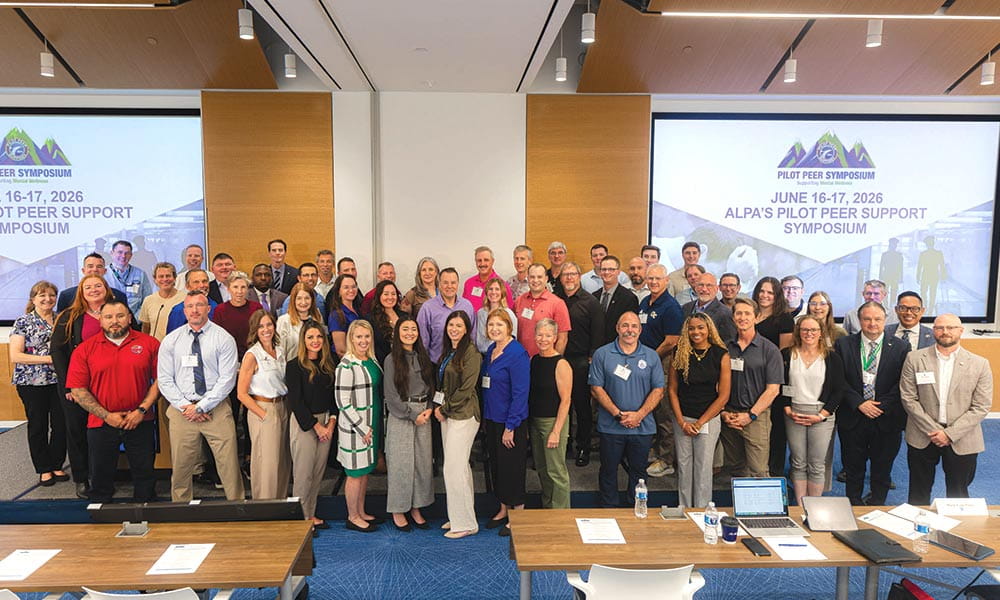
With legislation currently before Congress to break down barriers in dealing with pilot mental-health concerns, ALPA’s fourth annual Pilot Peer Support (PPS) Symposium couldn’t have been more timely. Conducted June 16–17 at the union’s McLean, Virginia, headquarters, the event brought together representatives from ALPA, the Allied Pilots Association, the International Brotherhood of Teamsters, the National Air Traffic Controllers Association, and the Southwest Airlines Pilots Association to discuss the important role peer support programs play in addressing mental-health issues in the aviation industry.

F/O Carrie Braun (JetBlue), the Association’s Air Safety Organization (ASO) PPS chair, moderated the two-day conference, which featured practitioners, government officials, and other subject-matter experts who commented on the current regulatory environments in the United States and Canada, efforts to expand and improve PPS usage, and the new and innovative ways to view and promote mental wellness. Braun was assisted by Capt. Elijah Nicolas (JetBlue), PPS vice chair, as well as other PPS volunteers.
In a virtual presentation, Capt. Wendy Morse, ALPA’s first vice president and national safety coordinator, thanked the many symposium attendees for their participation. “Most members will never see the countless phone calls, conversations, check-ins, and hours of volunteer effort you put in after a difficult event or during a personal crisis. But those efforts matter. They make a difference in people’s lives,” she asserted.
“ALPA remains committed to reducing barriers that discourage pilots from seeking help when they need it. We continue to support the Mental Health in Aviation Act and other initiatives that encourage aviation professionals to seek assistance without fear of unnecessary career consequences,” Morse added.
One of the union’s current Calls to Action urges airline pilots and their families to contact their senators to support the Mental Health in Aviation Act of 2025. Among the provisions, the bill would require the FAA administrator “to revise regulations for certain individuals carrying out aviation activities who disclose a mental health diagnosis or condition....”
ALPA has long been a leader in addressing pilots’ mental health, including establishing a confidential pilot peer support program available 24/7. ALPA also cochaired the FAA’s Mental Health & Aviation Medical Clearances Aviation Rulemaking Committee, which issued consensus recommendations in April 2024 to reduce barriers to care, improve the medical certification process, and strengthen aviation safety.
Packed Program: From Service Dogs to U.S. and Canadian Regulatory Trends
The Peer Support Symposium agenda featured a host of informative presentations and panel discussions, including a visit from Tiller and Vader, two of the trained dogs who worked with first responders following the PSA Flight 5342 accident in Washington, D.C., last year. Representatives from the Metropolitan Washington Airport Authority and the Virginia State Police talked about the 10 service dogs from Mutts with a Mission, including Tiller and Vader, who were dispatched to the rescue operation location to provide onsite “anxiety disruption.”
In another presentation, Dr. Susan Northrup, the FAA’s federal air surgeon, and Dr. Brendan Adams, ALPA Canada’s aeromedical consultant, spoke about regulatory trends in the United States and Canada. Northrup stated that the goal of her office is “to return individuals to flying or controlling as soon as it’s safe to do so in a manner that is timely, transparent, and consistent.” As part of this effort, she noted the new landing page for FAA MedXPress, which more expeditiously allows those requesting FAA medical clearance or medical certification to electronically complete their applications.
Northrup applauded the use of peer support programs, referencing a recent study in Europe in which 85 percent of those in the researched population who sought peer support didn’t require additional assistance.
Adams observed that in his country, civil aviation medical examiners (CAMEs) have remarkable discretion in evaluating pilot well-being. He referenced CAR 424.05, pointing out that CAMEs can grant medical certificates to applicants who don’t necessarily meet standard requirements, provided it’s in the public interest and won’t affect aviation safety. Adams noted that part of the intent of this flexibility is “to stop the ‘revolving door’ of medical documentation.”
In terms of mental-health issues, Adams highlighted “the big three” he’s witnessing—addiction/substance use disorders, mood disorders, and non-neurotypical attention deficit/hyperactivity disorders (ADHD). Like Northrup, he touted the use of peer support programs as an excellent and efficient way to triage those who need simple support versus others who may require professional attention.
Representatives of the Aeromedical Safety Coalition (ASC), stood up by the MITRE Corporation, provided an update on Sections 411 and 413 task group activities as outlined in the latest FAA reauthorization legislation. The ASC’s goal is to drive innovation in managing health-related aviation safety risks through information sharing and analysis, with the objective to create safer skies through a healthier aviation workforce.
Members of the coalition, including Capt. Travis Ludwig (United), ALPA’s Pilot Assistance Group chair, and Dr. Quay Snyder, the Association’s aeromedical advisor, together with representatives from Airlines for America and MITRE, discussed progress on Sections 411 and 413 and what they anticipate will appear in their final report to the FAA administrator next year.
In addition, attendees were briefed on the various disciplines of ALPA’s ASO Pilot Assistance Group and the role peer support can play in Safety Management Systems. They also heard a discussion about the five stages of the Association’s peer support escalation protocol. These include a clear crisis, a crisis ideation, a concern with the ambiguity of intent, a reluctancy on behalf of the caller to seek professional assistance, and the sufficiency of the support provided.
Clinically Speaking
Many symposium presentations dealt with the clinical and science-based aspects of mental wellness and the importance of peer resilience. Dr. Kirsten Peterson, an Olympic performance psychologist and high-performance expert, had conference attendees take a survey to determine how each reacts when faced with stress, challenge, failure, or big decisions. The intent of this exercise was to give participants a more objective sense of how they function.
Dr. William Hoffman, an aerospace neurologist and professor of aviation at the University of North Dakota, talked about the existence of white matter hyperintensities in the brain. Lesions can develop following continued exposure to high blood pressure, diabetes, a history of cardiovascular disease, sleep apnea, depression, high cholesterol, and/or obesity. These kinds of disorders and physical conditions can usually be avoided or controlled by pursuing a healthy lifestyle.
Dr. Daniel Danczyk, an aeromedical advisor and psychiatrist with the Aviation Medicine Advisory Service, also stressed the importance of preserving good health by eating right, routinely exercising, practicing relaxation techniques, getting fresh air and sufficient sleep, and regularly interacting socially with others. Both physicians used deidentified or hypothetical pilots to examine how healthy routines can support better brain function.
Krista Simmons, owner of Aileron Performance & Consulting, whose therapists, coaches, and support specialists work with pilots and other aviation professionals to help them better balance job demands with homelife, gave a presentation titled “Self-Care & Compassion Fatigue: Understanding, Preventing, and Managing Emotional Exhaustion.”
“You can’t create meaningful self-care until you know what you’re trying to preserve,” Simmons stated. She then put the attendees through a value-clarification activity designed to help individuals better understand their personal priorities and the concerns they view as nonnegotiable.
In addition, two optional workshops were provided at the conclusion of the formal program: “The Most Important Relationship High Performers Have,” offered by Peterson, followed by “Using Data and Storytelling in Peer Support Programs,” conducted by Hoffman.
Pilot to Pilot
“If an ALPA member calls Pilot Peer Support for assistance, the Association’s Engineering & Air Safety Department will place them in contact with an ALPA pilot peer who’ll listen and carefully assess their circumstances and needs, and, when appropriate, suggest resources available through the union,” said Braun. “PPS calls don’t need to be reported on a pilot’s medical certification application, and speaking with a peer is strictly confidential—except in the rare instances when an immediate risk of harm to the caller or others is apparent.
“The confidential peer-to-peer network lets pilots talk about what they’re experiencing openly and without fear of reprisals. A fellow ALPA pilot who understands the work environment and the challenges of flying for an airline will talk about the issues the caller is facing and help determine the best course of action.”
Pilot Peer Support Program
Specially trained pilot volunteers are here to help you deal with stress from any source. Learn more and connect with a peer today.

Featured Articles


