ALPA Members: A KCM outage is currently affecting many airports across the system. The provider is working to resolve the issue. Updates will be shared via email.

Article


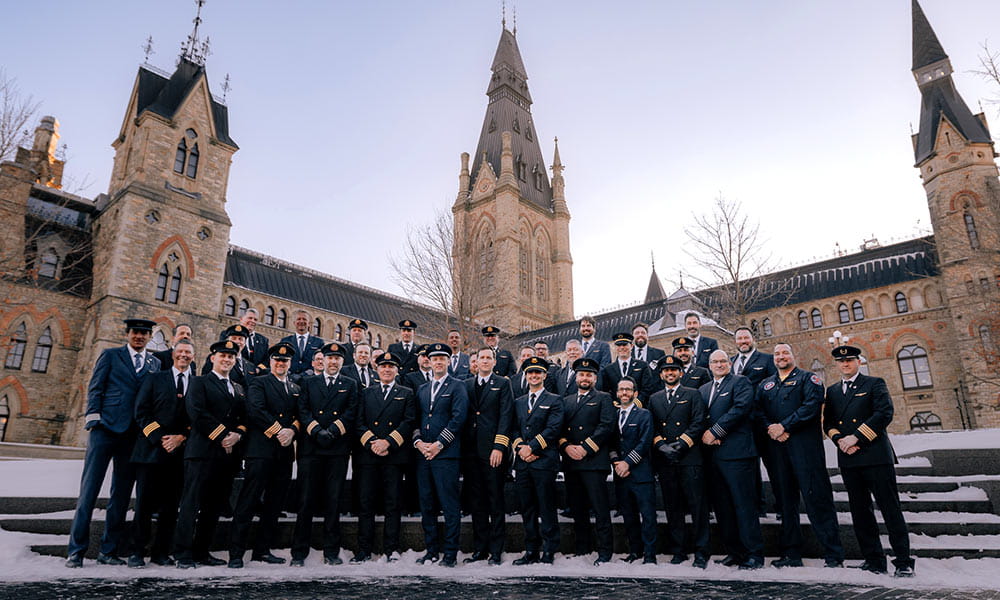
More than 40 members from 13 different ALPA pilot groups gathered on Parliament Hill in Ottawa, Ont., on December 2, 2025, to promote ALPA Canada’s pilot-partisan agenda and educate their elected members of Parliament (MPs) about issues related to safety and the exercise of fair representation. Airline pilots are uniquely qualified to provide feedback on the implications of air transportation policy because, in addition to their skills, training, and experience, they work at the epicenter of the airline industry.
As the culmination of ALPA Canada’s third annual Parliament Hill Day, the Association arranged more than 25 visits with senators and MPs whose constituencies include communities where many ALPA pilots live. These meetings focused on the importance of ensuring that the nation’s flight-time/duty-time (FT/DT) rules effectively manage flightcrew fatigue and call for an end to government interference in labour’s collective bargaining process.
Canada’s current airline FT/DT rules were introduced in 2018 and went into effect two or four years later, depending on the subpart of the regulations that applied. While this latest set of rules established stronger science-based standards, a provision within the regulations allows airlines under certain operational constraints to apply for adjusted limits using a Fatigue Risk Management System (FRMS). Transport Canada (TC) has consequently proposed an unfeasible option that fails to include proper FRMS considerations.
TC has introduced a plan to adjust the existing limits via a “global exemption.” With the necessary approvals, this approach would enable airlines to extend the amount of time a pilot can remain at the controls of an aircraft for up to a 14-hour flight-duty period. Equally concerning, this change would permit a 14-hour flight-duty period without any flight-time limits. By comparison, pilots in the United States are restricted to a maximum of nine hours of flight time.
Additionally, the maximum hours of work in a 28-day period could be increased from 192 to 210 and would permit pilots to be assigned up to 23 consecutive days on duty before having a day off.
In a public statement, Capt. Tim Perry, ALPA Canada president, said, “If adopted, we’d have more pilots fatigued, more often, and with worse fatigue symptoms—all to the detriment of air safety.” The Association continues to advocate for strong oversight and accountability to ensure fatigue-mitigation measures are effective and uphold the regulations’ original intent.
During one of Parliament Hill Day’s morning sessions, Capts. James Harding (Wasaya), Shane Neville (Cargojet), Jason Hartleb (Air Canada), Émile Lacourcière (Air Transat), and Michael Falk (Porter) met with Sen. Rodger Cuzner, who represents Nova Scotia. The pilots explained the significant effort that went into establishing the science-based rules and how they could easily be jeopardized. They also outlined the Association’s desire to work with government and other industry stakeholders to establish a more transparent policy approach to maintain the highest levels of safety.
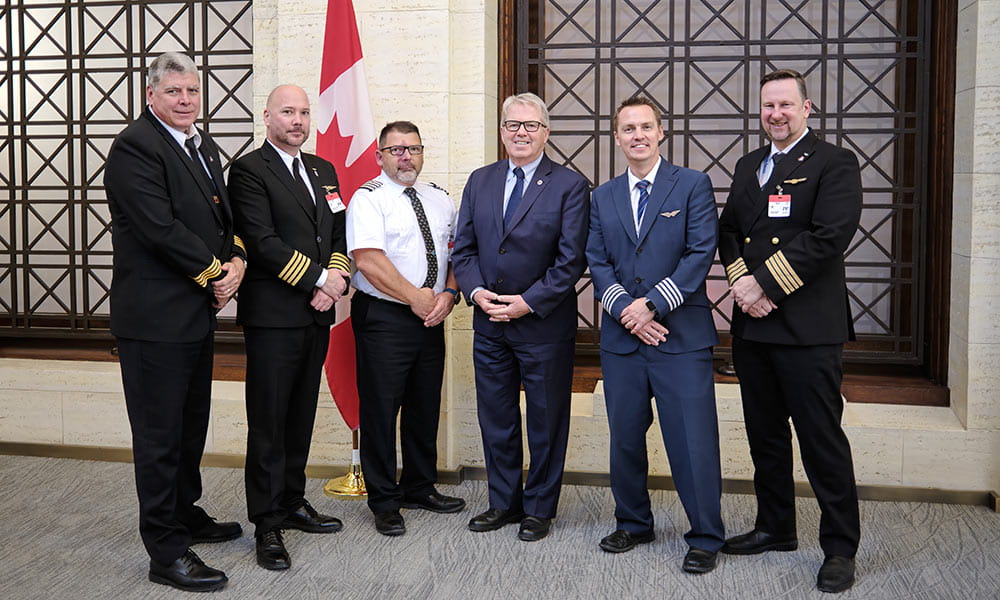
Later in the day, other pilots met with MP Madeline Chenette, representing Thérèse-De Blainville, Qué. Capt. Simon Robitaille (Air Transat), F/O Alexandre Dupuis (Air Transat), F/O Fred Poissant (Jazz Aviation), and Capt. Jean-Francois Perreault (Air Transat) spoke to Chenette about the recurring incidents of needless federal intervention in union contract negotiations.
The federal government has used Section 107 of the Canada Labour Code on numerous occasions to shortcut collective bargaining and impose binding arbitration. These decisions, while based on the code’s mandate to “maintain or secure industrial peace and promote conditions favourable to the settlement of industrial disputes or differences,” have increased tensions in labour relations, undermined the collective bargaining process, and opened the door to bad-faith bargaining.
One such example includes the 10,400 Air Canada flight attendants, represented by the Canadian Union of Public Employees. Following insufficient progress after eight months of collective bargaining in 2025, the group followed the legally outlined steps to declare a strike on August 16. Management responded, announcing a lockout, canceling flights, and calling on the federal government to intercede and require both parties to initiate arbitration.
In short order, Section 107 of the Canada Labour Code was invoked. Bargaining soon resumed, and a tentative agreement reached by the two negotiating teams was later rejected by the flight attendants. The parties are expected to begin arbitration shortly.
Speaking with Chenette, the pilots asserted that tools exist as part of the bargaining process to encourage both parties in negotiations to reach a fair collective agreement without external involvement. Knowing that the government will likely intervene gives management an unfair advantage, as it can use this anticipated interference to employ a strategy of delaying progress at the bargaining table. During 2024‒2025, Section 107 was invoked on at least eight occasions.
ALPA members respectfully urged the parliamentarian to support a measure to eliminate Section 107, and similar meetings between pilots and parliamentarians, addressing these same two concerns, were conducted throughout the day.
The day before the scheduled Parliament Hill visits, participating pilots gathered at an Ottawa hotel to get ready for their impending appointments. “There’s a Lot Riding on Our Wings” was the theme of this year’s visits, and ALPA Canada, working together with the Association’s Government Affairs Department, provided training to ensure the pilots were fully prepared. They heard presentations from key government leaders, received instruction on effective lobbying techniques, participated in simulations, and asked numerous questions.
Perry welcomed the group and outlined planned activities. He noted that approximately 13,500 ALPA members make up more than 95 percent of the professional airline pilots in Canada. “There’s power in our unity,” he remarked.
Liberal MP Peter Schiefke, who chairs the House of Commons Standing Committee on Transportation, Infrastructure, and Communities and represents Vaudreuil, Qué., addressed the pilots, outlining the work of the committee and the importance of his ongoing relationship with ALPA Canada.
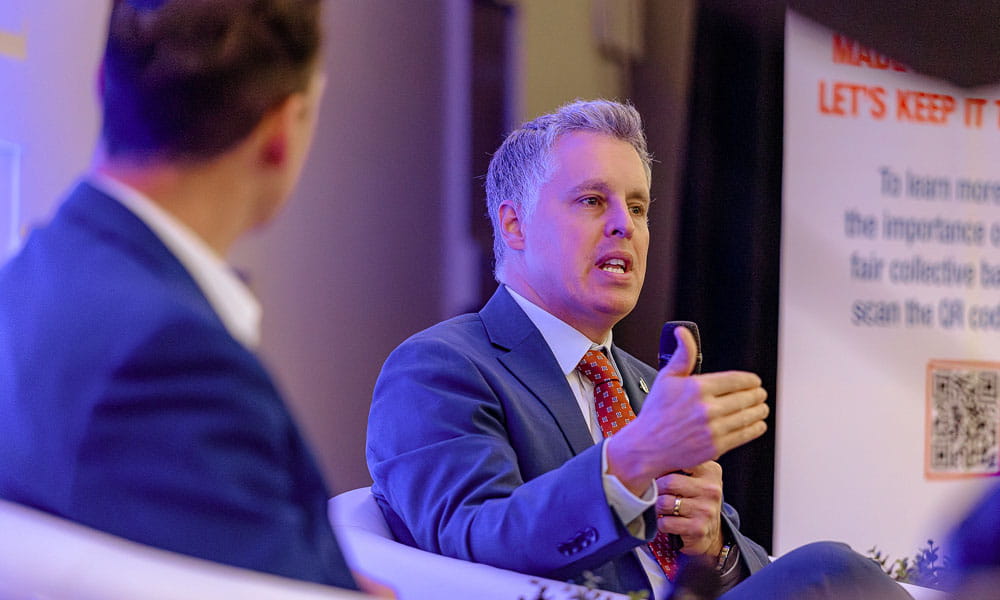
Later in the agenda, attendees sat in on a fireside chat, moderated by Perry, with Conservative Shadow Minister of Transport MP Dan Albas, who represents Okanagan Lake West-South Kelowna, B.C., and Conservative Shadow Minister of Labour MP Kyle Seeback, who represents Dufferin-Caledon, Ont. As members of the opposition party, the two MPs provided their perspectives on recent aviation and labour policy decisions.
Other segments included Marc Roy, Sandstone Group Public Affairs and Business Development vice president, and Sharon Cheung, ALPA’s Government Affairs manager, who shared best practices for engaging in effective lobbying efforts. “Your Parliament Hill experience doesn’t end in Ottawa—it’s fuel for recruiting next year’s advocates,” said Cheung. “Sharing it will inspire others to step up.”
Later during the session, Lacourcière, a member of ALPA Canada’s FT/DT Committee, explained how the current FT/DT rules work and why ALPA has concerns regarding potential abuse. In addition, Lana Payne, Unifor’s national president, discussed labour’s efforts in Canada to bolster collective bargaining and ensure fairness and equality in the negotiations process.
Immediately following ALPA’s lobbying efforts on December 2, ALPA Canada hosted a winter holiday reception for parliamentarians and other Ottawa insiders. Perry welcomed the many guests, including Minister of Transportation the Honourable Steven MacKinnon.
“As labour leaders, we must work for tangible results, both at the bargaining table and on the safety front,” Perry remarked. “That’s why today, we kept our focus on two of our most important issues. First, the safety-critical flight-time/duty-time regulations and ensuring that we respect the decades of consultation that went into them, that they remain rooted in science, and that they’re never eroded for commercial interests. Second, the need for labour groups to bargain freely with their employers until agreements are reached.”
Capt. Jason Ambrosi, ALPA’s president, also spoke during the reception, observing, “Rules and regulations must always support flight crews in their critical safety role. This is why it’s imperative that our government partners here in Ottawa continue to work with us to improve flight- and duty-time rules that use science-based data.” Regarding the Canadian government’s interference in the collective bargaining process, Ambrosi acknowledged, “Government intervention undermines the rights and voices of workers. The outcome is better when both sides feel pressure to remain at the table and bargain in good faith.”