The ALERT Act is not enough. Tell Congress to adopt ROTOR Act provisions before ALERT becomes law!

Article


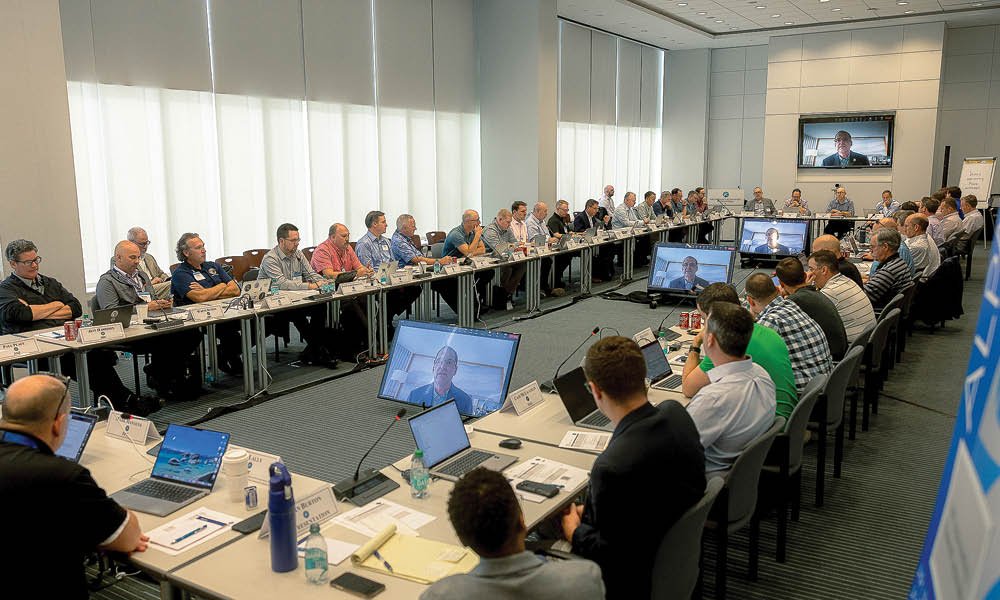
Nearly 50 pilot union volunteers from almost 20 airlines, including representatives from the Allied Pilots Association and the Southwest Airlines Pilots Association, took part in ALPA’s Industry Bargaining Roundtable on September 23–24 at the Association’s headquarters in McLean, Va. The annual event brings together pilot negotiators and other pilot leaders from across ALPA and the airline industry to share ideas and begin strategizing for the next round of contract negotiations.
“This is intended to be a frank and confidential environment that enables us to talk about what’s going on at our individual carriers, with the goal of building strategies and developing support networks to move the industry forward,” said Jeff Loesel, managing attorney of collective bargaining and dispute resolution in the Association’s Representation Department.
“As union members, it’s vital that we collaborate and coordinate to make the most of our contract negotiating efforts,” added Capt. Phil Otis (United), the union’s Collective Bargaining Committee chair, who together with Loesel shared moderator duties for the two-day conference. “Negotiators have the opportunity to network and develop relationships that can prove invaluable long after this roundtable has concluded,” he observed.
The meeting provided attendees the opportunity to brief the group on the status of their individual collective bargaining efforts, labor relations, or other emerging issues at their pilot groups. Some of the pilot negotiators and elected officers outlined preparations under way for upcoming contract negotiations while others discussed current contract talks, whether under the Railway Labor Act or Canada Labour Code. Those who recently completed the bargaining process remarked on the ease or difficulty they encountered during the implementation phase following recent negotiations or underscored the stages and dynamics involved when airlines merge. Presentations were given by pilots from Air Canada, Air Transport International, Alaska/Hawaiian, American, Amerijet International, Breeze, Delta, Frontier, Jazz Aviation, JetBlue, Ravn Alaska/New Pacific, Porter, PSA, Southwest, Sun Country, United, and WestJet.
Several of these briefings led to questions about the latest tools to increase pilot involvement, mediation, and approaches taken to engage sometimes intransigent management negotiating teams, prompting further conversation among roundtable participants.
Capt. Jason Ambrosi, ALPA’s president, who at the time was attending the International Civil Aviation Organization Assembly in Montréal, Qué., thanked the attendees for their efforts via video conference. “These roundtables are good examples of what makes ALPA powerful,” he said, adding, “By working together and breaking down barriers, we’re more effective.” Among the benefits already achieved through this kind of collaboration, Ambrosi cited the use of competitive snap-up clauses for pay rates as a means of sharing pilot group gains with industry peers.
In addition to pilot group briefings, participants received an economic overview of and forecast for the North American airline industry from Paul Karg, the Association’s Economic & Financial Analysis Department manager of bargaining analysis. He observed that the North American airline industry has fared better than most overseas markets, with profits estimated between $11 to $12 billion from 2024 and 2025. Karg added that while growth has eased this year, moving into 2026, much will depend upon gross domestic product performance, the effect of the tariffs the United States has imposed on other countries, and ongoing geopolitical concerns.
In addition, Dave Semanchik, senior managing attorney in ALPA’s Legal Department, gave a presentation on emerging issues in scope and job protections, particularly in the ways different airlines work together. He talked about the spectrum of airline partnership arrangements—from traditional interline agreements that address transport of distressed passengers to marketing provisions like code sharing and joint ventures—prompting an additional group discussion on how to analyze and address these new arrangements in pilot contracts.
To continue this discussion and the progress made at the conference, the Collective Bargaining Committee is tentatively planning to hold a joint Roundtable and Scope Summit next summer.
“We’re always looking for new opportunities to learn from each other and, when we can, to coordinate our efforts to make pilot collective bargaining stronger,” Loesel concluded. “Bringing everyone together under one roof, including pilot representatives from other unions, is a great way to accomplish this.”