The ALERT Act is not enough. Tell Congress to adopt ROTOR Act provisions before ALERT becomes law!

Article


It’s day 119 of a planned 120-day midterm negotiation between your pilot group and airline management. Only a handful of items remain on the table—but if a deal is to be made, it must be completed by the deadline.
This was the situation facing attendees of ALPA’s Negotiations Training Seminar, which took place November 3–6 at ALPA’s McLean, Va., offices. More than 60 pilot volunteers from 19 pilot groups took part—a record for this important event—including negotiators, master executive council officers (MEC), local executive council representatives, and experts from MEC Communications, Strategic Planning & Strike Preparedness (SPSC), Scheduling, Grievance, and Training Committees.
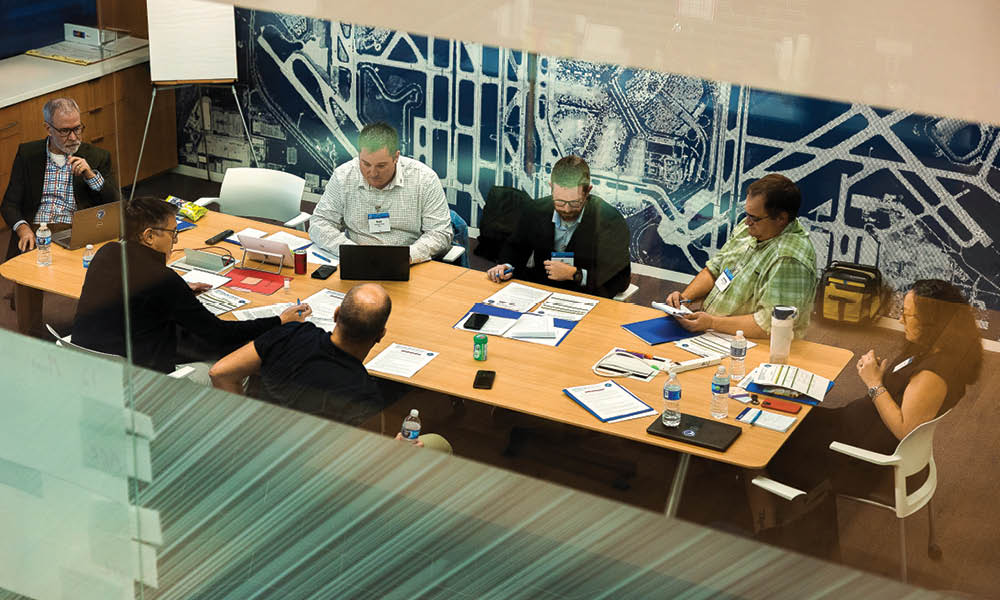
This simulation, designed to mimic actual scenarios that ALPA leaders and negotiators face, was the culmination of the four-day training and provided participants the opportunity to use the skills and knowledge gained during the seminar’s presentations and exercises in a controlled experience.
Capt. Jason Ambrosi, ALPA’s president, addressed the attendees, stressing the importance of coordination and collaboration. “When we work together, we’re stronger,” he asserted, noting that standing together in solidarity has helped move the needle for many ALPA pilot groups. But there’s still work to do—together. “Those of us who’ve been down that road before are always here to help,” he remarked.
Andrew Shostack, the director of ALPA’s Representation Department, encouraged participants to network with each other and make use of ALPA’s collective institutional knowledge. “What your group is currently experiencing,” he said, “another group already has gotten through.”
ALPA’s national committees—such as the Strategic Planning Committee, Collective Bargaining Committee, and SPSC—and staff support were also highlighted as resources available to all pilot groups, along with a review of the Association’s “Go Team” collaborative process among MECs, national committees, and staff.
Prior to the seminar, attendees used the ALPA Academy to review modules on the technical aspects of negotiations, which allowed the live training to take participants deeper into the planning and execution of a successful contract negotiation, ratification, and enforcement.
During the seminar, presentations from pilot and staff subject-matter experts were supported and supplemented by group exercises designed to help build necessary skills.
A presentation on strategic planning led to an exercise in which attendees discussed the necessary elements of the various plans required for a successful negotiation. Another presentation on communication strategies was supported by an exercise reviewing the ongoing elements of communication—between the Negotiating Committee and the MEC, among various committees, and, most importantly, with the pilots.
Participants learned about the various types of negotiations, the importance of preparation, and how to adapt when circumstances change. Panel discussions also included accounts from experienced negotiators, with real-life examples and advice about communications, establishing ongoing collaboration between the MEC and Negotiating Committee, how to know when the deal is done, and how to get the deal across the finish line and ratified.
Throughout the event, there was a strong emphasis on collaboration, communication, and planning—including the need to constantly review and evolve the plan when circumstances dictate. That work away from the table, said Jeff Loesel, managing attorney of collective bargaining and dispute resolution in the Association’s Representation Department, is of utmost importance.
“Only about 1 to 2 percent of the work in negotiating a contract actually happens at the table with management,” he explained. “It’s what you do the other 98 or 99 percent of the time that generates success.”
Pilots spent the final day and a half of the training in the bargaining simulation, testing their cumulative education from the previous two and a half days. After establishing a communications and negotiations plan, participants received guidance from their MECs, then met with management and passed a proposal.
They then had to determine the next steps based on variables introduced to the simulation—whether they return to their MEC for more guidance, adjust their proposal due to previously unknown data, or walk away from the table to explore an alternate path if a deal isn’t possible.
The seminar ended with a debrief of the negotiations, including feedback from facilitators and a discussion regarding the pilots’ bargaining experience.
Together, these presentations, exercises, and simulations—along with the opportunity to network with ALPA colleagues—provided participants valuable instruction and experience to ready them for the next bargaining opportunity, whatever form it may take.