


When the Call Comes for Aviation's Most Demanding Assignment
Air Safety Organization Course Prepares Investigators
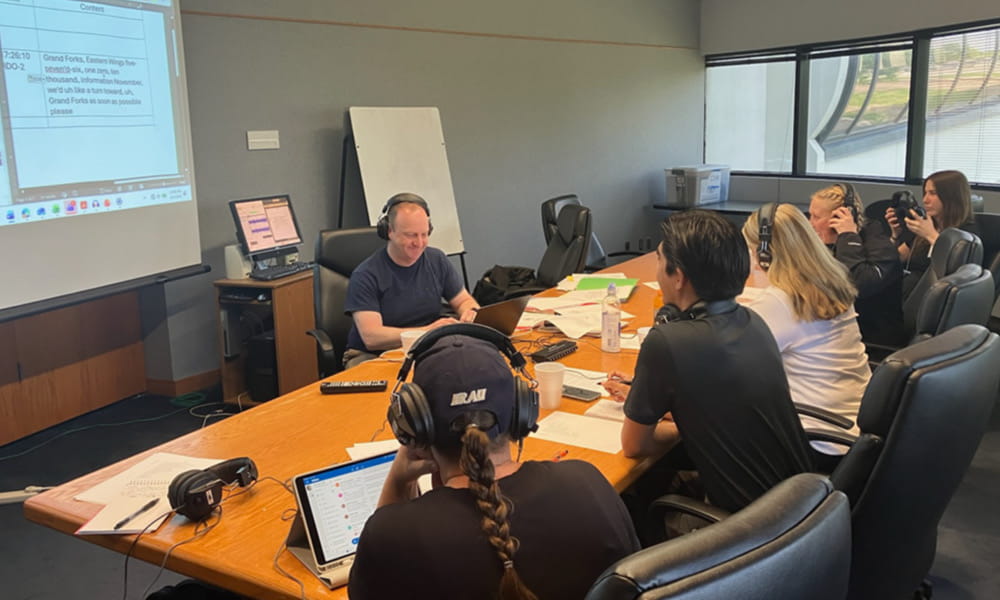
Seated around a conference table at the University of North Dakota (UND), accident investigators scribble notes during a phone interview as they question Capt. Hans Gruber, the veteran pilot of Eastern Wings Airlines Flight 576, a B-727-227 that’s recently experienced a runway excursion while landing at Grand Forks International Airport. Some of their questions probe aircraft systems. Others explore crew resource management, weather, fatigue, and flight deck communication. Every answer raises new questions.
But the interview is a training exercise, and the man on the phone is a former course instructor. He’s portraying Gruber, complete with a convincing German accent, in a realistic training exercise designed to give course participants hands-on experience in accident investigation interview techniques. The training also provides practical experience in accident response, on-scene investigative methods, and what to expect when participating in U.S. NTSB and Transportation Safety Board (TSB) of Canada investigations.
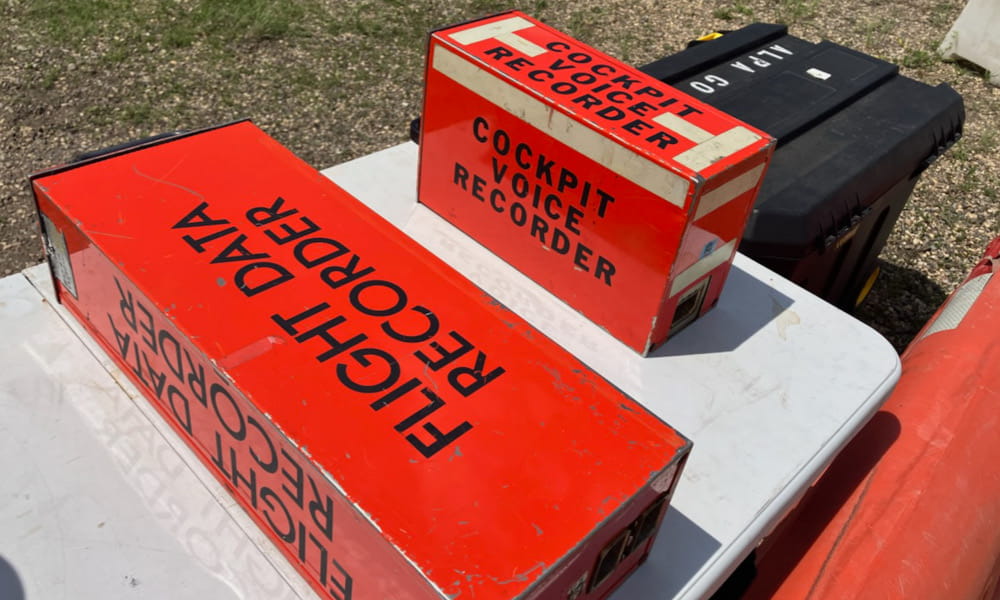
By the end of the week, participants will have interviewed crewmembers, documented aircraft damage, examined systems, transcribed cockpit voice recorder (CVR) audio, and reconstructed events from physical evidence. They’ll also have participated in investigative progress meetings. None of them knows the probable cause of the simulated accident. Just like a real investigation, that answer remains elusive—and that’s by design.
“When you’re teaching accident investigation, you’re not teaching people to solve a mystery,” said Capt. Chris Duggan (Air Canada), the course director who served as investigator-in-charge for the simulated accident. “You’re teaching them how to gather facts, work as part of a team, and contribute professionally to an investigation whose purpose is improving aviation safety.”
Duggan traces his own involvement in the course to August 2011, when First Air Flight 6560 crashed during approach to Resolute Bay, Nunavut.
“I was amazed at who showed up,” Duggan remarked. “People came from all across ALPA. It didn’t matter that we worked for different airlines. We were all professional pilots supporting each other.” Among those volunteers were ALPA-trained investigators as well as members of the Association’s Critical Incident Response Program, who quietly supported crewmembers and employees coping with tragedy. “I was so impressed with all these people who left their families and rearranged their lives to come and help us,” said Duggan. “Teaching this course is my way of giving back.”
Instructors Bring Decades of Real Experience
That same sense of service is evident throughout the cadre of instructors who oversaw the most recent course, which took place June 8–11 in Grand Forks, N.D. Some first attended the training as students decades ago. Others arrived after participating in major accident investigations. Collectively, they’ve worked alongside investigators from the NTSB and the TSB on many of the most significant airline accidents of the past two decades. Their experience spans a range of expertise, including aircraft operations, aircraft systems, structures, powerplants, and CVRs, as well as being a party coordinator or observer.
“We’re constantly evolving the course,” explained Capt. Jeff Mee (United), an instructor who’s also a member of ALPA’s Accident Investigation Board. He served as chair of the CVR Group during training, helping participants better understand the painstaking work required to accurately transcribe CVR audio and analyze information obtained from the flight data recorder.
“Everything we learn from real investigations comes back here,” Mee observed. “We’ve taken everything we’ve experienced in the field and built it into the scenario. Then we continue to tweak it as we learn more.”
An Immersive Exercise
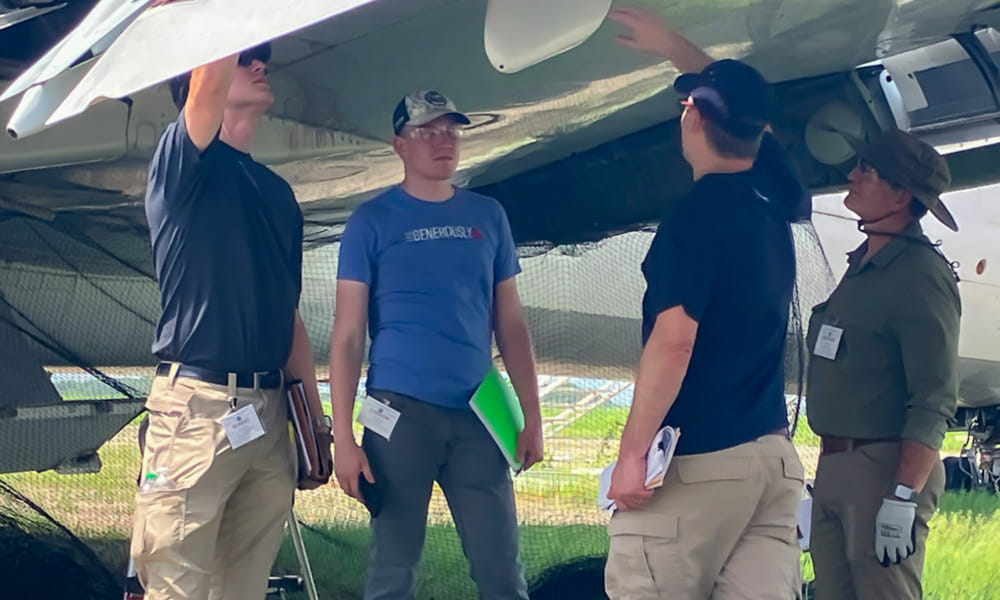
The June training brought together 16 participants representing eight ALPA pilot groups, aviation safety representatives from Boeing and United Airlines, investigators from the TSB, and students from the UND’s aviation program. Working together, participants gained practical experience in the same procedures and investigative groups used during major airline accident investigations, including Operations, Systems, CVR, Flight Data Recorder, Structures, and Powerplants.
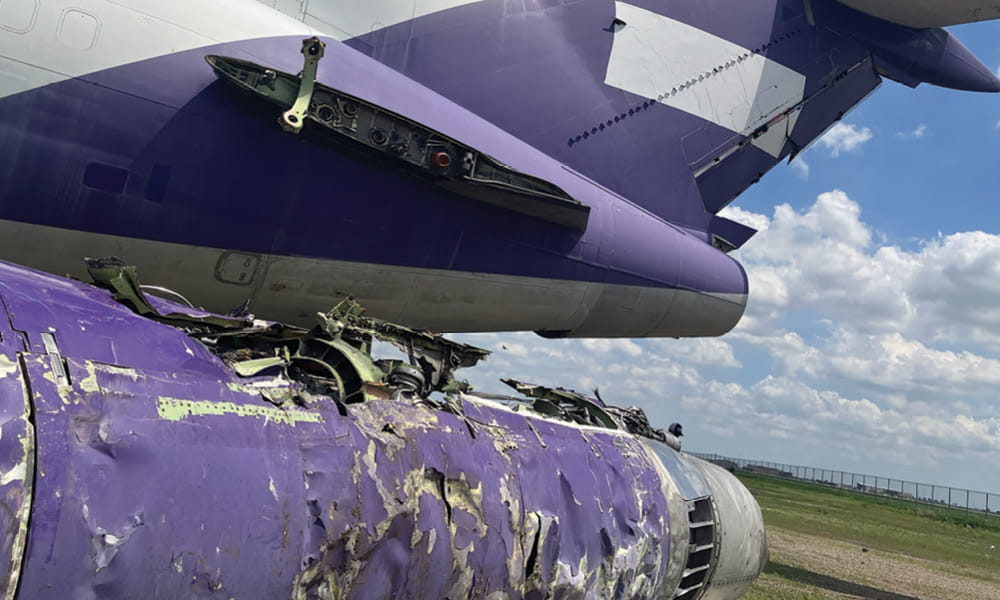
Course participants worked from a detailed scenario built around the fictitious Eastern Wings Airlines accident and a full-scale training aircraft located at Grand Forks International Airport, a retired B-727 donated by FedEx Express. They documented wreckage, recovered simulated evidence, examined aircraft systems, interviewed witnesses, reviewed maintenance records, analyzed weather information, and listened to audio of a mock CVR. Even the smallest details were intentional to provide the most realistic learning experience possible.
Among the latest course enhancements are two Pratt & Whitney JT8D engines recently acquired by ALPA and positioned at the simulated accident site. Separated from the aircraft’s tail section, the engines require participants to document, examine, and correlate evidence spread across the accident scene, adding another layer of realism and complexity to the investigation. Capt. Ryan Greene (Frontier) led participants through the examination of the engines and documentation of damage. The powerplant module is an evolving aspect of the course.
Throughout the week, Chris Heck, manager of Engineering & Investigations in the union’s Engineering & Air Safety (E&AS) Department, served as the ALPA party coordinator, quietly helping to orchestrate the investigation behind the scenes. The course instructors and E&AS staff, veterans of numerous NTSB investigations, meticulously ensured that each exercise reflects the realities of an actual field investigation.
During the CVR exercise, participants heard Gruber briefly revert to his native German during a moment of high workload. Later, during the interview, investigators explored whether a language barrier had influenced flight deck communication as the accident occurred. This was just one aspect of the scenario intended to encourage participants to think like investigators and consider all factors that might have contributed to the accident.
“I was blown away by the attention to detail in this course and the focus on creating a real-life accident investigation,” stated F/O Chantal Dienstbier (WestJet). As a Canadian pilot, Dienstbier appreciated the opportunity to interact with TSB investigators. “There are significant differences in the way that accident investigations are conducted in the United States and how they’re done in Canada, especially relating to privacy laws,” Dienstbier said. “It helps to understand those differences.”
The Course’s Reputation and Reach
The TSB’s participation reflects the course’s growing reputation. Originally attended primarily by ALPA members and UND students, it now regularly attracts participants from government agencies, aircraft manufacturers, airlines, investigative agencies, and pilot organizations around the world through ALPA’s relationship with the International Federation of Air Line Pilots’ Associations.
“No two investigations are the same,” said Capt. Stacey Jackson (WestJet), ALPA’s Air Safety Organization’s Training Programs coordinator. She served alongside Adam Huray, an ALPA senior staff engineer and former NTSB investigator, as cochair of the Systems Group during the course. “It all depends on the investigator-in-charge, the group chairs, the size of the investigation, and the people involved,” Jackson noted. “The goal isn’t simply to teach a process. It’s also to teach our folks how to adapt because every investigation unfolds differently.”
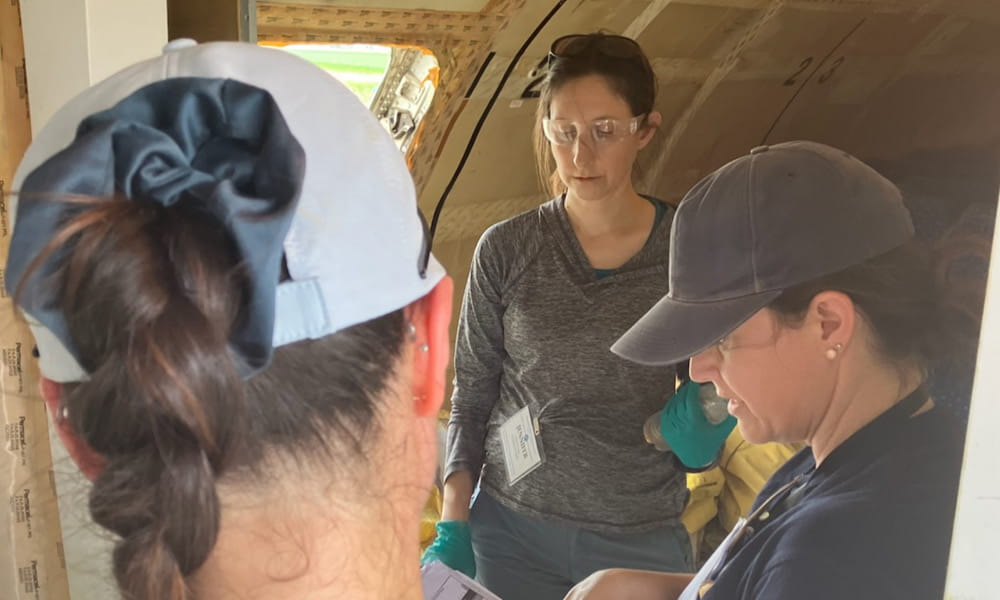
F/O Kate Benhoff (United), who served as cochair for the Operations Group during the mock investigation, brought a unique perspective to the course after having spent four years working as an investigator with the NTSB before joining United.
“I know how investigations work from the NTSB side,” she said. “It’s really beneficial to be able to bring those real-world experiences into the classroom and show participants how the board works and how ALPA fits into that process.”
Benhoff said she was struck by how closely the course mirrored the investigations she’d worked. “It was easy to step into teaching because it was exactly what I had been doing.”
F/O Mike Wickboldt (United), ALPA’s Accident Investigation Board chair, who cochaired the Operations Group with Benhoff, said the realism and hands-on aspects of the course are particularly beneficial. “We want our volunteers to be valued by the investigative agency when they arrive,” he observed. “People who’ve gone through this course often come back after a real investigation and tell us how similar it was.” That validation continues to reinforce the instructors’ commitment to improving the course.
Building Confidence in New Areas of Expertise
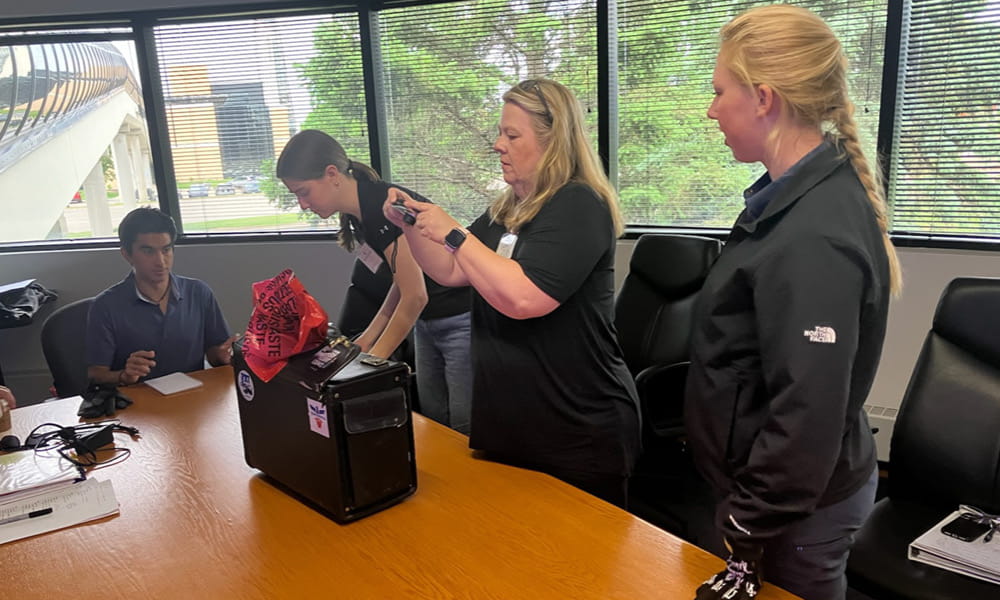
Some of the participants said their experience in Grand Forks changed the way they viewed accident investigation. Several admitted that before arriving, they couldn’t imagine serving on a Systems or Structures Group. By the end of the week, they felt confident that they could contribute productively if they were called to serve in that role.
“When you’re out at an accident site and you look around, it can be a little overwhelming,” said Capt. Mike Palazzolo (PSA), a course participant who responded as an ALPA investigator for the January 2025 PSA Flight 5342 accident near Washington, D.C. “You think, ‘Who trusted me to come out here and do this?’ But you already have credibility when you show up at the accident site because of the quality of the training you’ve received and the work ALPA’s investigators have done behind the scenes to build trust with the NTSB. It’s because of guys like Chris Heck and the other folks here who have developed those relationships.”
Palazzolo recalled another investigator on the Flight 5342 response who had previously attended the Advanced Accident Investigation Course. “He said the attention to detail was so accurate that the actual investigation felt very much like what he’d experienced here in Grand Forks.”
Farewell to Retiring Instructor F/O Don Sterling
This recent training also marked the final course as an instructor for F/O Don Sterling (United), who’s retiring in August. Looking back, Sterling, who cochaired the Structures Group along with Greene, said the course’s greatest strength has always been the people associated with it. He describes the instructor cadre as “one of the largest concentrations of accident investigation expertise outside organizations like the NTSB.
“The course participants leave here understanding how important ALPA’s relationships with the investigatory authorities are,” Sterling remarked. “Those relationships have been built over decades. They also leave here with credibility. They know how to conduct themselves professionally and represent ALPA at an accident scene.”
Newly Certified Investigators Ready for Duty
At the end of the week, participants departed Grand Forks with certificates in hand and greater knowledge of how aircraft accident investigations are conducted. But the course instructors know they’re taking away something much more important. They know that one day if the phone rings and one of these volunteers must take the call that no one ever wants to take—another tragedy, somebody’s worst day—they’ll grab a go-bag and head for the door. And by the time they arrive at the accident scene, the lessons they learned in Grand Forks, and the decades of experience passed from one generation of investigators to the next, will have already prepared them for the work ahead.
“Our goal is to give ALPA’s volunteer investigators confidence,” said Wickboldt. “Not because they’ll know everything—they won’t—but because they’ll know how to contribute.”
The union’s accident investigation instructors offer this advanced course twice a year. The next course is scheduled for October 19–22.
Explore Training Opportunities
The ALPA Air Safety Organization provides comprehensive year-round training courses to help pilots and aviation professionals stay ahead in safety practices and regulatory standards.

Featured Articles


