


Rough Air: New Technology Helps Pilots Better Predict and Manage Turbulence
On December 18, 2022, Hawaiian Airlines Flight 35, an Airbus A330-200, made headlines when the flight crew encountered a severe turbulence event right before its descent into Honolulu, Hawaii. In addition to the captain and first officer, eight flight attendants and 283 passengers were on board, four of whom sustained serious injuries and 20 sustained minor injuries.
Hawaiian Flight 35 is among several turbulence encounters that have captured public attention through news headlines and social media, prompting broader conversations and questions about the unpredictable nature of rough air and decisions pilots must routinely make in rapidly evolving weather. It also remains one of aviation’s most persistent operational hazards and a continuing source of in-flight injuries to passengers and crewmembers. National Transportation Safety Board data shows that turbulence is the leading cause of accidents for airline operations.
Efforts to reduce turbulence-related injuries have long been a focus for ALPA. In 1981, the FAA approved a regulation requiring illuminated “Fasten Seatbelt” signs in passenger aircraft cabins following years of advocacy by the Association. The effort was driven in large part by Capt. Ray Lahr (United, ret.), a 1975 recipient of ALPA’s Air Safety Award, who spent eight years pushing for the change after a passenger aboard one of his flights was seriously injured during a turbulence encounter.
“Turbulence is something pilots manage every day,” says Capt. Jason Ambrosi, the Association’s president. “We receive training on strategies to avoid and mitigate it, and our airplanes are built to withstand it. The key is preparation—using the best available information to anticipate conditions and reduce risk before turbulence becomes a problem.”
It’s important to note that modern aircraft are designed to withstand forces far greater than most passengers realize. The risk that turbulence poses is typically not to the aircraft itself, but to the people inside it, particularly when turbulence occurs unexpectedly or before passengers and cabin crew have had an opportunity to secure themselves.
Reports and Data
For decades, turbulence awareness depended largely on one of aviation’s oldest forms of information sharing: pilot reports (PIREPs). Whenever pilots encountered turbulence, they relayed information about altitude, location, and severity to air traffic control, making it possible for other crews to adjust routing or altitude to find smoother air.
PIREPs remain an important tool today. But they also have significant limitations. PIREPs are inherently subjective. What feels like moderate turbulence in one aircraft may feel considerably different in another. Aircraft size, weight, and design all influence how those conditions are experienced. Timing can also limit usefulness. Atmospheric conditions evolve rapidly, so reports can become outdated within minutes.
Capt. Christian Amaral (United), an aviation weather expert within ALPA’s Air Traffic Services Group, notes that the aviation industry has spent decades working to improve turbulence reporting.
“There weren’t always a lot of pilots reporting, and the information could be very subjective,” Amaral points out. But that began to change as aircraft systems evolved.
Today, many airlines rely increasingly on automated turbulence reporting that gathers information directly from aircraft in flight and translates it into objective measurements. One important advancement is the Eddy Dissipation Rate (EDR), which is an internationally recognized standard through the International Civil Aviation Organization’s standards and recommended practices. Unlike traditional descriptors that might categorize turbulence as light, moderate, or severe, EDR attempts to measure the actual disturbance occurring in the atmosphere itself rather than simply how turbulence feels inside an aircraft. The result is a universal language for turbulence, which is objective, aircraft-independent, and increasingly shared across the industry.
What Lies Ahead
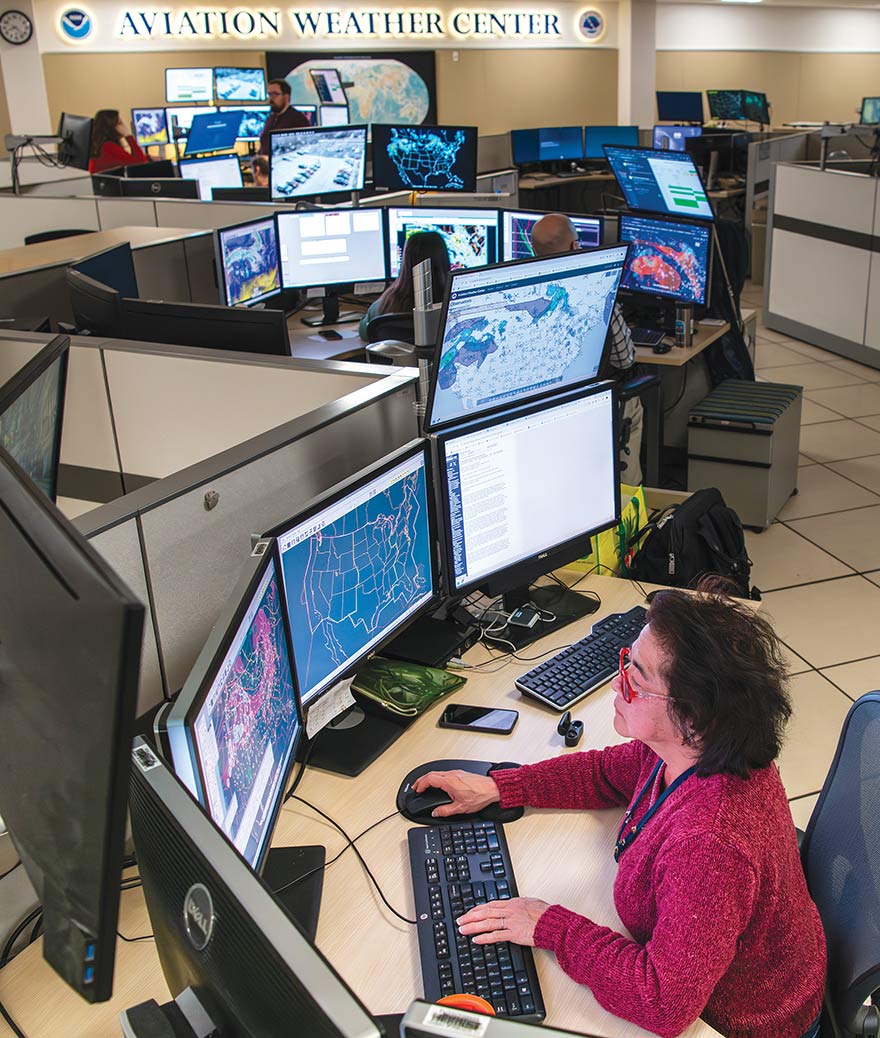
Knowing where rough air has already occurred is only part of the challenge. Pilots also need to identify what may lie ahead, and that need has driven major improvements in airborne weather radar. Earlier generations of airborne radar systems required considerable skill and experience to interpret effectively. Newer, more sophisticated airborne weather radars use advanced algorithms to assess turbulence hazards associated with thunderstorms and convective activity, helping crews to evaluate weather earlier and to make better decisions regarding deviations, altitude changes, and cabin preparation. However, access to this technology remains inconsistent.
At some airlines, pilots can access near real-time turbulence information through Internet-connected flight decks, electronic flight bags, and sophisticated weather applications that combine aircraft-generated reports with predictive weather information. Many of these tools aggregate turbulence data from multiple aircraft and display near real-time conditions across wide areas of airspace, helping crews identify smoother routes or altitudes before encountering rough air.
“Technology has improved dramatically over the past several decades,” observes Amaral. “Pilots today have access to tools that help identify areas of potential turbulence and improve situational awareness.”
A Varied Landscape
Access to these tools, however, varies widely across the industry. Radar technology on older aircraft is rarely updated so that some pilots operate with far less turbulence awareness than crews on newer equipment. Some carriers or aircraft continue to operate without flight deck Internet connectivity, or with inoperative WiFi, limiting pilots’ ability to receive real-time turbulence data after departing the gate. In those environments, crews rely more heavily on dispatcher communications, onboard radar, and information exchanged over air traffic control frequencies.
Additionally, many automated turbulence reporting systems remain proprietary, requiring airlines to subscribe to specific platforms to benefit from the data. Researchers and aviation weather experts are increasingly exploring whether automatic dependent surveillance-broadcast (ADS-B) surveillance data could eventually provide broader access to turbulence reporting.
ADS-B continuously transmits information about an aircraft’s position, speed, and movement. By analyzing subtle changes in an aircraft’s motion, researchers can derive an estimate of how much the atmosphere is disturbing the airplane and translate that into an EDR measurement. While the concept continues to evolve, the potential is significant because ADS-B data is already widely available, making it possible to provide a much larger and more accessible picture of turbulence conditions in near real time.
The benefits of better turbulence awareness have certainly helped to improve safety, but they extend beyond that. Improved atmospheric mapping also helps crews to avoid unnecessary deviations, reduce fuel burn and emissions, and improve operational predictability.
Emerging Research and Evolving Threats
Despite rapid advances in turbulence reporting and sensing, significant challenges remain. Rapidly developing thunderstorms can produce severe turbulence with little warning. Clear-air turbulence, one of aviation’s most difficult hazards, often develops without visible moisture or radar returns, leaving crews with few advance indicators.
Researchers are exploring new ways to address these gaps. MITRE is studying the use of Light Detection and Ranging (LIDAR), which uses lasers to identify movement in tiny airborne particles invisible to traditional radar systems. The goal is to improve pilots’ ability to identify turbulence before they encounter it. The FAA’s Aviation Weather Research Program supports efforts aimed at transitioning weather research into operational tools pilots can use.
Researchers also continue to study whether changes in atmospheric conditions may be influencing turbulence patterns over time. Some studies suggest certain forms of turbulence, like mountain-wave turbulence, may become more frequent as the atmosphere warms.
Technology Assisting Two Pilots on the Flight Deck
“Even objective data can be highly perishable,” Amaral says, noting how quickly turbulence information becomes outdated. And that’s why technology can only supplement a pilot’s judgment; it doesn’t replace it. Pilots must still interpret weather conditions, understand the atmospheric forces driving turbulence, and determine which information remains operationally relevant.
Pilots may not always be able to avoid rough air entirely. But better sensing, better reporting, improved forecasting, and improved operational awareness help crews prepare, reduce risk, and improve outcomes when turbulence occurs.
“Pilots do everything possible to avoid significant turbulence in the first place,” Ambrosi observed. “But when it can’t be avoided, training, preparation, and good information help us manage the risk and ensure the safest possible outcome.”
Featured Articles


