


First-Ever ALPA Scope Summit Puts Focus on Important Aspect of Every Contract
Scope Is Number 1
“There’s a reason scope is Section 1 of our contracts,” said Capt. Jason Ambrosi, ALPA president, in highlighting the significance of the union’s first-ever Scope Summit on June 25 in McLean, Virginia. “If you don’t have job protections, the rest of it isn’t worth a thing.”
That reason is what brought together more than 60 pilots from 14 pilot groups—along with representatives from the Allied Pilots Association and the Southwest Airlines Pilots Association—for the event, in addition to two dozen staff experts from ALPA’s Representation, Legal, and Economic & Financial Analysis departments.
As the airline industry has evolved, scope has become increasingly significant in every collective bargaining agreement (see “What Is Scope and Why Is It Important?). The summit shined a spotlight on the subject and provided a platform for sharing and learning from successes throughout the Association.
“We don’t expect to solve everything today,” said Capt. Phil Otis (United), ALPA Collective Bargaining Committee chair, “but we can start building those relationships with other subject-matter experts that will help us in the future.”
The Scope Summit
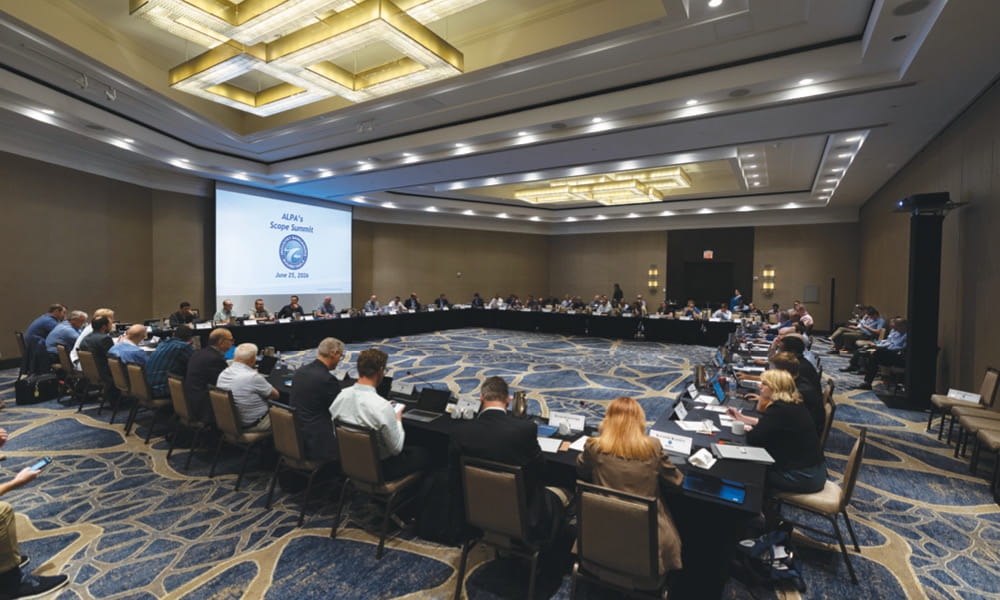
Attendees received an overview of commercial relationships among airlines, then shared updates from their properties and discussed potential new avenues to protect pilots through their individual collective bargaining agreements.
Consistent themes included the importance of negotiating data and information sharing with airlines, the benefit of including defined terms in the contract to create a shared understanding, and ensuring scope provisions keep pace with the dynamic changes in technology and regulations that have fostered industry evolution.
Participants also discussed the value of educating their pilot groups about scope and helping them understand why scope and job protections require attention during each round of bargaining.
Attendees shared past successes to help pilot groups that may face similar issues, as well as current concerns and how to address them. In addition, they examined potential future areas of focus, such as eVTOL flying, cargo protections, and the continued evolution in airline partnerships.
Andrew Shostack, director of ALPA’s Representation Department, closed the Scope Summit by underscoring the importance of continuing to share information and build on each other’s successes. “It’s critical that we collaborate,” he stressed. “The more we coordinate, the stronger the profession will be.”
What Is Scope and Why Is It Important?
A scope clause is the language in Section 1 of your contract that defines and protects the work of the pilot group. Section 40 of ALPA’s Administrative Manual directs negotiators to make “every reasonable effort…to incorporate” scope language. Scope clauses are critical because they protect work of the pilot group from being outsourced or shifted to others to the detriment of the pilots’ jobs and careers.
Essentially, a scope clause identifies who performs the flying for your company versus other airlines that operate under your airline’s brand or with whom your company has a partnership or arrangement. Initially, scope clauses were simple, stating that all revenue flying was to be done by the company’s seniority-list pilots. But they’ve evolved tremendously as ownership structures, cooperative arrangements, and transactions have grown more complex. For example, pilot groups have also negotiated scope language to address the threat of corporate shell games so that a company can’t “swoop” in to create and shift flying to a new low-cost alter-ego airline under the same corporate umbrella. Scope language can protect you against that. Scope clauses typically include protections in the event of an acquisition, merger, or other transaction. Scope clauses now apply commonly to alliances, code shares, or mainline-regional partnerships, among others, and can protect desirable (and valuable) international flying from being taken over by foreign airlines.
More important is what the language in Section 1 of your contract does: it protects your job and career by ensuring that the airline’s flying belongs to the pilot group. This doesn’t guarantee that your airline won’t try to find new loopholes, but scope clauses can protect you by providing the opportunity to file a grievance over the company’s business decision or require the company to negotiate with your pilot group over the decision’s ramifications. Scope provisions also commonly include expedited enforcement mechanisms to ensure that remedies for violations are quickly available.
The stronger the scope language in your contract, the stronger the protection you have for the flying you do. This is what makes the scope clause an important part of your contract and maintaining or strengthening it a top priority for every pilot group’s master executive council and Negotiating Committee.
We Secure Stronger Contracts
The Collective Bargaining Committee equips ALPA pilot groups with the training, resources, and strategies needed to negotiate industry-leading contracts.

Featured Articles


