ALPA Members: A KCM outage is currently affecting many airports across the system. The provider is working to resolve the issue. Updates will be shared via email.

Article


On January 27, the National Transportation Safety Board (NTSB) convened a public board meeting to finalize its investigation into the January 29, 2025, midair collision involving PSA Flight 5342, a Bombardier CRJ700 on approach to Runway 33 at Washington National Airport (DCA), and a U.S. Army Sikorsky UH-60 Black Hawk helicopter. The collision occurred at night about a half mile southeast of the airport. All 67 people aboard the two aircraft perished.
The board meeting, which occurred just days before the one-year anniversary of the accident, marked the culmination of one of the most complex investigations in NTSB history. The agency formed 13 investigative groups, including aircraft systems, air traffic control, operational factors, and human performance. The board examined helicopter route design and the effectiveness of safety management systems across multiple organizations. As a party to the investigation, ALPA provided line-pilot expertise, especially to operational and human performance groups, to support the NTSB's fact-finding work.
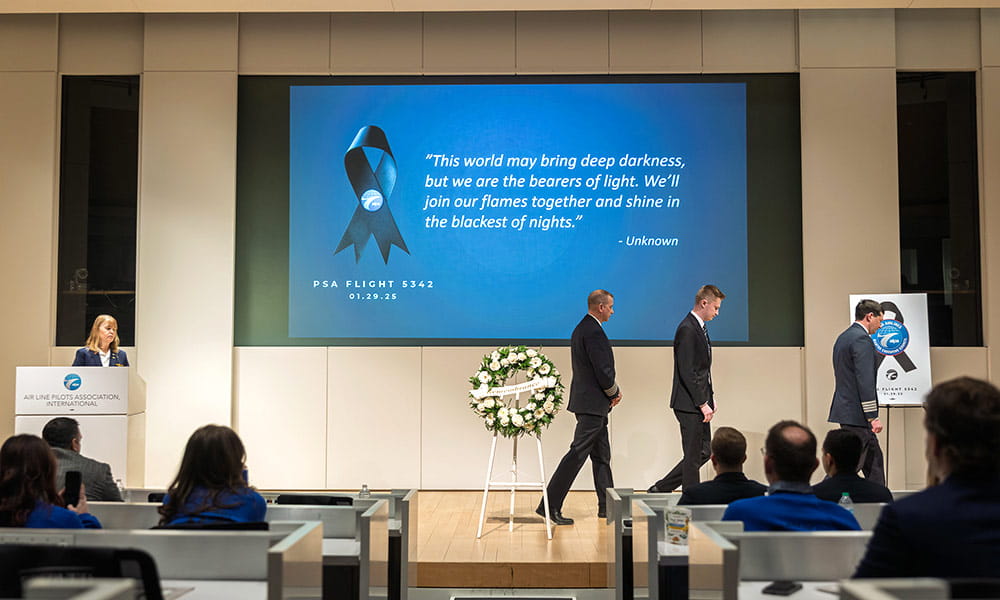
“For those of us who fly for a living, the anniversary of the deadly midair collision between a military helicopter and a commercial airliner near Washington National Airport isn’t an abstract memory—it’s a somber reminder that we must always do more to advance safety,” said Capt. Jason Ambrosi, ALPA’s president, on the one-year anniversary of the accident.
That sentiment was echoed in remarks by Capt. Wendy Morse, the Association’s first vice president and national safety coordinator, during a remembrance ceremony for the crew of Flight 5342 held at ALPA’s headquarters. Morse, who coordinated ALPA’s response to the accident, underscored the imperative to pair reflection with reform.
“This tragedy exposed gaps in a system meant to protect lives,” said Morse. “It reminded us that the work of aviation safety is never finished. Every accident shows us where we must be better. And every lesson learned carries a responsibility to act. For the families, for our fallen colleagues, and for every pilot who places their trust in this system each time they step onto the flight deck—complacency isn’t an option.”
After extensive documentation into the conditions and circumstances involved, the NTSB identified the FAA helicopter route design and oversight as causal factors. Specifically, the agency cited the placement of a helicopter route in close proximity to a runway approach path, the failure to regularly review and evaluate helicopter routes and available data, and the failure to act on prior recommendations to mitigate known midair collision risk near DCA. Overreliance on visual separation was also a causal factor.
At the time of the accident, the tower had combined the local control and helicopter control positions into a single air traffic controller. Investigators determined that the decision to do so increased workload and degraded situational awareness. As traffic volume increased in the minutes before the collision, critical tasks competed for attention. The board concluded that the combined positions should have been separated given traffic volume and complexity.
DCA’s complex operating environments, which include a dense mix of varying types of aircraft, coupled with constrained airspace and long-standing practices intended to maximize airspace capacity, were additional factors that, over time, led to a reliance on pilot-applied visual separation, particularly between helicopters and fixed-wing aircraft.
Degraded radio reception, blocked transmissions, ambiguous nighttime visual cues, and the absence of additional positional information were also contributing factors. Compounding the problem, allowable tolerances in the helicopter’s pitot-static/altimeter system likely resulted in the crewmembers observing an altitude approximately 100 feet lower than true altitude, leading them to believe they were below the published maximum altitude for their route of flight.
“This was 100 percent preventable,” stated Jennifer Homendy, NTSB chairwoman. “We’ve issued recommendations in the past that were applicable here. We’ve talked about ‘see and avoid’ for well over five decades. It’s shameful. I don’t want to be here years from now with other families who’ve had to suffer such a devastating loss.”
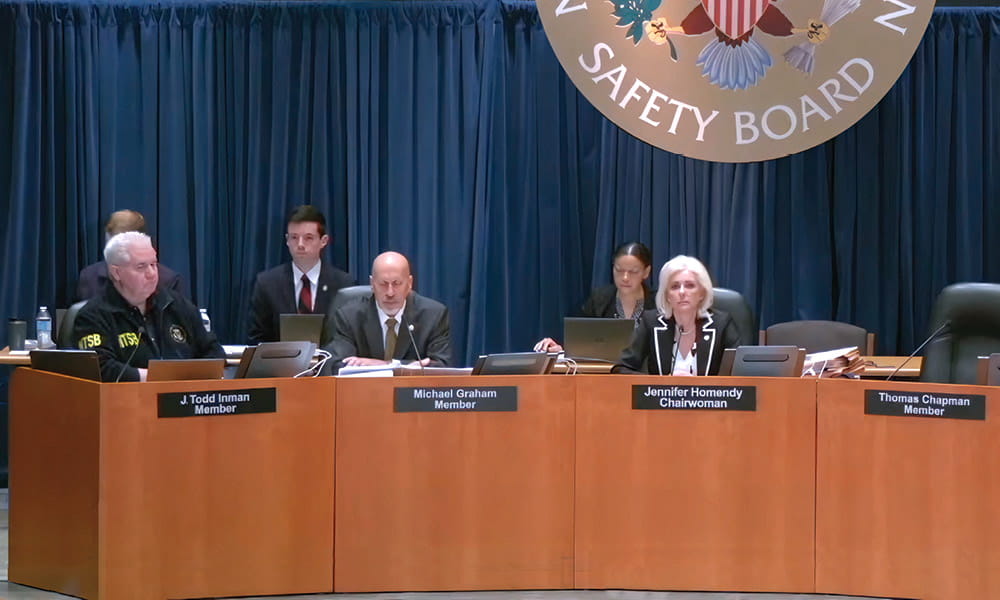
In addition to earlier urgent safety recommendations to limit or prohibit helicopter operations near DCA in certain situations, the agency issued 50 recommendations, including calling for FAA implementation of supervisory time-on-position limits and expanding instructor-led, scenario-based threat and error management training. The board’s recommendations also seek changes to helicopter route design and charting, as well as ensuring vertical separation from approach and departure paths.
These recommendations also included a requirement for upgrading existing traffic alerting and collision avoidance systems (TCAS I, TCAS II) with directional traffic symbols and transitioning aircraft to airborne collision avoidance system X (ACAS X) on new and existing aircraft so that pilots can be warned more quickly and accurately to see and avoid a potential conflict.
The NTSB’s recommendations also align with ALPA-supported legislation calling for the expanded equipage with ADS-B In. This is a key component of the Rotorcraft Operations Transparency and Oversight Reform (ROTOR) Act. The proposed legislation, which passed unanimously in the U.S. Senate this past December, aimed to reduce the risk of midair collision, especially in mixed-used airspace. However, on February 24, the U.S. House of Representatives failed to pass the legislation.
The agency also issued recommendations directed at the U.S. Army, addressing the need for pilot training on fixed-wing operations and the interaction of those traffic flows with published helicopter routes at DCA; flight data monitoring for rotorcraft; transponder inspection and configuration; altimetry education; safety reporting utilization; and the development of a robust, independent safety management capability for rotary-wing operations in civil airspace.
In addition, the board called for improved data sharing, timely notification after near midair collisions or resolution advisories, and independent audits of Safety Management System performance.
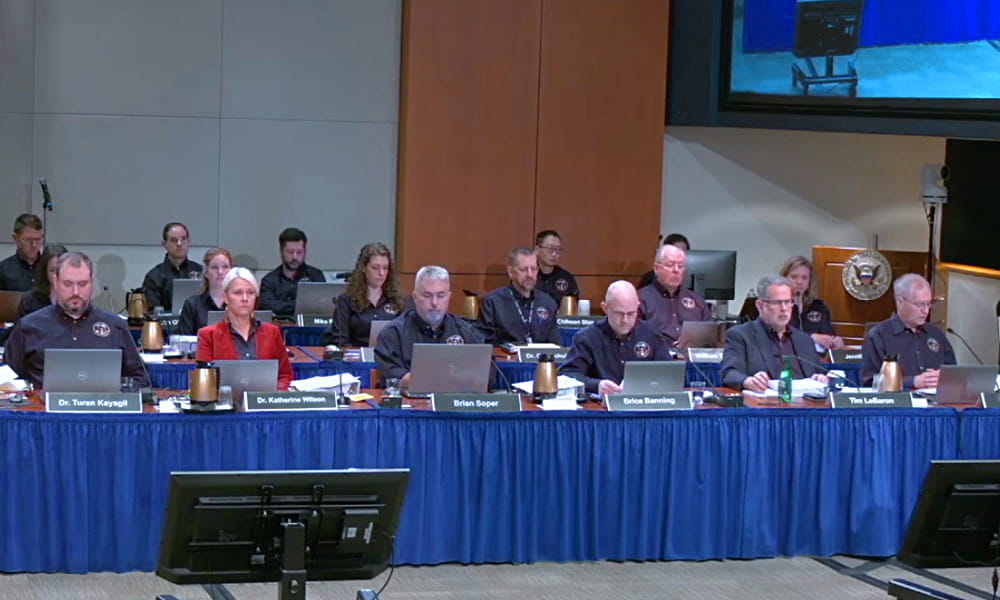
Addressing the families who attended the meeting, Homendy promised to work tirelessly to see that action is taken on the agency’s recommendations. “The first step in the process is getting this final report out, getting the safety recommendations out. And then we’ll work together, if you’re willing and able, to get our recommendations implemented, to see that no other family goes through this again. We’ll vigorously advocate for implementation of our recommendations.”
“It’s critical that we continue to advocate to enact and implement the NTSB’s safety improvements,” commented Capt. Steve Jangelis (Delta), ALPA’s Aviation Safety Group chair, emphasizing the importance of follow-through. “That’s because safety recommendations only matter if they’re acted upon. The ALPA experts who responded to this tragedy had a solemn but sacred task. While the work is never easy, our commitment is simple and unwavering: to learn from this tragedy, to improve the system, and to honor those affected by ensuring that these lessons lead to meaningful change. That’s our responsibility as safety professionals, as an industry, and as ALPA pilots.”
One year later, the lessons from this accident are clear. The challenge now is to follow through on implementing corrective action to ensure that the changes identified by the board translate into safer outcomes for pilots, controllers, and passengers alike.
“We commend the NTSB’s unwavering commitment to uncovering the full scope of factors surrounding the accident involving PSA Flight 5342,” said Ambrosi. “Through extensive investigative efforts, which ALPA supported, the agency made numerous recommendations to strengthen our aviation system and prevent similar tragedies from occurring in the future. Along with our support of existing regulatory and legislative solutions, ALPA is ready to fight for the board’s recommendations to save lives and spare us another tragedy like the one we solemnly remembered this January.”
The ALERT Act is not enough! Demand that Congress adopt the stronger safety mandates of the ROTOR Act into the final law.