ALPA Members: A KCM outage is currently affecting many airports across the system. The provider is working to resolve the issue. Updates will be shared via email.

Article


More than 140 participants gathered at ALPA’s headquarters in McLean, Va., on March 10–11 for a Fatigue Management Seminar hosted by ALPA and Airlines for America (A4A). Pilots, researchers, industry representatives, and regulators examined fatigue science, sleep research, wearable technology, fatigue modeling, and operational strategies for improving Fatigue Risk Management Systems (FRMS). Discussions were facilitated by Capt. Doug Marchese (JetBlue), ALPA Flight Time/Duty Time Committee chair, and Capt. Matt Morley (FedEx Express), A4A seniormanager for Operations Performance.
The annual seminar reflects a long-standing commitment across the industry to address pilot fatigue, an issue that’s been central to the union’s mission since its founding. While regulatory improvements over the past decade have strengthened protections for pilots, fatigue remains an inherent challenge.
Despite the implementation of FAR Part 117 and ongoing advances in fatigue risk management, pilots continue to face operational pressures that can contribute to fatigue. Many pilots report experiencing fatigue well before reaching regulatory limits, underscoring the need to better understand how fatigue develops in real-world operations.
“In an industry that spans time zones and around-the-clock operations, we must work together to mitigate the causes of fatigue to ensure that it never compromises flight safety,” said Capt. Jason Ambrosi, ALPA’s president. “To be true champions for safety, we need to recognize that fatigue is about more than the actions of any individual pilot. Together, we must address schedules, operations, layovers, stress, and culture. Our industry has always been better off when we come together to share ideas, concerns, and best practices among stakeholders, like you all are doing here today.”
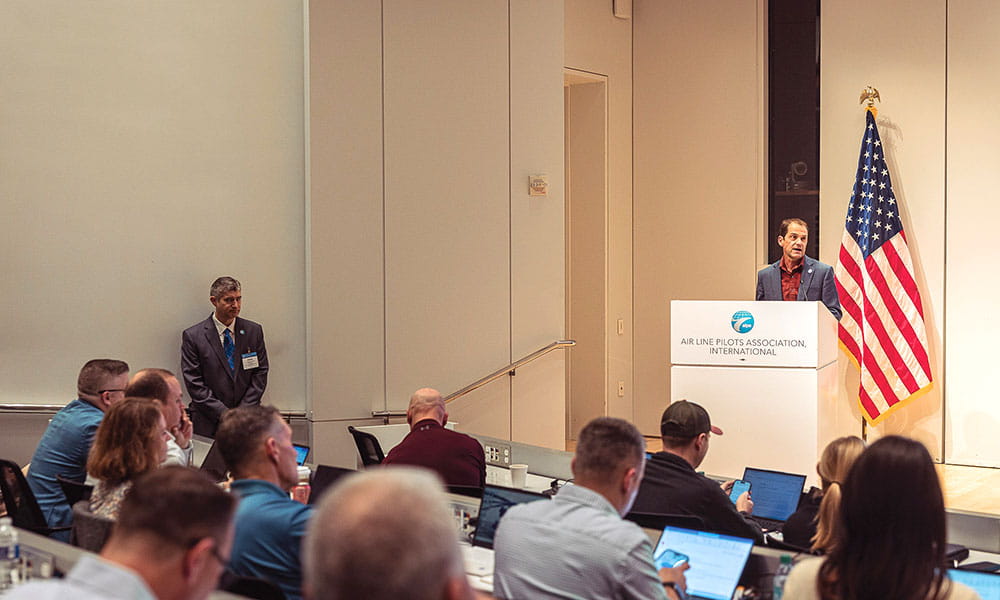
One focus of this year’s seminar was the growing body of research aimed at better understanding how fatigue affects pilots in different operational contexts. Erin Flynn-Evans, Ph.D., director of NASA’s Fatigue Countermeasures Laboratory, presented results from a collaborative study conducted by researchers from NASA’s Ames Research Center and the Civil Aerospace Medical Institute examining fatigue in short-haul operations. The research highlights the importance of circadian disruption as a key driver of fatigue, even in relatively short duty periods.
Early-morning departures, late-night arrivals, and rapid transitions between schedules can all interfere with the body’s natural sleep-wake cycle. The study’s findings indicate that pilots experience higher levels of fatigue and reduced performance during nighttime hours, particularly during the window of circadian low. The study also suggests that while existing mitigations are helping to reduce risk, measurable performance degradation still occurs under certain conditions.
Flynn-Evans also led a panel discussion, which included Cindy Hu, Ph.D., WHOOP Clinical Research Scientist, and Shannon Sullivan, M.D., a Stanford Medicine clinical professor of psychiatry and behavioral sciences. These sleep scientists explored the physiological foundations of fatigue, including the role of circadian rhythms and sleep quality. Marchese and Morley also joined the discussion to provide the line-pilot perspective. Panelists emphasized that fatigue isn’t just a function of how long a pilot has been awake, but also when that wakefulness occurs relative to the body’s internal clock. This distinction is critical in an industry where pilots are frequently required to operate during their biological night.
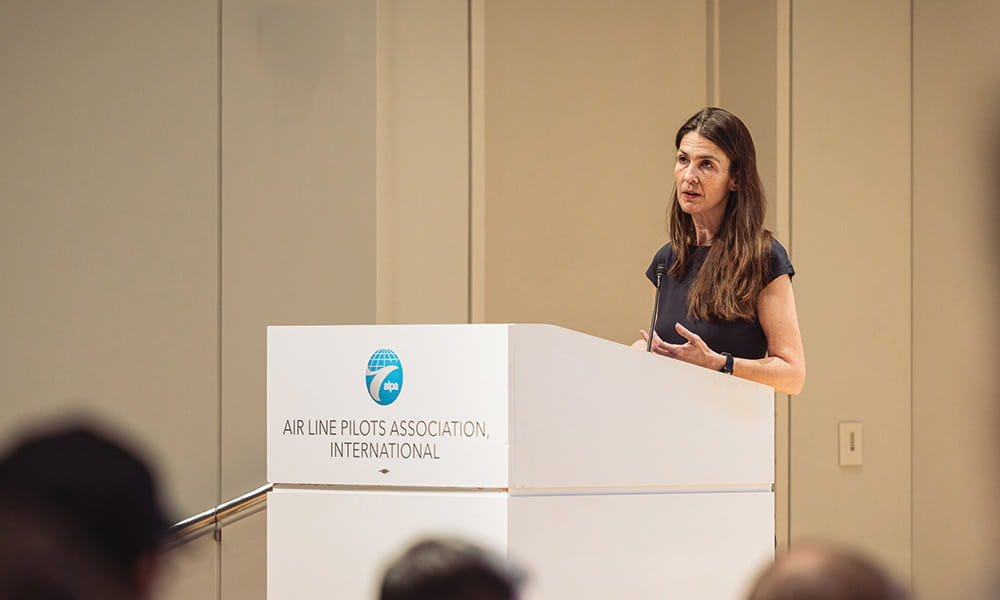
Discussion also focused on the increasing use of wearable technology and other data-driven tools to better understand fatigue. Advances in consumer sleep technology have made it possible to collect large amounts of real-world data on sleep patterns, activity levels, and recovery. Speakers explored how these tools might be integrated into fatigue risk management efforts, allowing both pilots and operators to better comprehend how different schedules and operational conditions affect performance.
But information collected from wearable devices needs to be considered in context. Jaime Devine, Ph.D., director of Sleep Science at the Institutes for Behavior Resources, delivered a presentation on the in-flight use of consumer sleep technologies for aviation research. She cautioned that accuracy and methodology vary significantly among consumer devices, which are often not suitable for research purposes. While wearable technologies can enhance awareness, they must be used as part of a broader system that includes scientific expertise, operational knowledge, and pilot input.
Flynn-Evans addressed some of the challenges of using consumer wearable technology in scientific fatigue research. “We often add consumer wearables to our studies with the hopes of having external validation,” she observed. “But if the device is discontinued or the algorithm is changed, or if we can’t get into the raw data, we aren’t able to do the validation.”
Just like any technology, these devices can be used for other purposes, such as collecting data to potentially support reduced-crew operations. Therefore, pilots must always be cautious when engaging in studies involving these types of technology.
As the volume of fatigue-related data continues to increase, researchers and safety advocates have grappled with how to translate that information into actionable insights. Panelists addressed the use of biomathematical models and other analytical tools to assess fatigue risk and support decision-making. Zak Klinck, FedEx Express manager for Fatigue Risk Management, facilitated discussion on modeling and interpretation of modeling results. Participants included Steven R. Hursh, Ph.D., president and chief scientist at the Institutes for Behavior Resources; Tomas Klemets, head of Scheduling Safety for Jeppesen; Capt. Robert Bassett (FedEx Express), his pilot group’s Fatigue Risk Management Committee chair; and Hans Van Dongen, Ph.D., director of the Sleep and Performance Research Center at Washington State University. Panelists examined the capabilities and limitations of these models to help identify patterns, evaluate scheduling scenarios, and predict potential fatigue risks.
Discussions also addressed the need to bridge the gap between theoretical modeling and day-of-operations realities. Factors such as delays, reassignments, and unexpected disruptions can significantly alter a pilot’s fatigue profile, highlighting the importance of flexible, responsive systems that can adapt to changing conditions. Capt. Kirk Koenig (United), fatigue and FRMS lead for his pilot group, moderated a panel focusing on day-of-operations, preferential bidding systems, and improving FRMS solutions. Panelists included Capt. Michael Kulbacki (United), cochair of his pilot group’s Fatigue Safety Action Group; Tracy King, United Airlines manager for Fatigue Risk Management; Rob Mora, SAFTE-FAST product manager at the Institutes for Behavior Resources; and Klemets.
The seminar also provided an opportunity to hear from regulators. Morley invited Chester Piolunek, an FAA aviation safety inspector, and Scipio Garling, an FAA senior program management analyst, as well as Capt. Robert “Chip” Benton, United Airlines senior manager for Flight Ops Fatigue Programs, to discuss FRMS as an alternate means of compliance to FAR Part 117 for certificate holders.
Fatigue issues specific to different types of operations were also reviewed. Capt. Dylan McGee (Delta), Fatigue Risk Management Committee chair for his pilot group, led a discussion on operational solutions to address fatigue at regional airlines. Participants included Capt. David Silvestri (Mesa), his pilot group’s Central Air Safety Committee chair; Capt. Dana Thomas (Piedmont), a member of his pilot group’s Fatigue Committee; and Aaron Pennington, Republic Airways manager for Flight Safety.
The seminar also highlighted the value of cross-disciplinary collaboration in addressing fatigue from multiple perspectives, including safety, scheduling, training, and human factors. This collaborative effort has proven to be effective in the industry’s approach to fatigue management. Marchese moderated a discussion on cross-disciplinary collaboration, which included Capt. Jason Graves (JetBlue), a member of his pilot group’s Professional Standards Committee; Capt. Michael Kendrick (JetBlue), ALPA’s Safety Council chair; Jeff Ohman, United Airlines director of Flight Training; and Chris Powers, FedEx Express manager of Flight Safety.
As fatigue-management systems become more sophisticated, the role of emerging technologies, including artificial intelligence (AI), has become an important topic of discussion. Marchese delivered a presentation about avoiding the pitfalls of overreliance on the use of AI for fatigue management analysis, noting that it’s often difficult to assess the veracity of the information that AI models produce. “Pilots aren’t experts in either AI or fatigue science, and AI is very good at masking errors,” remarked Marchese. “As those errors compound, whether they’re related to fatigue science or regulatory compliance, we’re going to start to have issues.”
While advances in science and technology are providing new tools and insights, they’re intended to support the pilot’s role in ensuring fitness for duty, not replace it. Understanding fatigue, recognizing its signs, and taking appropriate action remain a critical part of the job for every line pilot. Progress over the past decade has been significant, but seminar participants agreed that the work is ongoing. By continuing to invest in research, refine FRMS, and foster collaboration across the industry, stakeholders are working to ensure that pilots remain well rested, alert, informed, and prepared to operate safely.
“We fiercely advocate for our members on fatigue as both a safety issue and a contract issue because we understand the consequences when pilots are pushed,” Ambrosi noted. “We must protect a pilot’s ability to make the safe decision and call out fatigued without fear of repercussions.”