


Managing Wildlife Hazards: Evolving Strategies in Risk Mitigation
Bird Strike Threat Outpaces Industry Progress
From the earliest days of powered human flight, birds and other animals have occasionally caused problems for aircraft operations. Despite decades of mitigation efforts, the industry continues to rethink how it manages this persistent threat.
F/O Steve Franklin (United), an ALPA airport safety liaison for Washington Dulles International Airport and a recognized expert on wildlife hazards, contends that, while progress has been made since the 2009 “Miracle on the Hudson,” it hasn’t kept pace with changing conditions or with growing wildlife populations.
“Miracle on the Hudson” and Other Case Studies
On January 15, 2009, US Airways Flight 1549 famously ditched onto New York’s Hudson River after a flock of Canada geese disabled both engines shortly after departure from LaGuardia Airport. The accident brought concerns about bird strikes to the attention of the public, highlighting problems associated with wildlife hazards. What’s far less known is how narrowly the industry has avoided similar events since then.
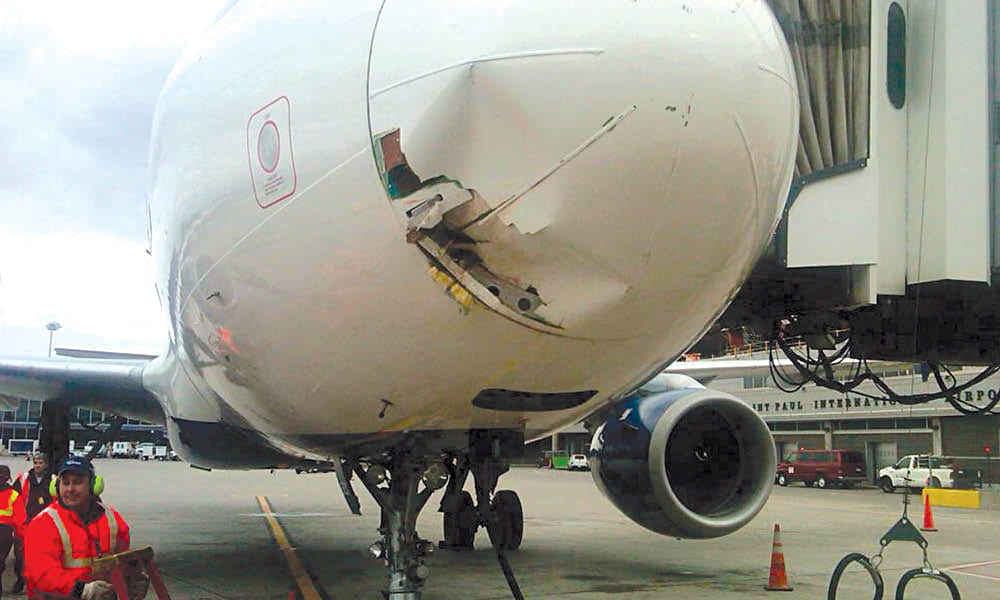
On November 19, 2022, the crewmembers of Delta Flight 2295 experienced a loud explosion and rapid decompression at 13,000 feet during a nighttime descent to Omaha Airport when their aircraft was struck by birds. After landing safely, the crew noted that birds penetrated the aircraft skin and entered the flight deck, causing damage and endangering the pilots. The resulting increase in workload required for the flight’s safe conclusion demonstrated the need to always have two pilots on the flight deck.
On March 1, 2025, a FedEx B-767 departing Newark Liberty International Airport also encountered a serious birdstrike event that, while not ending in catastrophe, underscored the ongoing vulnerability of transport-category aircraft to large birds and flocks. These weren’t isolated occurrences, but part of a much larger pattern.
Data from the FAA shows thousands of strikes involving birds weighing more than 2.5 pounds at Part 139-certificated airports. Nearly half of those strikes caused aircraft damage, according to research by wildlife-hazard experts Richard Dolbeer and Michael Begier.
Coordinated Efforts Across North America
Franklin serves as ALPA’s liaison to the Bird Strike Committee USA and works closely with international counterparts, including the Bird Strike Association of Canada. In that role, he and Capt. Ronald DuJohn (WestJet), ALPA’s chief Canadian airport safety coordinator, attended the most recent North American Aviation Wildlife Management Conference in Portland, Ore., last August, during which regulators, airport operators, and researchers shared updates on mitigation strategies and emerging technologies.
“I was encouraged by the commitment I saw from the FAA, Transport Canada, the U.S. Department of Agriculture, and other stakeholders,” Franklin remarked. “But it’s also clear that the job isn’t done.”
Today’s Approach and Promising Advances
Airports today rely on a layered approach to wildlife management. These measures include habitat modification, pyrotechnics, distress calls, trained falconry birds, and strict wildlife-management plans mandated for certificated airports. While effective, most of these tools are limited to the airport environment itself.
Some of the most promising advances in wildlife-hazard mitigation are coming from outside traditional civil aviation channels, like the ongoing research by the U.S. Navy in collaboration with Purdue University at Patuxent River Naval Air Station in Maryland. There, researchers have identified specific frequencies and wavelengths that align with the visual perception of Canada geese.
When light that’s tuned to the avian eye is mounted on an unmanned aerial vehicle and flown toward a flock, the birds scatter rapidly to escape what they perceive as an approaching threat. Franklin said that this is “extremely encouraging,” but noted that significant progress is needed before this application can be used on airline aircraft.
Another area of growing promise is bird-detecting radar. Unlike traditional wildlife-control measures, radar systems can identify and track bird movements beyond the airport perimeter, including at altitude and at night, when visual detection is limited and flocks of birds tend to be larger and more hazardous.
Despite their potential, bird radar systems remain expensive, and many airports have been reluctant to invest in them. Franklin acknowledged the cost concerns but pointed to early adopters that demonstrate what’s possible. Vancouver International Airport, with its wintering flocks of thousands of snow geese, implemented a bird radar system and actively coordinates radar data with air traffic control to manage risk during peak bird activity.
Low-powered lasers are another example of a tool that initially raised concerns among pilots. However, after ALPA received briefings on their federally approved use and tight standard operating procedures, these systems, used primarily at night, have proven to be highly effective at dispersing birds with minimal risk to flight crews or wildlife.
Think Beyond the Fence Line
Dolbeer, the Portland conference’s keynote speaker and widely regarded as the world’s leading authority on aviation wildlife hazards, urged the industry to move beyond a fence-line mentality and adopt a broader, data-driven approach that incorporates off-airport wildlife management. He likened the needed evolution to the development of wind shear detection and alerting systems. Just as pilots now receive timely, actionable advisories about wind shear, Dolbeer said they should also receive meaningful information about bird-hazard levels, supported by radar and standardized reporting.
Rising Bird Populations Brings Higher Risk
Research shows that populations of many large bird species in North America have increased substantially over the past 30 years. More birds, especially flocking species, translate directly into higher strike risk. As the industry confronts these trends, ALPA continues to push for improvements that reduce risk and enhance pilot situational awareness.
“Wildlife hazards remain a growing safety and operational concern for aviation,” acknowledged Capt. Jeffrey Sedin (United), ALPA’s Airport & Ground Environment Group chair. “While the risk can’t be eliminated entirely, meaningful progress is being made through enhanced mitigation programs, improved detection technologies, and targeted research into smarter, data-driven risk management. ALPA actively supports these efforts and continues working with regulators, airport operators, and industry partners to strengthen wildlife-hazard mitigation and protect flight crews and passengers.”
Stakeholders Consider Wildlife Condition Code
ALPA, the International Federation of Air Line Pilots’ Associations, and other stakeholders are in early discussions about developing a wildlife or bird condition code. Modeled on runway condition codes, icing advisories, or turbulence reporting, such a system could help quantify wildlife risk and provide pilots with clearer situational awareness.
Mitigation Measures Crews Can Implement Today
Pilots remain a critical part of the solution, Franklin observed, emphasizing a number of practical measures that crews can implement right away to mitigate these threats:
- Report all wildlife strikes, regardless of perceived severity. Data drives funding, research, and mitigation priorities.
- Engage your ALPA airport safety liaisons, who serve as direct links among pilots, airport operators, and regulators.
- Report wildlife observed near runways or taxiways, even if no strike occurs. Airports can’t address hazards they don’t know about.
- Minimize time below 3,500 feet above ground level when operationally feasible, where the probability of damaging strikes increases sharply.
- Use all available aircraft lighting below 3,500 feet above ground level, which may improve visibility to birds.
- If maneuvering to avoid birds, remember that they tend to dive in response to threats, making climbing the more effective avoidance strategy.
The Search for Innovative Strategies Continues
More than 15 years after the Hudson River ditching, there’s still much that can be done to guard against wildlife hazards. A real need for innovative management strategies still remains.
“We’re making progress,” Franklin remarked, “and mitigations for the wildlife-hazard threat will continue as long as pilots and airlines report strikes and near misses and remain engaged with air traffic control and airport operations. That’s how we drive change.”

Featured Articles


