


Crucial Pilot Protections Secured During Global Pandemic
Editor’s Note: In celebration of ALPA’s 95th anniversary this year, this nine-part Air Line Pilot series revisits some of the union’s “wins”—successful campaigns, projects, and products that make public air transportation safer and more secure and that improve the working lives of the union’s members.
ALPA Wins, Part 2: The CARES Act
Throughout ALPA’s 95 years of existence, the Association has time and again demonstrated its leadership and influence to confront and respond to instances of large-scale crises, like the terrorist attacks of 9/11. As part of its crisis response, ALPA has consistently partnered with other aviation industry stakeholders to determine effective tactical solutions and take necessary actions.
However, no other example better demonstrates the union’s vision, authority, and reach during bleak periods than the occasion six years ago this month when the Association helped convince federal policy makers to enact the Coronavirus Aid, Relief, and Economic Security (CARES) Act. This legislation provided $63 billion in aid—10 percent of the U.S. gross domestic product at the time.
What made the CARES Act unique was the Payroll Support Program it introduced under Division A, Title IV, Subtitle B of the bill. This innovative provision enabled U.S.-based airlines to continue operating despite the burgeoning global health emergency and, thanks to the leadership and engagement of ALPA and other airline industry trade unions, targeted workers as beneficiaries.
The U.S. airline industry is critical for interstate and international commerce, accounts for 5 percent of the nation’s gross domestic product, and employs approximately 750,000 workers including pilots. It’s reasonable to surmise that without access to this vital federal support, today’s industry would look very different.
Viral Implications
An outbreak of a novel SARS-CoV2 strain of the coronavirus, also known as COVID-19, which appeared in December 2019 in Wuhan, China, quickly spread to other parts of the globe. The World Health Organization announced a public health emergency of international concern on January 30, 2020, and a month later declared the outbreak a pandemic.
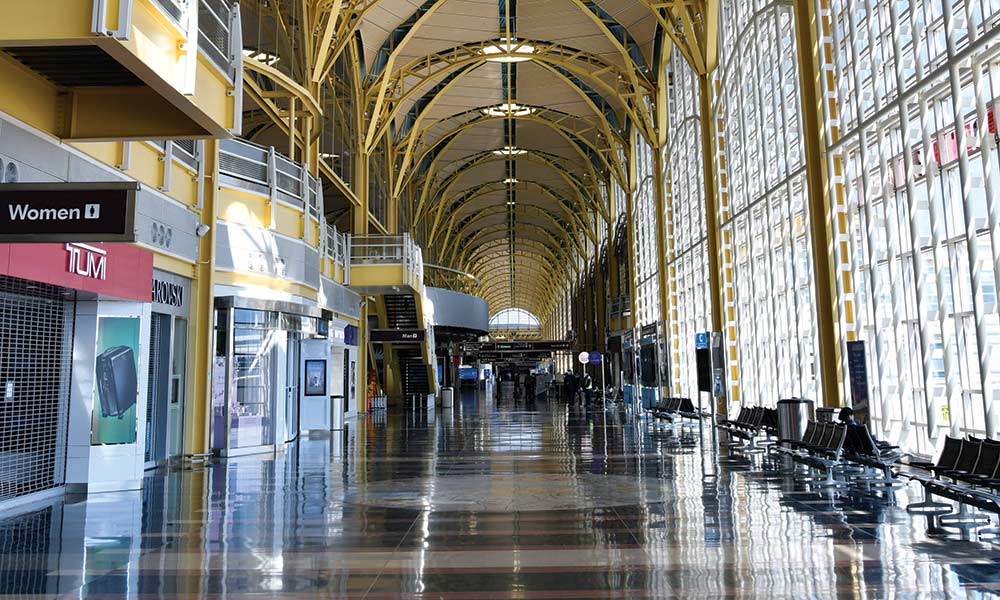
To curb the deadly disease’s proliferation, health experts and government officials called for “social distancing,” urging individuals—when possible—to maintain a distance of at least six feet, wear masks, and avoid gathering in groups. In short order, large segments of the global economy experienced major shutdowns, severely damaging stock markets and other financial indices. In addition, flight cancellations mounted as temporary air travel conditions and restrictions were imposed (see the April 2020 issue of Air Line Pilot).
Airlines around the world witnessed an 80-90 percent decline in passenger demand during the months of March and April, and the corresponding reductions in U.S. airline schedules were no less extraordinary. Delta reduced its operation by 70 percent while United slashed its schedule by 60 percent. All-cargo carriers like FedEx Express faced comparable challenges as they continued worldwide operations but also felt pressures, including reduced revenues, resulting from the impacted global business environment.
Despite this changing landscape, airline pilots continued to demonstrate their crucial role in maintaining supply chains and transporting food and other necessities including shipments of vaccines throughout the pandemic. They also delivered medical staff and equipment to locations where they were most needed (see the May 2020 issue of Air Line Pilot).
ALPA’s Lobbying Efforts
With the airline industry facing these and other associated challenges, the Association lobbied Congress for a stimulus package. “I sent a letter to President Donald Trump, U.S. House Speaker Nancy Pelosi, and Senate Leader Mitch McConnell to make clear that stabilizing the U.S. airline industry as our global community addresses the coronavirus disease is imperative,” said Capt. Joe DePete, ALPA’s president at the time.
“I was unequivocal that any package must contain strong labor protections for the airline employees who suffer financial harm, experience quarantine or treatment, or need to care for a loved one,” DePete added.
Policy makers and the public needed to understand the numerous complications and bureaucratic hurdles airlines would confront following systemwide employee displacements. Simply addressing what would be necessary to requalify airline pilots, following widespread layoffs or a potentially extended industry shutdown, by itself would be staggering.
Subject to the maintenance of medical certification requirements and various training and operational standards, airline pilots are among the most regulated employee groups of any industry. Tens of thousands of them all returning to work at the same time would create massive regulatory and airline backlogs, which would more than overwhelm the industry, crippling it indefinitely because of a whole new set of reasons.
As part of its lobbying campaign, the union’s Government Affairs Department coordinated an extensive Call to Action plan, urging pilots and their family members to contact their members of Congress through letters and social media messages using Twitter (X). In all, more than 167,000 messages were communicated.
“It’s been insane,” remarked Vanessa Kermick, a former ALPA senior government affairs and grassroots strategist, noting the volume of messages and the quick response time. “This has been by far one of the most successful campaigns we’ve ever launched. I think we had 10,000 people taking action in just 24 hours.”
Government Aid
On March 27, 2020, the CARES Act was signed into law (see Air Line Pilot May 2020). Title IV of the legislation designated $25 billion in grants to passenger airlines and $4 billion in grants to all-cargo carriers, requiring that the funds be directed to cover worker salaries and benefits through the month of September 2020. Participating airlines would need to maintain their employment levels as of March 24, 2020, and retain at least 90 percent of their employees as of that date also through September.
An additional $25 billion was extended to passenger airlines in the form of loans or loan guarantees while all-cargo carriers were offered $4 billion in loans or loan guarantees. To ensure the law served its intended purpose, Section 4112 stipulated that executive compensation and severance packages would be capped for two years and that airlines would be prohibited from paying dividends or initiating stock buybacks for a year—another provision ALPA recommended.
In a letter to members of Congress, the Association asserted, “For the first time in American history, rather than providing unfettered financial assistance to airlines, aid is conditioned to promote, rather than subordinate, the livelihoods of employees.”
With the CARES Act, airline workers had easier access to 401(k) accounts and IRAs as well as health savings accounts. The law also expanded existing unemployment insurance benefits. Most significantly, Section 4003 prevented carriers that benefitted from CARES Act loans from abrogating existing collective bargaining agreements for the term of the loan, plus a period of two additional years.
That September, ALPA launched its “Ready for Takeoff” public-relations campaign to assure the public that when they were ready to return to the skies, the union’s then-63,000 pilots would welcome them aboard (see Air Line Pilot August 2020). The Association announced the campaign during an International Aviation Club webinar, inviting other industry partners to join the effort. “By working together, we can do more than we can as individual organizations to define and drive the strongest, swiftest, and safest economic recovery possible.”
Workers an Afterthought in Previous Stimulus Packages
Prior to the CARES Act, workers within a beleaguered industry were treated as an afterthought in the consideration for industrial federal aid. Some packages were even contingent upon worker concessions. The Chrysler Corporation Loan Guarantee Act of 1979 authorized $1.5 billion in federal loan guarantees for the Chrysler Corporation, enabling it to avoid bankruptcy.
According to a New York Times article from November 5, 1979, the government called for “Chrysler to raise at least another $1.5 billion through financial concessions from those with a stake in the company and new private loans granted without federal guarantees.” Members of the United Auto Workers union, employed by the car manufacturer, were compelled to give up $203 million in wage concessions and an additional $200 million in pension deferrals as part of this arrangement.
Other federal stimulus packages essentially overlooked workers and, in some cases, only delayed the affected industry’s inevitable hardships. Following the terrorist attacks of 9/11, the Airline Transportation Safety and Stabilization Act was passed on September 23, 2001, in part to prevent the collapse of U.S.-based airlines, which, if a complete shutdown had occurred, would have brutally damaged the national economy. The government allocated $5 billion in grants and an additional $10 billion in loan guarantees.
However, the federal aid proved futile as U.S. airline losses amounted to nearly $40 billion between 2001 and 2007, prompting many carriers to turn to Section 1113 of the U.S. Bankruptcy Code to nullify pilot and other airline labor contracts to dictate new terms of employment. Widespread worker layoffs followed as the industry consolidated. Consequently, it took the U.S. airline industry a decade and a half to resume the performance levels it had achieved prior to September 11, 2001.
Additional Aid as Pandemic Dragged On
With the pandemic lingering, the U.S. airline industry posted $12 billion in second-quarter losses for 2020. Anticipating the layoffs of tens of thousands of employees, ALPA waged another aggressive lobbying campaign in the fall of 2020, urging the government to extend the Payroll Support Program.
Congress responded and on December 27, 2020, the 2021 Consolidated Appropriations Act extended an additional grant of $14.8 billion to passenger airlines, once again, for the continued payment of worker salaries and benefits (see Air Line Pilot January‒February 2021, page 6). Participating airlines were prohibited from conducting layoffs or furloughs through March 2021. Following the proper distribution of the aid, the airline could receive federal assistance equal to the total paid to its employees between October 1, 2019, and March 31, 2020.
By the end of January 2021, the Treasury Department had distributed more than $34 billion of the total offered to air carriers through the two allocations of the Payroll Support Program.
DePete addressed the House Aviation Subcommittee in a March 2, 2021, hearing titled “COVID-19’s Effects on U.S. Aviation and the Flight Path to Recovery.” In his written testimony, he applauded the Payroll Support Program’s “three-legged stool in which collective bargaining is walled off from government interference, financial aid is exclusively subscribed to employee payroll, and strong furlough prohibitions maintain employment.” Nonetheless, he asserted, “While the industry is on firmer footing, the economic dangers posed by COVID-19 remain” and asked for additional funding.
Congress subsequently approved passage of a third statute, the American Rescue Plan Act, and on March 11, 2021, presented a final $14 billion package for U.S. airline employee compensation (see Air Line Pilot April‒May 2021).
The third Payroll Support Program installment featured enhanced furlough protections developed and supported by ALPA and the AFL-CIO’s Transportation Trades Department (TTD) to prevent participating airlines from furloughing employees before September 30, 2022, or until the carrier thoroughly depleted its government aid. Airlines that received federal assistance were barred from buying back stock and couldn’t issue dividends through September 30. In addition, limits were placed on executive salaries that exceeded $425,000.
Much of the success of the Payroll Support Program can be attributed to the tens of thousands of ALPA pilots and family members who participated in the union’s Calls to Action and social media campaigns. Another contributing factor was the Association’s long-standing relationships with its fellow TTD union affiliates, other aviation industry stakeholders, and the many members of Congress who offered their support. Collectively, they worked to pass the landmark CARES Act and subsequent related legislation, providing a lifeline to an ailing air transportation industry and keeping American workers on the job.
Reflecting on This Unprecedented Success
Capt. Bob Fox, ALPA’s first vice president during the pandemic, offered some words of hope in his Air Line Pilot “Weighing In” column in the April‒May 2021 issue. “As we’ve learned, there’s no checklist for handling the issues brought about by the COVID-19 pandemic,” he wrote. “The decisions we make today will impact our industry for years to come. But through the exceptional resilience and focus of ALPA members, I’m confident that we’ll emerge stronger than ever.”
There’s no denying the CARES Act, the additional stimulus packages, and the Payroll Support Program were unprecedented successes. Unlike any other U.S. federal aid extended to an industry in distress, this legislation focused on the many as opposed to the few. Airline employees kept working and years later, as Fox predicted, ALPA membership is larger than it’s ever been and the Association maintains a robust financial position.

Featured Articles


