


Pushing for Advancements to the Federal Flight Deck Officer Program
 Established in 2003 in the aftermath of the 9/11 terrorist attacks, the Transportation Security Administration’s (TSA) Federal Flight Deck Officer (FFDO) program remains one of ALPA’s top priorities in the aviation security realm. The Association continues to lobby for increased funding, staffing, and government support and remains committed to the growth and evolution of the program.
As a result of ALPA’s advocacy, one of the union’s sought-after enhancements to the program was recently instituted: the creation of the Senior FFDO Training Program, which provides FFDOs who have at least 10 years’ experience in the program with additional skills to enhance their ability to protect the flight deck.
A Brief History
The TSA was directed to establish the FFDO program by the Arming Pilots Against Terrorism Act, part of the Homeland Security Act of 2002. The program enhances national security by training and deputizing airline pilots as federal law enforcement officers, authorized to carry firearms and defend the flight deck against hostile threats. Since its inception, tens of thousands of pilots have volunteered as FFDOs—at minimal cost to the U.S. government and taxpayers.
FFDOs have protected roughly one million flights per year, safeguarding more than 23 million flights since the program was instituted. On average, each FFDO mission costs the U.S. taxpayer less than $25, making the program perhaps the most cost-effective in-flight security measure in the United States.
The reason? FFDOs are volunteers who receive no payment for their services. Additionally, while TSA covers the direct costs involved in training, participants must cover their own travel expenses and must attend training on their own time.
Senior FFDOs
In 2016, ALPA began lobbying for an advanced training curriculum within the program that would provide FFDOs with additional professional development. “At the time, we had FFDOs with more than 10 years’ experience,” said Capt. Wolfgang Koch (Delta), the Association’s former Air Safety Organization (ASO) Aviation Security Group chair. “A pilot could potentially be an FFDO for up to 40 years, which put the need for advanced training into greater focus.” He observed that a “life cycle training program” would provide a path for growth within the position, with an ongoing progression of skills training and positioning the officers as invaluable mentors for newer volunteers.
Through Koch and Capt. Darrin Dorn (Alaska), ASO Aviation Security Group vice chair, ALPA advocated for the creation of a senior FFDO position, with additional training programs to support the position. The Federal Air Marshal Service (FAMS), which oversees the FFDO program, utilized input from ALPA, other stakeholders, and FAMS instructors to develop the Senior FFDO Training Program curriculum, which is loosely modeled off a senior-level course already in use for federal air marshals. After years of discussion and planning, TSA conducted the first Senior FFDO Training Program class in June 2024.
“The benefits of having this additional training and senior-level position are immense,” Koch remarked. “First and foremost, it’s a recognition of our volunteers and the role they play in service to our country—professionals who quietly serve because the nature of their mission requires discretion. Operationally, it keeps FFDOs engaged and able to advance their skills in defense of the flight deck. And it provides a ready-made population of recognized experts as mentors to new officers.”
Eligibility and Training
To attend the senior program, an FFDO must have served for 10 or more years and have completed at least two mandatory intensive Recurrent Training Programs in addition to their regular semiannual firearms requalification. They also must have an impeccable record within the FFDO program.
The program is currently held weekly in Atlantic City, N.J. The two-day training course—which is separate from the Recurrent Training Programs—consists of additional, specialized training modules designed to enhance the skills of the officer, with instruction, simulations, and drills focused on advanced techniques, tactics, and procedures. Participating FFDOs also take part in joint FAMS/FFDO training scenarios to further collaboration and coordination while enhancing the knowledge of both groups.
Additional Priorities
Since the program’s establishment, ALPA has continuously advocated for FFDO program improvements. While funding has increased in recent years, the program remains underfunded and understaffed, which creates training backlogs, prevents much-needed expansion, and limits support for active FFDOs.
“Right now, the time from application to completion of training for a newly minted FFDO is approximately 24 months,” said Koch. “We’re working hard to get that number down and accommodate more pilots, so don’t let this stop you from applying.”
Minimizing the costs of travel and time off and adding a West Coast facility are also issues the Aviation Security Group is addressing to make this important volunteer position accessible to all who are interested. Initial training is conducted at the Federal Law Enforcement Training Center (FLETC) in Artesia, N.M., by FLETC and FAMS instructors, while Recurrent Training Programs are in Atlantic City; Dallas, Tex., and Atlanta, Ga., which all have seen enhancements.
ALPA is lobbying to move the Initial Training Program from Artesia to Atlantic City, a much more accessible location, and is also advocating for a West Coast Recurrent Training Program facility. “It’s a matter of respect for volunteers’ time,” Koch stated.
ALPA continues to address other potential improvements via the FFDO stakeholder group, which includes government representatives, airline managements, and other unions and associations.
Interested in Becoming an FFDO?
Interested pilots can apply online. You can also contact your master executive council’s Security Committee with any questions.
To become an FFDO, you must have
- A current FAA airman certificate,
- A current first-class or second-class medical certificate, and
- U.S. citizenship.
Applicants are required to undergo screening, including a personal interview and criminal background check, and receive a recommendation from their airline. Once accepted to the training, an applicant has two years to attend the one-week Initial Training Course.
The demand for FFDOs continues to grow as threats evolve. “I highly encourage anyone interested in becoming an FFDO to apply,” remarked Koch. “It’s an extremely important role, and it’s very rewarding to serve your country while conducting your job.”
Honoring a Fallen Officer
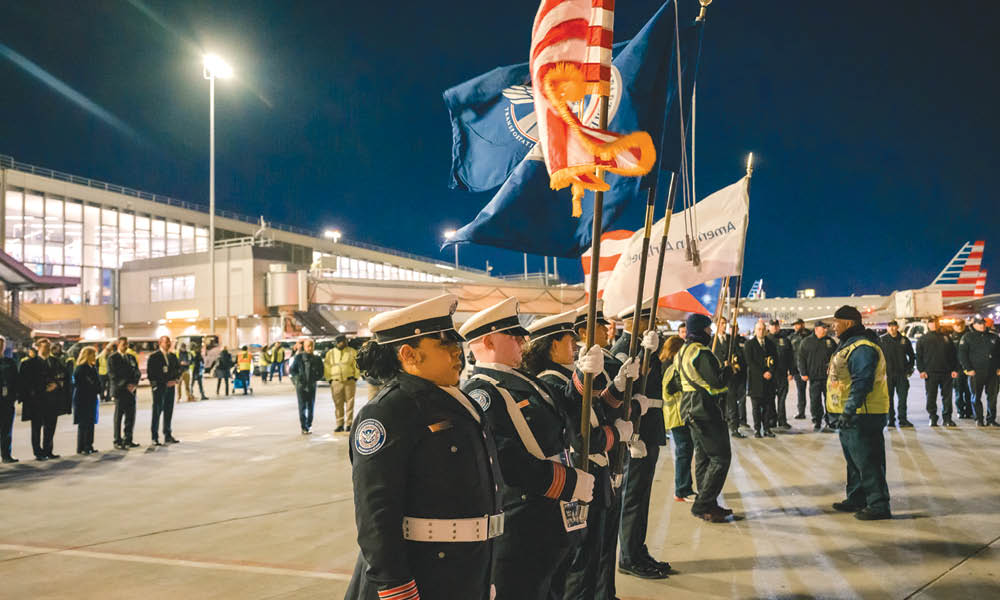
The Federal Flight Deck Officer (FFDO) program suffered its first loss of a mission-status FFDO on January 29, 2025, when PSA Flight 5342 was involved in a midair collision with a military Black Hawk helicopter on approach to Washington National Airport.
Capt. Jonathan Campos (PSA) completed his FFDO initial training nearly two years prior. Through his 21 months of service, he successfully completed 687 in-flight security missions before this fateful flight. He served faithfully, meeting and exceeding all FFDO requirements.
“FFDOs are a critical component in the Transportation Security Administration’s (TSA) layered security approach,” observed Denise D. Stark-Jones, the TSA Law Enforcement/Federal Air Marshal Service (FAMS) Aviation Programs Branch manager. “Capt. Campos’s sacrifice underscores the dedication and responsibility FFDOs take to safeguard our skies.”
That sacrifice is being honored in multiple ways—within the TSA, FAMS, and the larger law enforcement community. Five members of the TSA Honor Guard met Campos’s family and his remains at LaGuardia Airport as they were transported home from Washington National Airport after the accident. They were joined by representatives from the Port Authority Police Department and American Airlines in honoring Campos.
During the search-and-rescue process, recovery divers located Campos’s duty firearm in its holster on his side. After the recovery, the firearm was hand carried to the TSA National Armory in Atlantic City, N.J., where it was retired from service.
In addition to retiring the firearm, FAMS permanently retired Campos’s badge and credential number. Together, his duty firearm, badge, and credential will be on permanent display at the FFDO Initial Training Center located at the Artesia, N.M., campus of the Federal Law Enforcement Training Centers. The display honors the life, dedication, and service of Campos.
Campos’s name will be inscribed on the National Law Enforcement Officer Memorial in Washington, D.C., as part of the 2026 Police Week in May. His name was previously read aloud during a candlelight vigil on May 13, 2025, during last year’s Police Week events.

Featured Articles


