
Voices of Remembrance


In their own words, ALPA pilots recount the uncertainty and lasting impact of 9/11.
ALPA Pilots Remember
For the 10th anniversary of September 11, 2001, ALPA pilots reflected on the day that changed aviation, our nation, and their lives forever. From the skies above New York and Washington to airports across North America and beyond, their memories capture the confusion, courage, and compassion that emerged in the face of tragedy.
-
By Capt. Timothy I. Meldahl, Delta
I was tired. My crew and I had been scheduled to fly Northwest Flight 28, a B-747-200 from Tokyo to San Francisco, but we were delayed two-and-a-half hours by the remnants of a typhoon that had struck a day earlier. When we finally lifted off at 6:02 p.m., local time, we fully expected the remainder of our “transpac” to be routine. It occurred to us shortly after leveloff that Northwest Flight 28 of Sept. 11, 2001, would be anything but.
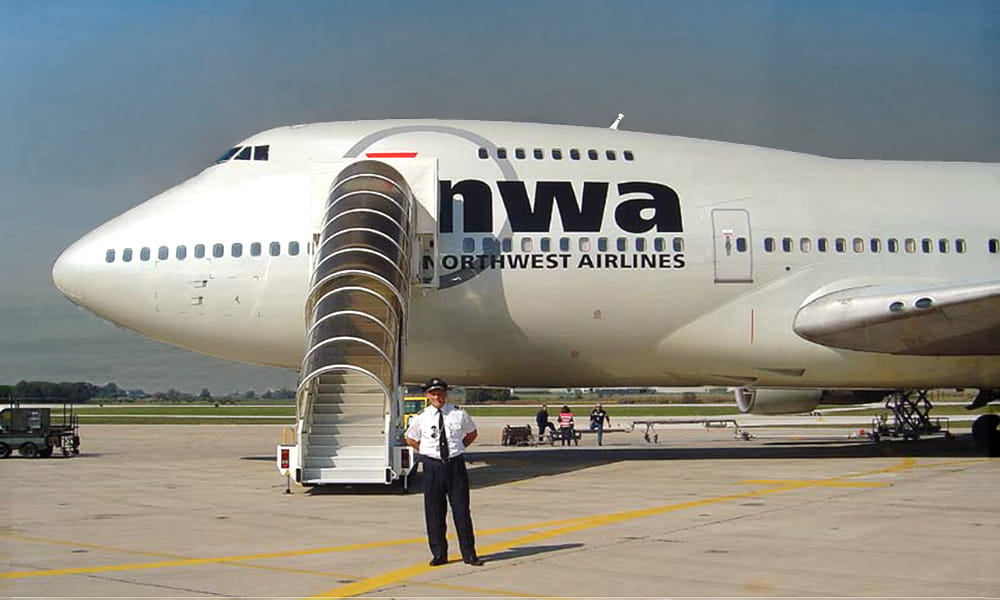
Capt. Meldahl stands in front of his B-747-200. It began with queries from crews in the vicinity, monitoring VHF frequency 123.45. “Is anyone getting the same information that we are over our company frequency?” a pilot asked. Another crewman responded, “Yes. It appears that one or two light aircraft have struck the World Trade Center.” A third pilot added, “They were not light aircraft. They were airliners, and there were four of them!”
Minutes passed as more crews added pieces to the puzzle. In a coordinated attack, four airliners had been hijacked and flown into the World Trade Center, the Pentagon, and a field in Pennsylvania. Tremendous damage was being reported, and the crisis brewing on the East Tremendous damage was being reported, and the crisis brewing on the East Coast of the United States was beyond our comprehension.
We needed to act. I directed F/O C.A. Mansfield to “pull the power back on all four engines.” I believed that by reducing power I could conserve fuel and possibly gain some time. I continued, “I may be distracted as the night progresses, so you will be flying and navigating. I will verify any important changes that occur, but, for now, you have the aircraft.”
I then turned to S/O Zack Bergazin and said, “Our fuel score will prove very important tonight, so I will work with you to manage our fuel and monitor aircraft systems.” My first and second officers were competent professional aviators, and I was glad they were there.
At this point, I called Pam, the purser, to the flight deck. Listening to my explanation of the developments, she shook her head in disbelief. We talked further and, at Pam’s suggestion, I decided not to say anything to the passengers beyond normal flight announcements. She then returned to the cabin.
A few moments later, I addressed the entire cabin crew. I did my best to explain what had occurred and instructed them to stay calm, be professional, and remain alert. Moments later, a message came across our intercompany communications. “Go to High Alert,” it screamed. The three of us knew what high alert meant from our military experience, but none of us had ever seen a message like this while flying for an airline. The obvious question was, Is there something we are not being told about our particular circumstances?
As we searched our manuals for some interpretation of this alarming message, Pam called from the cabin. “Tim, I think we have a problem with one of the passengers. He is holding a briefcase very tightly and appears quite confused. He may be a threat. What would you like us to do?”
“Watch him closely and report any changes,” I said. Jeez! What next?
It was time for the flight crew to review how best to protect the cockpit. All we had were the two crash axes. “Zack,” I said, “for better or worse, you are the first line of defense. If someone succeeds in opening the cockpit door, you’ll need to swing with all your might until they are no longer a threat. C.A., you have the second axe, so you are next. Swing and swing hard. If they get to me, I will do all I can to prevent them from getting control of our aircraft.”
As I looked into the determined eyes of both men, I realized none of this had to be said. We were as ready as we would ever be. It was time to check in with Oakland Center. “Oakland Center, Northwest 28 checking in at FL370.” “Roger, Northwest 28, squawk 3456.” It was good to hear from someone on the ground. “Northwest 28, radar contact. You are cleared direct to the SFO VOR. Are you declaring an emergency?”
“Negative,” I answered.
“Northwest 28, are you declaring an emergency?” Center asked again, this time with an increased sense of urgency. What the hell is going on? I thought. Again I responded, “Negative. Northwest 28 is not declaring an emergency.” The next words from Center were chilling.
“If you do not declare an emergency, you will not be permitted to land on American soil.” The flight deck became very quiet as we absorbed what had just been said—If we did not declare an emergency, we would not be permitted to land in the U.S. Zack responded first. “There is a good chance we have been intercepted by fighters and they are on our tail right now. My guess is that the powers that be are watching us very closely, and they are not kidding around.”
C.A. added, “We are on a very tight leash out here and one wrong turn, one missed altitude, or one call that does not make perfect sense, and I truly believe they will shoot us down.” Just then a chime went off, shaking me from my thoughts. “Tim, this is Pam. We are watching that passenger closely, the lights are up and the cabin is ready for landing.”
“Thanks, Pam,” was all I could say.
It was time to respond to Center. Not knowing how my words would be interpreted by fighter aircraft that might be in trail nor fully comprehending why I was being forced to declare an emergency, I slowly picked up the mike. “Oakland Center, this is Northwest 28.”
“Go ahead, Northwest 28,” Center responded.
“Northwest 28 is declaring an emergency.” The night kept getting longer and longer.
“Roger, Northwest 28. Direct to the SFO VOR, descend and maintain FL210.”
In the descent I turned to C.A. and said, “This is where you nail every heading and every altitude.”
“Absolutely,” he responded. I realized that I had been awake for more than 36 hours and suddenly felt very tired. I took a last sip from a cold cup of coffee, sat up in my seat, and forced myself to focus on the tasks at hand.
C.A. was doing a magnificent job flying. On short final, he commanded, “Flaps 25, landing checklist.” The airplane rumbled as the flaps slid noisily into place. Checklists completed, it was time to land. With a slight rotation of the nose, the main wheels of the B-747 touched down smoothly, and C.A. pulled all four reversers back to assist the brakes in stopping.
“Eighty knots—I’ve got the aircraft,” I said as we slowed to taxi speed. It was 11:37 a.m. PDT. At this moment it occurred to me that, in spite of the fact that a little more than nine hours had passed since we departed Tokyo, I had, indeed, just completed the longest flight of my life.
As I taxied to the gate, I noticed that not a single plane, truck, or car was moving. There were no sounds on the radio. Unbelievable, I thought. I turned into the gate, set the brakes, and shut down the engines. When we finished our post-flight checklists, I thanked C.A. and Zack for their superb work and headed for the cabin. The airplane was empty now, and I thanked Pam for her extraordinary efforts and all of the flight attendants for their work that day. They had truly made a difference.
The bus ride to the hotel seemed surreal, the world much different from just 11 hours before. When I arrived at my hotel room, I turned on the TV to witness for myself the destruction caused by the hijackers. I could not believe my eyes. Such devastation, such sadness. I sat down on the side of my bed, put my head in my hands, and, when the full gravity of the situation finally took hold, I felt the tears start to come.
-
By Capt. William Glen Lykins, Continental
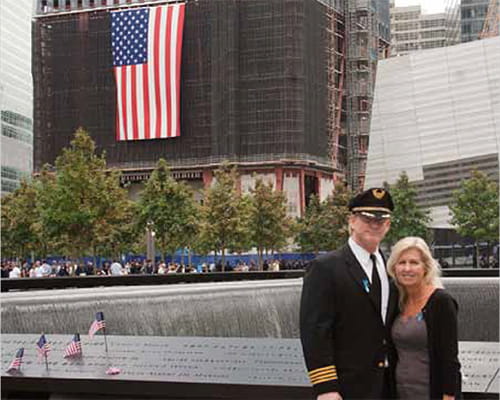
Capt. Lykins and his wife at the 9/11 memorial at Ground Zero.
As a Continental pilot based in Newark, I found myself at Ground Zero just days after the 9/11 attacks. The view of the smoldering aftermath outside my kitchen window finally wore me down. I got in my car and began the slow, arduous drive into the city. I needed to make sense of this. A few blocks out, I abandoned my car and started walking. Soot a foot thick blanketed the streets like a heavy snowfall; the air was nearly unbreathable. Finally, I found myself at the foot of the atrocity. Overwhelmed, I leaned against a wall, taking in the enormous mound of steel girders and trash that, only days earlier, supported the massive towers that held up the New York skyline. I was forever changed.
It has taken me 10 years to find my way back.
Last year, as the anniversary of 9/11 approached, I found myself needing to once again pay my respects to all who lost their lives, including the flightcrew members—our brothers and sisters from the four United and American flights.
So, like the decade before, I made my way down Church Street, this time with my family in tow. The event had streets barricaded for several blocks in every direction to provide privacy for families and friends, dignitaries, and the two U.S. presidents who would be speaking. We parked on a side street and walked from there. The closer we got, the more crowded it became. As we inched forward and stopped, we got our first obscured view of Ground Zero. It was a tough one for us all.
As we stood among the crowd, we quietly paid our respects and then walked down a long, sterile street. We couldn’t help but feel the weight of history and the times on our shoulders. Finally, we passed through a white tent, the last security station before entering Ground Zero.
The memorial was surprisingly peaceful. The park-like setting of trees and benches was serene. Two huge square fountains, in the footprint of the Trade Centers, cascaded into a flat basin then flowed to the center, disappearing into a bottomless smaller square.
The entire perimeter of both fountains was etched with the names of all who were lost. It was tough not to get choked up. Families, police, and firemen from around the world touched the names of loved ones they lost. Some traced names and took pictures, while others stared into the fountains’ abyss in prayer, thought, or just remembering a better time.
For my family and me, it all hit home when we approached the names of the lost crewmembers from both the United and American flights. I read each to myself. Some names had pictures taped next to them, while others had personal notes and flowers tucked into the letters of their loved ones’ names. One note was simply addressed to “Mom.” I glanced at my wife as she turned away; just too much to take.
My son and I walked up to a haggard tree in the midst of a beautiful, well-manicured area. An older fireman explained that the tree was found in the rubble of the Trade Centers, crushed and burned but still alive. He said that the city nursed it back to health and that it finally bloomed again.
But in March 2010, a pair of nor’easters brought high winds and rain that uprooted the tree, almost killing it a second time. Once again, it was nursed back to health and now stands in the memorial as a living symbol of hope and recovery after tremendous adversity. They call it the Survival Tree.
Much like I felt when I left Ground Zero the first time, I was forever changed, this time for the better. The Ground Zero memorial is one of the places on Earth where you feel the incredible weight of tragedy. Yet when you leave, you come away with an incredibly uplifting sense of hope.
-
By Capt. Bruce Hoppe, Delta
On September 11, I pushed back from Boston three minutes after American and took off right after United on a crossing runway. Over Massachusetts, I listened to ATC vectoring people away from American, as it was off course and altitude and not communicating. Coincidentally, an unrelated strong ELT signal went off, and I remember telling my F/O, Marcus Keene, that “things seem really strange this morning.” We were headed southwest on J75 over Newark when the first tower was hit. I didn’t see the impact, but must have looked down about 10 seconds afterwards, as there was a large cloud of smoke over the building, and I could see the fire climbing up through the tower. I made my “there’s Manhattan” PA and mentioned that the World Trade Center was on fire. Half the passengers got up to take a look out the left side.
Dialing up an AM station on the ADF, we heard that a commuter plane had hit the tower, which seemed odd since the visibility was the best I’d seen that summer in the northeast—clear without any haze. A few minutes later, ATC told us to turn left 90 degrees, then changed that to a hard right with an immediate climb for traffic they couldn’t communicate with. We picked up the traffic and watched him make a left 180 degree turn from south to north in front of us. ATC said he wasn’t squawking and asked if we could ID him. As we crossed paths a thousand feet above him, I rolled left, looked down, and told ATC it was a United 767-200.
We passed the Pentagon about five minutes before it was hit, and shortly afterwards were told to land. Not being able to get hold of the dispatcher, we picked a field ahead we could make a normal descent into and landed at Columbia, South Carolina. In an emptied-out airport, we watched the towers fall on CNN. My wife was relieved to hear my voice as the news had reported that a 737, which left Boston the same time as us, hit the second tower. The flight attendants were pretty shook up, so we took them to dinner each night. One never flew again, and another retired within a year.
On the third day, we returned to an empty airport and ferried the plane to Orlando. Someone had hung American flags from the main entrance doors of all the Delta airplanes. Marcus and I took the flag down from our 737, folded it military style, and presented it to the station personnel.
I was in New York three days later on a layover. The smoke was still hanging over the city and it was an empty feeling not to see the Trade Center towers in the skyline. Just north of the Milford Plaza, the 8th Avenue fire station had hundreds of flower bouquets in front of it. Pictures of the 15 men who lost their lives were in the front windows. I remember there were a lot of Irish and Italian names.
Driving from the turnpike to Johnstown, Pennsylvania, a decade later, I passed an exit sign for the memorial site. It was an unexpected reminder of those “who gave the last full measure of devotion” and how well we remember September 11.
-
By Capt. Mark Seal, United
The call from the chief pilot that two of our aircraft had been hijacked, the knowledge that the flightcrews on board Flights 175 and 93 were JFK-based pilots, three of them members of [ALPA Local] Council 52, “my guys.”
The vision, which is forever burned in my brain, of driving over the Point Lookout Bridge and seeing the second tower fall down.
Getting to Kennedy Airport and seeing that bright blue sky completely empty of aircraft, except for one. It was a lone F-15 orbiting overhead, flown, as I found out later, by Tim Duffy, one of our B-777 first officers based here at Kennedy.
The feelings of anger, confusion, and helplessness, which I know we were all filled within those first hours of 9/11/2001.
Let us always remember those families whose lives have been torn apart in so many ways by what happened all those years ago. As time passes, they will more than ever need the support of colleagues, friends, and loved ones. Let us dedicate ourselves to maintaining that support in the months and years ahead.
Never Forget.
-
By F/O Nina Johnston, Jazz
I am an airline pilot now, but at the time I was a flight attendant just getting my pilot’s license, dabbling in arts on the side. I flew down from Ottawa to Toronto Island in a small plane, as I had an audition in Toronto on the morning of the 11th. After showing up ready to win the part, I couldn’t figure out why I wasn’t being “tended to”—the TV studio was a mess, no one had a second for me, and eventually hours had passed, so I left and figured, “Who needs that part, anyway?”
It wasn’t until I tried to get back to the plane (at City Centre Airport) that I realized something was wrong. Then as I walked to the bus station, amidst the bustling of people in a state of controlled panic, I was handed the evening edition of a newspaper. My heart broke, devastated that my friends and colleagues were up there that day. I’d traded shifts with a close friend to get to my audition.
I think the entire bus was silent on the ride back to Ottawa. The next day, the gravity of the situation really hit me. I watched as the news replayed the horrible events of the day.
With my father and sister both working in the airlines, and both my mother and other sister in aviation, we had a gut-wrenching feeling that something more than the immediate tragedy of lives lost and a wonderful city in distress was about to hit the industry. Jobs were lost, thankfully not ours, but many close to us. My newly minted commercial license was not to be used for years as thousands of pilots, much more qualified than I, were all hoping to gain the very few jobs available.
Once back at my flight attendant job a few days after the event, we saw the best of our passengers come to our attention. They were patient and kind, always understanding that our aviation family is indeed small, and a very close-knit one at that. When we lose one of our brothers or sisters, we all feel it very deeply.
Eventually, I did finally get that elusive first flying job. Every September 11, no matter where I was employed, in the bush or in the city, everyone remembered and stopped to pay tribute to the lives lost that day. We all love what we do, and in a way, do it for those who can no longer, due to circumstances too tragic to have imagined at one time. No one should ever go to work and not come back home. I will never forget.
-
By F/O Linden Hillman, AirTran
September 11, 2001. Every pilot remembers where he or she was that morning. It is a moment etched in our memories that we will truly never forget. While every American shares in the pain of that day, it was different for airline pilots. For us, it hit far closer to home. It is a rare day when we show up for work and don’t think of what happened that day. Signs of it are around us everywhere, from the TSA agents in their government uniforms to the reinforced cockpit door that we lock before every pushback. It is impossible for us to escape the reminders of the terrible events of September 11.
Like all of you, I remember that morning like it was yesterday. I was scheduled to catch a noon flight from my home in Orlando to an MEC [ALPA Master Executive Council] meeting in Philadelphia. I turned on the TV to CNBC at about 8:30 a.m. and gave my attention to getting ready for the day as the news played in the background. Overhearing a reporter mention that there had been an incident at the World Trade Center, I dropped what I was doing and watched the horrific events unfold on live television. First described by the reporter as a small plane accidentally hitting the North Tower, it quickly became obvious that this was no accident. American Airlines Flight 11 had struck the North Tower, and I watched in disbelief as United Airlines Flight 175 struck the South Tower.
As I’m sure many of you did, I remained motionless for quite some time, trying to process the shock of what I had just seen. And then, like so many people have done in the years since, I began to ask myself how and why. As the dust settled in New York and Washington, D.C., I pondered what the attacks would mean for our profession. Before this “day of infamy,” our profession as airline pilots seemed relatively secure from hijackings, or at least so I thought. I was jolted by this sudden attack on our nation. September 11, 2001, snapped me out of a false sense of security. Every time we don our uniforms and enter an airport to go flying, we are constantly reminded of that dreadful day.
I want to take a moment to recognize all of our fellow pilots who work to keep our country safe—to make sure that we don’t have to wake up to another horrific morning. From the many military veterans in our ranks and the FFDOs who protect our cockpits to the safety and security volunteers in our union who work to make the skies safe for us and our passengers, our fellow pilots are constantly at work to make sure that while we will never forget that horrible day, we also will never have to relive it. Please thank your union brothers and sisters who do this important work. We owe all of them a debt of gratitude.
Never forget.
-
By Capt. Wesley Monge, Atlantic Southeast
September 11, 2001, was an early report for my crew in ATL. We had a four-leg day flying the EMB-120 with our first roundtrip to Wilmington, N.C., and back. It was a clear day as the sun rose, and the flight to ILM was uneventful. It was on the flight back to ATL when things got “interesting.” As we passed over Florence, S.C., we heard some chatter on Comm 2 (Atlanta radio) about some sort of small plane that had hit a building in New York. There were no details given, and nothing else was said.
Curious, I dialed in an AM station on the ADF, and what we heard next was almost unbelievable. While it was confusing and speculative at that point, the news media was reporting that some type of aircraft, possibly one as big as an airliner, had hit the World Trade Center. My F/O and I were in disbelief and likened what we were hearing to War of the Worlds, just waiting for the gig to be up. But it wasn’t—and as we passed Augusta, Ga., on the Sinca Arrival, it became very apparent to us that something real big was happening. We decided to go max forward speed to get back to ATL and see what was happening. Shortly after is when we got the call from dispatch.
Just north of Macon, Ga., over the Sinca intersection, we were told to divert to Augusta in the interest of national security as quickly as possible. As a new father with a 10-month-old baby girl at home, I requested that we go straight in to Macon since it was closer to our position (and only 40 miles from my house—something told me we weren’t going anywhere for a while) but was told that Macon was already planned full and we were to go to Augusta. We landed sometime after 9:30 that morning and deplaned the passengers so we could get them in the terminal and inform them of what was happening. Minutes later, we sadly watched together as the South Tower fell.
After discussions with Dispatch and Scheduling, it was apparent we weren’t going anywhere else that day. As we waited for the hotel van to pick us up, we again stood speechless as we watched the north tower fall. My crew spent the next 30 hours in Augusta with nothing but our flight bags, watching television and learning along with the rest of the country what was going on. While we shared the hotel with many crews from various airlines, my crew was the only one on a day line and had no overnight bags.
We were finally authorized to rent a car and return to ATL the evening of September 12. Interstate 20 was lined with a police presence I’d never seen before, as was the Atlanta airport when we arrived. What we experienced next, we will never forget. We returned the rental car, and the airport was eerily quiet. It took us a couple of minutes to realize how truly quiet ATL was. No engines, no APUs, no tugs, nothing. We’d never heard the airport dead silent and hope we never do again. We were relieved to be back home and fortunate to be on our way to our families.
I, along with the rest of the world, watched the story unfold during the days after 9/11. Our comrades are gone, but will never be forgotten. I proudly pinned on my red, white, and blue remembrance ribbon and still wear it in their memory today.
-
By F/O Rick Hayden, United
The 9/11 stories of many airline pilots are filled with first-hand accounts, as they were in and among the goings-on of that horrific day. My story is quite different, as I was one of the last people in the world to learn of the events of 9/11.
At 11 p.m. PDT on 9/10/2001, I boarded a United 747, setting out on what was to be a three-week vacation around Australia. It was a wonderful 14-hour flight, if there ever is such a thing. Just prior to landing, the captain included with his normal arrival announcement that we may notice an increased security presence around the airport, as there had been some sort of terrorist activity in the United States. I looked curiously at one of the flight attendants, who whispered to me that there was not a single aircraft in the air over the United States at that moment. Having heard some doozies from flight attendants in my time, I took it with a grain of salt, yet I became more curious. Nobody had mentioned what the “terrorist activity” was at this point.
Upon arriving at the gate, as each passenger passed the Australian CSR, along with a “G’day” we were handed a sheet of paper with a statement that began, “United confirms that two of its aircraft have crashed.”
What! Two? One in New York and one in Pennsylvania? With still no explanation, I was even more confused as I exited the aircraft. I wondered if my friend Tom, who was already in Sydney and was to meet me in baggage claim, had heard any of this.
Upon reaching the customs area, I realized that in my confused state, I had left my roll-aboard in the forward closet of the 747. After explaining my way through heavily armed security, retrieving my bag, and being the last to process through customs, I found Tom, who had the BIGGEST expression of relief on his face. I had no idea why.
Tom told me that the World Trade Center had been leveled by hijacked aircraft. Now, Tom has always been a bit of a BSer, and when I gave him a doubtful look, he said, “No, look!” pointing over my shoulder to a large TV monitor.
For a moment I felt as though I had been dropped in the middle of a Tom Clancy novel, but quickly the reality set in—the reality of all the people who must have lost their lives. Were some of them people I had known? Flown with? Loved?
About that time I was approached by an Australian reporter who peppered me with questions. I shared my astonishment with him but politely said that I needed to find a phone to tell my parents I was OK.
Tom and I spent the next hours and most of the next few days popping in and out of Internet cafes trying to learn more of the story. As it turned out, gone were several fine folks with whom I had worked.
One of the more personally touching moments of those days came as we were heading to a local attraction as a diversion. We passed a bank of pay phones, and I asked Tom if he minded if I checked my messages. I ended up standing there for almost an hour listening to the most heart-warming sentiments, prayers, and concerns that so many friends and family had left for me. Many of the messages came from old friends with whom I hadn’t communicated in years.
I ultimately decided that I could not stay and vacation for the next few weeks, so I listed myself on the first United flight headed back to the States, three days after arriving in Australia.
After flying back and getting into my car at Dulles, I turned on the local radio station I always listened to. Rather than their normal programming, they were airing continual updates and stories of what had been going on for the past days. And that’s when it all came down on me like a ton of bricks. It was no longer something on a TV screen from across the globe. This was real. This was local. This was frightening. This was personal. I sobbed most of the way home.
It wasn’t until seven hours into our new reality that I found out about any of it, and it took over three days before it really started to sink in, but like everyone else, I would never be the same.
-
By Capt. Chris Hayes, Delta
On the morning of 9/11, I awoke in room 344 of the Metropolitan Hotel in Manhattan, NYC. Since I didn’t turn the TV on for another 30 minutes, the world hadn’t quite changed for me yet. At 0930, I saw the damage from the first airplane and wondered how an aircraft could accidentally run into a building on such a beautiful day. When I saw the second one hit, I realized commercial aviation would never be the same.
Pickup was scheduled for 1300, so I knew I had time to look around a bit. I put on my jogging gear and headed for Times Square. As I ran over there, I could see the smoke from the damage, mostly white, like a low-lying fog bank over lower Manhattan. The island was already becoming eerily quiet. The crowd that had gathered at Times Square was talking of different possibilities. “Was it American or United?” “What kind of airplane was it?” “I think the hijackers stole the airplane from the ground. There probably weren’t any passengers on board.” I knew that last one was wrong—much easier to commandeer an aircraft in the air than steal one on the ground and take off.
Back at the hotel, it soon became apparent that I would be staying in NYC for at least one more night. That afternoon, I headed for lower Manhattan, deciding I would get as close to the damage as I could. Streets were beginning to be barricaded, but there were still a few cracks in the armor, so I got to within about one-half mile of the damage. Although much smoke was visible, I couldn’t see any debris or damage due to other tall buildings in the area. Many other people had gathered, all eager to see and assist if possible. A bunch of us started helping the Salvation Army distribute bottles of water to emergency personnel. Soon the net tightened and “unknowns” were no longer allowed to help. As darkness began to fall, I returned to my room.
As chairman of the Critical Incident Response Program (CIRP) at the time, I knew I had to start mobilizing the team. Unfortunately, we were scattered all over the planet, completely immobile. Both the trunk lines at the hotel and the cellular circuits were overloaded, so communication was difficult. I eventually got a message to the team through ALPA’s voice messaging network. I asked those available to contact their chief pilots and help in any way they could.
In the meantime, several crews who might need CIRP assistance were stuck in New York. I called or left messages to 35 people, mostly pilots. Twenty-five gathered in a conference room at the hotel at 1300 on Thursday afternoon. I spent 15 minutes talking about stress-related issues and then answered a few questions. We then got a conference phone from the hotel and got through to a chief pilot in Atlanta. Flight information was changing by the minute. It soon became apparent that we wouldn’t be leaving the city for at least one more night. After another gathering at the hotel on Friday afternoon, we were told to head to LaGuardia, where a special flight would take us all to Atlanta. I arrived in Atlanta too late to catch the last flight to Salt Lake, so I didn’t get home until Saturday night.
In the meantime, Delta was able to get some CIRP teams on the move earlier. One team drove to New York from Atlanta on Wednesday. Some of our pilots who were not stuck away from home headed to the flight attendant and pilot lounges of their home bases. The program is designed for pilots to interact with pilots, ramp personnel with ramp personnel, etc. But this event was of such magnitude, and the need was so great, that everyone pitched in to help where they could. Howard Rohan and Dick Allis spent days in the Atlanta lounges meeting incoming flights to offer assistance to pilot and flight attendant crews. Tim Velasco and Mike Dunn not only spent time in the SLC lounges, they also went to LAX for a couple days to assist, since we had no other CIRP volunteers in the area. John Peterson and Lynn Rhoades commuted in early and spent many hours in the lounges talking and answering questions. In addition to his coordinator duties, David Cleveland spent many hours at the airport helping out. Many from other bases went to where the need was greatest.
Responses to individuals started diminishing after about 10 days. The worst was over, although we would be forever changed. CIRP pilot peers alone interacted with several hundred employees, mostly flight attendants and pilots, although a few responded to mechanics, ACS, ramp personnel, etc. As of November 9, 2001, Delta peers interacted with a total of 8,058 employees, approximately 10 percent of the workforce.
When this program began at Delta in 1995, no one envisioned an event such as the terrorist attack of 9/11. But the team stepped up to the task and accomplished the mission. My thanks to all the pilots of the team who made it possible.
-
By Capt. Adam C. Wright, ExpressJet
I cannot begin to tell you how or when I heard the news. What I can tell you is I felt American Airlines Flight 77’s impact on the Pentagon. You see, I was on duty as a first lieutenant in the United States Air Force stationed at the Pentagon. To this day, I remember very specific things, yet I’m vague on other details of the day and days that followed.
For me, September 11, 2001, started as any other beautiful clear fall day in Northern Virginia. I elected to ride my motorcycle to work to enjoy the reduced commute time from my Crystal City apartment (by avoiding the Metro) as well as enjoy the weather. After eating breakfast in the Pentagon’s cafeteria, I engaged in my typical Tuesday morning tasks as the Strategic Systems Branch chief (a part of the Air Force Pentagon Communications Agency). A few minutes before 9 a.m., the master sergeant who worked for me summoned me to see the TV coverage (as I was also a part-time flight instructor at a flight school in the area). I was in charge of an around-the-clock shop, so we had a TV on the floor (so access to a TV was easy). We were watching the TV coverage as United Flight 175 crashed into the World Trade Center at 9:03 a.m. I remember thinking, like so many, that it was a strange replay. That was right up until I realized in the replay that the other tower had smoke from American Airlines Flight 11. I remember watching CNN intently with my troops for the next 35 minutes.
At 9:37 a.m., while watching CNN’s coverage, our elevated floor (for allowing computer wires and air conditioning to run underneath) shook four distinct times immediately followed by fire alarms sounding. In retrospect, the floor shook each time Flight 77 penetrated a “ring” at the Pentagon. At that exact moment, without understanding the gravity of the situation, my troops and I immediately jumped up and began evacuating. We didn’t have a grasp of the situation going on outside as our office was in a windowless middle of the Pentagon space on the third floor. Once joined the mass exodus in the halls, the urgency of the situation began to sink in along with an intense adrenaline surge (now understanding that something major was occurring).
Due to the fact that the office I worked in supported the secretary of defense, our closest exit was on the east side of the Pentagon, toward the river. As we exited, we could see the smoke cloud beginning to ascend from the west side of the Pentagon. Very shortly after that, as we were trying to make our way to our designated meeting location, several military helicopters began landing on the lawn in front of us, impeding our progress. We eventually made our rendezvous spot on the south side; I recall I was impressed that we met up with our chain of command as fast as we did, as many groups were assembling in the large parking lot. At that point, I shockingly learned that the mission must go on, and we needed to keep our shop running. I had the duty to pick one person who worked for me to accompany me back into the burning building. The technical sergeant and I began making our way back to the east entrance that would yield the shortest distance to our office (the same entrance we exited from).
During the trek back to the east entrance, I began trying to call my family and friends for the first time. However, this was to no avail as all the cellular telephone lines were down. I finally got connected to my mom as we were back on the east side. Unfortunately, I couldn’t hear much of anything due to the helicopter noise as more were arriving and some departing. As we stepped to the entrance, we were met by two large gentlemen in black suits with some of the largest shotguns I think I’ve seen (or so they seemed at the time). I recall being very surprised that nonmilitary personnel (who I can only assume were secret service) had already arrived and were guarding the entrances. And even though we were in military uniform, I still felt obligated to approach these gentlemen with my hands out and visible to “request” to gain entry.
Once we were granted entry, we began making our way toward our office. For the first time, I felt uneasy as by this time the hallway had completely filled with a thick grey smoke. Additionally, I was accustomed to seeing a few people in any hallway in the Pentagon, even if it were Christmas Eve. But at this point, the technical sergeant and I were the only two people around. Additionally, two glass fire doors I had never seen closed were now closed. Once we gained entrance to our secure facility, there wasn’t any smoke and things began to calm down for us. We used the landline telephone to attempt to call our friends and family.
After creating a duty roster, I began figuring out how to feed my troops as the Pentagon was mostly shut down (with the exception of rescue efforts). I had to hunt hard to find a pizza place in Alexandria that was still open and making pies. I ran home to change clothes and go pick up a pizza. I learned a valuable lesson that day as to what happens to pizza in a box strapped to the back of a sport bike. By the time I arrived back at the office, alternate food services had been brought in for those shops still in operation. I don’t think the pizza was too appetizing once I got “it” there, but I tried. After returning with the pizza, reality began to set in as the rescue personnel were taking body bags to the center courtyard which had been designated as the morgue (partly due to the fact the media had no access to that area).
I remember how after I got home that night and had showered, I couldn’t get the smell of the smoke out of my nose. I tried everything I could think of, but that smell stuck with me for a couple days. And I can’t recall, but I think I may have thrown away the uniform I wore that day due to the smell. After returning to work on September 12, every vending machine had been vandalized. In reality, the limited amount of food quickly disappeared, and the rescue workers had used their axes and other equipment to “gain access” to the vending machines.
As for the days that followed, I remember that there were daily briefings on evacuation procedures if the fire spread around the roof. On one morning, we were briefed to expect to evacuate by 10 a.m. if they couldn’t get the fire under control. Interestingly, the challenge in getting the fire under control was the fact that the shale stone roof was apparently difficult to break into to spray water.
In the months that followed, even though I knew better, I experienced a sense of guilt that 125 personnel in the Pentagon perished in addition to the 64 on American Airlines Flight 77 (excluding the hijackers), and that’s in addition to the loss of life in New York. I felt guilty that my experiences on September 11, 2001, were rather uneventful compared to some of the tragic and truly heroic stories that occurred that day in the Pentagon and New York. Why was I that lucky? When people find out where I was, they are usually interested in hearing the details and typically find it “cool.” As such, I typically don’t volunteer where I was that day. In fact, this is the most detailed account I’ve given of my day in about eight years.
Needless to say, I have some opinions on the topic of keeping our flight decks secure during flight and adhering to the best-practice procedures.
-
By F/O Troy Holladay, Continental
I was a captain on the regional jet at the time, based in Cleveland. We had an early morning departure from Grand Rapids, Michigan, to LaGuardia, New York. It was one of those mornings where there wasn’t a cloud or bump in the sky—perfect. It was day four of a four-day trip, and all we had to do was go to New York then back to Cleveland and were finished. We were en route hearing the normal radio chatter. Cleveland Center was trying to reach a United 93 flight as we were passing over Ohio and Pennsylvania. Not anything new, and it still happens every day I fly. Sometimes the controller gives the wrong frequency, or we hear it wrong—eh, they’ll find him.
We finished our corn flakes and muffin and started our “in range” (45 minutes out) stuff we needed to do. Sent a message to our operations giving them an ETA, getting weather for New York, setting the radios and such up for the approach, same routine stuff we do every day. The weather for N.Y. was nice, just a thin, low layer of clouds probably left over from the morning fog. After reading the weather, I looked out the window ahead to take a look. We were still 100 miles from New York, but on a clear sunny day it can be seen easily. I mentioned to my first officer to take a look at something that was very cool that you don’t see very often. There was the low overcast like a thin blanket covering the city. None of the buildings were visible except two. The entire coast was covered and the twin towers were standing tall and strong up through the fog. They were the only things we could see. Within the next 30 minutes, the clouds were gone, and it was one of the bluest skies I could remember.
We landed and parked the plane at 8:35 a.m. I jumped out and headed downstairs to get the paperwork for the next flight to Cleveland. As I looked it over, I asked the Ops guy if there are any delays getting out of here—big mistake! He said all traffic had been stopped (before he finishes, I think: “Figures, not a cloud in the sky, and New York stops the traffic, I want to go home!”); an aircraft just hit the World Trade Center. (Again, I think: “Dumbass Cessna pilot, and on a perfectly clear day, too. Probably trying to impress his girlfriend and got too close.”) He turned on the TV downstairs, and as the first reports and video were coming in, I see right away that it was no Cessna. Like everyone else in the country, we had 100 emotions going through our minds—disbelief, denial, fear, sadness—just to name a few. It wasn’t until the second tower was hit that the s*** really started hitting the fan. We were told that the airport was being evacuated. The cops were even taking all the public trash cans outside, just in case.
As I’m walking with my crew and the Ops guy, he says that one of the towers is gone. Gone? What do you mean gone? As simple as he put it, I still didn’t know what he meant—how could it be gone? Next thing I know we are standing next to a rental car lot with another Continental mainline crew. I had managed to finally get a call out on my cell phone to my Dad telling him where I was and that I was OK. It took 15 minutes to get a connection—can’t imagine why? No one knew where I was, and they usually don’t, since I wasn't going to spend the night in New York and was coming home today. He told me to be careful and he would call Lori for me.
Since it didn’t seem like we would be leaving anytime soon, my next call was to Scheduling to see what they were going to do with us. They said that all traffic across the United States had been diverted and stopped; that was all they knew. I asked about a hotel, and the lady with a very sweet voice said, “I’m not trying to sound cruel, but there isn’t a hotel room within 150 miles of N.Y., and if you can find one, get it, and the company will pay you back.” I’m still not sure to this day why this popped in my head, but I asked her what the inbound flight number was for the crew who was staying overnight in LGA that night. She told me, and we hung up. Someone was looking after me that day.
As I was hanging up, I see the Continental captain starting to walk out in the middle of the road right in front of a van, causing it to stop. It was the hotel van where we stay here! It was empty, and the captain said, “I don’t care where you are going or what you are doing, you are taking all of us to the hotel!” I’ll never forget the look on the driver’s hardened New York face as he knew there was no way he was getting out of this. It was beautiful and the first time I had smiled since seeing the towers from the air. The hotel was, to put it mildly, chaos. There must have been 100 people standing around, and every desk clerk had a phone in each ear. When I finally got a chance to talk to one, I proudly said that we were Continental Express Flight 2375 (the night flight), and we need our rooms.
After some keypunching, the clerk said, “That flight doesn’t come in until 10 p.m.!” Well, you are under contract, we are that flight, and we would like our rooms. Thanks goes out to the mainline captain for showing me how to get things done in N.Y.! And to whoever was looking out for me . . . The clerk said it would take a couple of hours until they were ready, I could wait. Turns out several crews were there, and in fact, an ATA 767 crew of 26 was given only three rooms to share. I decided to compromise and bunk with the first officer, letting the flight attendant have her own room. Later that night we all got rooms. I remember a guy who wanted to stay longer because his flight had been canceled and he had nowhere to go. The clerk apologized, saying there was nothing he could do; I still don’t know what he did.
We were in Queens, which is across the river from Manhattan. For the next four days, we were there with no place to go. My room had six channels, all of which had news coverage 24/7. I could only watch for so long. I opened my drapes to see the smoke from Ground Zero covering much of my view, there’s only so much of that you can take as well. One of the worst things was you didn’t know if there was going to be another attack. Did they put poison in the water? Will they put something in the air? If fear is what they wanted to accomplish, they did.
On normal nights at that hotel, there are planes landing and taking off all day and night, but you get used to it. Back then, about every hour or so, all you heard was a fighter jet screaming overhead just as I was about to fall asleep again. Then it was gone. We finally get the news after four days that the airport has reopened and we are going back to Cleveland. I made it home on the 15th, just in time for my son’s first birthday party. I was to start another trip on the 16th and did. I learned and grew up a lot in that week.
It put priorities where they needed to be and made me understand what is really important in life. This is a day I will never forget and hope our children will never have to live through.
I know that everyone has a story about where they were, and this is mine. I talked to other crews who got stuck in Cancun or San Juan, lucky bastards! I don’t think, looking back now, that I would have traded with them, though. It gave me a greater appreciation for what the people in New York went though and maybe a different outlook on friends, family, and life.
Thanks for putting up with this novel, it was more than I was planning on writing. I wanted to write it down before I forgot it, but I don’t think I or anyone will.
-
By Capt. William Glen Lykins (Continental)
For my family and I, it all hit home when we approached the names of the lost crewmembers for both the United and American flights [at the 9/11 Memorial and Museum in New York]. Frankly it was all I could do to contain myself from losing it. I read each name to myself, some names had pictures taped next to them, others had personal notes and flowers tucked into the letters of their loved one’s names. One had a note that simply said Mom. I glanced at my wife as she turned away, too much to take.
As we were getting ready to leave, my son and I walked up to a . . . well . . . frankly, haggard tree in the mist of beautiful, well-manicured trees. There were pictures of Firemen and Policemen on all the branches. As we stood looking at the pictures an older fireman approached. He explained that tree was found in the rubble of the trade centers, crushed and burned but still alive. Barely.
He went on to say that the Parks Department nursed it back to health and it finally began to bloom again. But in March 2010 a pair of nor’easter storms brought high winds and rain that uprooted the tree, almost killing it a second time. Once again, it was nursed back to health and now stands in the Memorial as a living symbol of hope and recovery after tremendous adversity.
They call it the Survivor Tree.
Much like I felt when I left Ground Zero the first time, I feel forever changed, this time for the better. If you ever get a chance, I highly recommend you visit Ground Zero. One of the few places on earth where, when you get there you feel the weight of tragedy yet when you leave you are left with an uplifting feeling of hope.


Never forget what happened that day. Never forget those that were lost that day. Never forget that this industry can change like that, that our world can change like that, that we have to be vigilant at all times and do what we have for 95 years here at ALPA—put our members and the safety of the traveling public first.
25 Years Later, We Will Never Forget
The stories of ALPA pilots who lived through 9/11, those we lost, the days that followed, and our fight to secure the flight deck.